
There is no single best time to visit the United States, because the country holds five working climates at once. Across the year, September and May ask the least of a traveler: warm in the Northeast, dry in the Mountain West, before or after the Atlantic hurricane peak of September 10 recorded by the National Hurricane Center. Avoid the last week of June and the first of July, when the Transportation Security Administration screened an average of 2.69 million people a day in 2026. Winter belongs to Florida and the ski states: Miami averages 76 °F (25 °C) in January while Chicago sits at 32 °F (0 °C). Start your search on My USA Stay.
At a glance
- Best overall months: May, September and early October. Warm in the North, open in the parks, below peak air traffic.
- Best value months: January and February. TSA screened 2.12 million people a day in January 2026 against 2.69 million in June, a gap of 21 percent.
- Busiest months: June and July. The single busiest day in TSA history remains Sunday 22 June 2025, with nearly 3.1 million people screened.
- Atlantic hurricane season: 1 June to 30 November, peaking 10 September (NOAA National Hurricane Center). It shapes Florida, the Gulf and the Carolinas, not the West.
- Southwest monsoon: 15 June to 30 September (National Weather Service). Afternoon storms and flash floods in Arizona, New Mexico and southern Utah.
- Mountain roads open late. Going-to-the-Sun Road in Glacier National Park opened fully on 22 June 2026; the Grand Canyon North Rim opens 15 May and closes to services 15 October.
- Rain is regional, not national. Los Angeles records 21 rain days a year, Miami 90, New York 79 (NOAA 1991-2020).
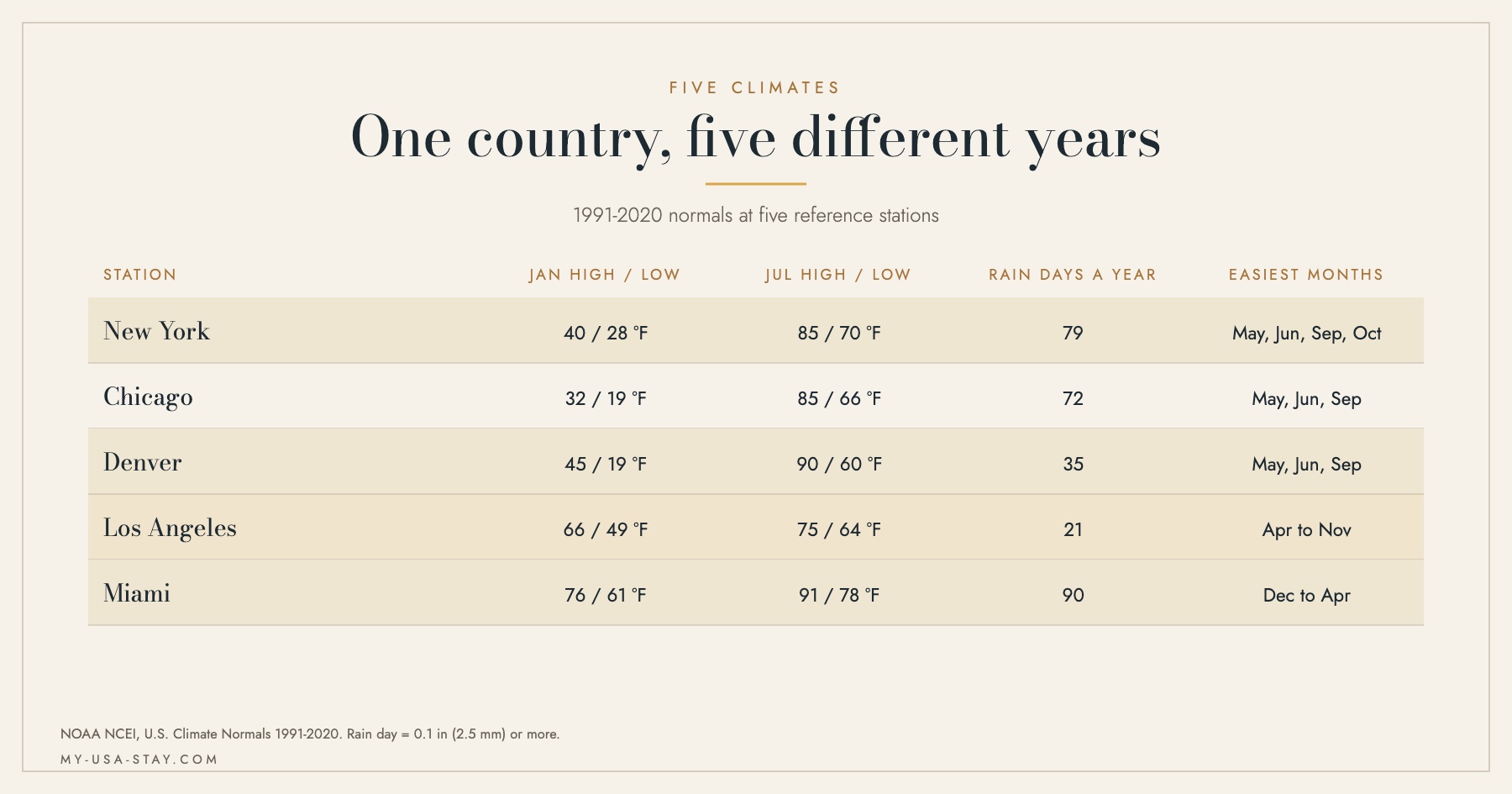
Five NOAA reference stations, five different years. Normals 1991-2020.
Understanding the climate: five countries in one
The United States spans six time zones and roughly 24 degrees of latitude in the lower 48 alone, so a national average tells you nothing useful. The five NOAA reference stations below cover the climates that most itineraries touch, and their numbers diverge sharply in the same month.
New York is a humid continental city with a genuine winter and a heavy summer: 40 °F (4 °C) as an average January high in Central Park, 85 °F (29 °C) in July, and 79 rain days spread evenly through the year. There is no dry season on the East Coast. Chicago runs colder still, with a January average high of 32 °F (0 °C) and around 39 inches (98 cm) of snow a season at O'Hare.
Denver shows what altitude does. Above 5,000 feet the airport records a January high of 45 °F (7 °C), warmer than Chicago, but a January low of 19 °F (-7 °C), the same as Chicago. The swing between day and night is the Mountain West signature, and it holds in July as well: 90 °F (32 °C) by day, 60 °F (16 °C) at night. Denver gets only 14.4 inches (367 mm) of precipitation a year.
Los Angeles has a Mediterranean climate with an inverted rain calendar. Rain falls between November and March, almost never in summer: 0.0 inches in August, 0.1 inch in July. Coastal highs barely move, from 66 °F (19 °C) in January to 77 °F (25 °C) in August. Inland, Palm Springs and Death Valley run 20 to 30 degrees hotter in summer than the coast.
Miami is subtropical, and its year splits into a dry half and a wet half rather than four seasons. From December to April it records 3.5 to 4.7 rain days a month. From June to October it records 9.0 to 13.3, with 10.5 inches (267 mm) falling in June alone.
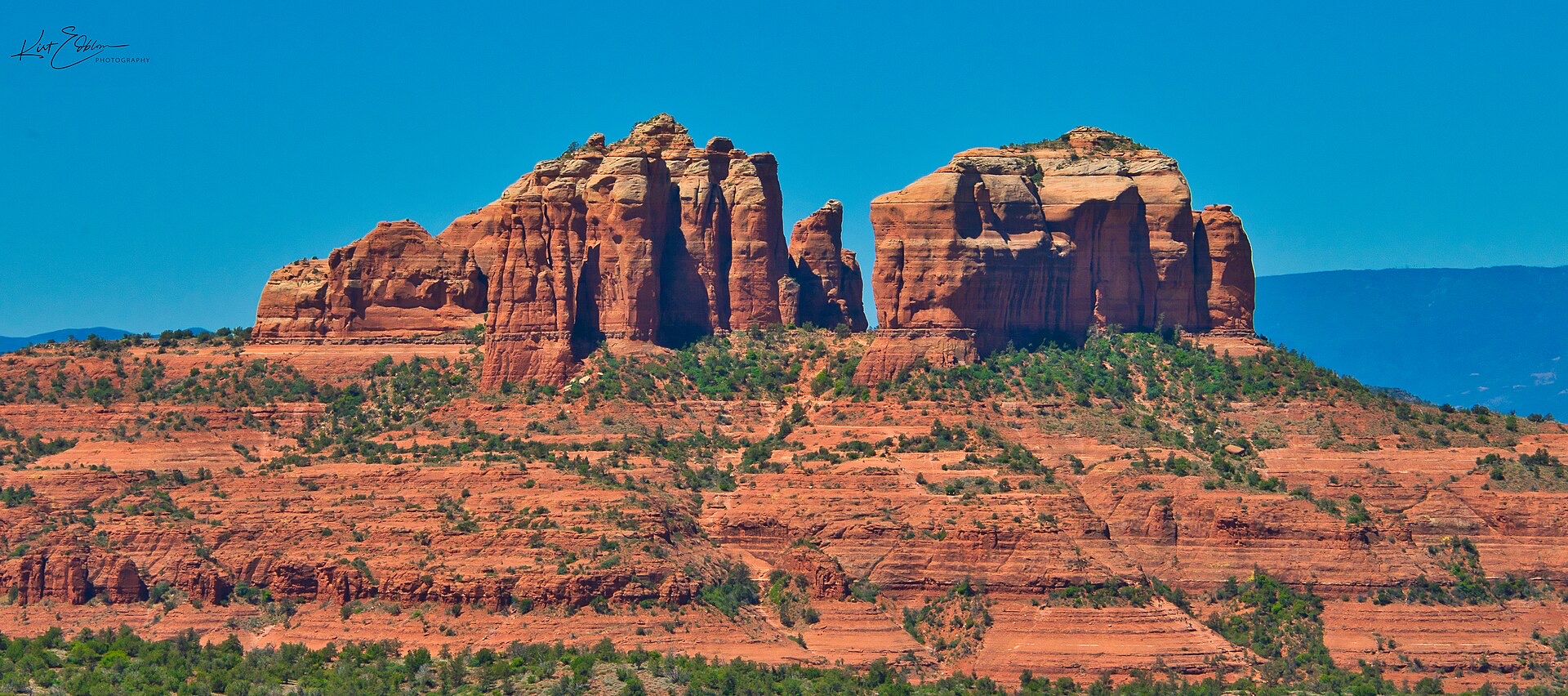
Cathedral Rock, Sedona, Arizona. The desert Southwest is comfortable in March and April and dangerous in July. Photo : Kirt Edblom, Wikimedia Commons, CC BY-SA 2.0.
Two more climates matter and sit outside this table. Hawaii runs on a wetter winter and a drier summer, with little annual temperature range. Alaska concentrates its visitor season between May and September, when the interior is light almost around the clock and the Inside Passage is ice free.
Spring, March to May: the widest window
Spring is the moment when the country is usable end to end. The desert Southwest is still comfortable, the Northeast has thawed, and the mountain snowpack has not yet cleared the high passes.
Washington sets the calendar for many spring trips. The National Park Service recorded peak bloom on 26 March 2026 for the Yoshino cherries around the Tidal Basin. Peak bloom has arrived as early as 15 March (1990) and as late as 18 April (1958), and the NPS states the most likely window is the last week of March into the first week of April.
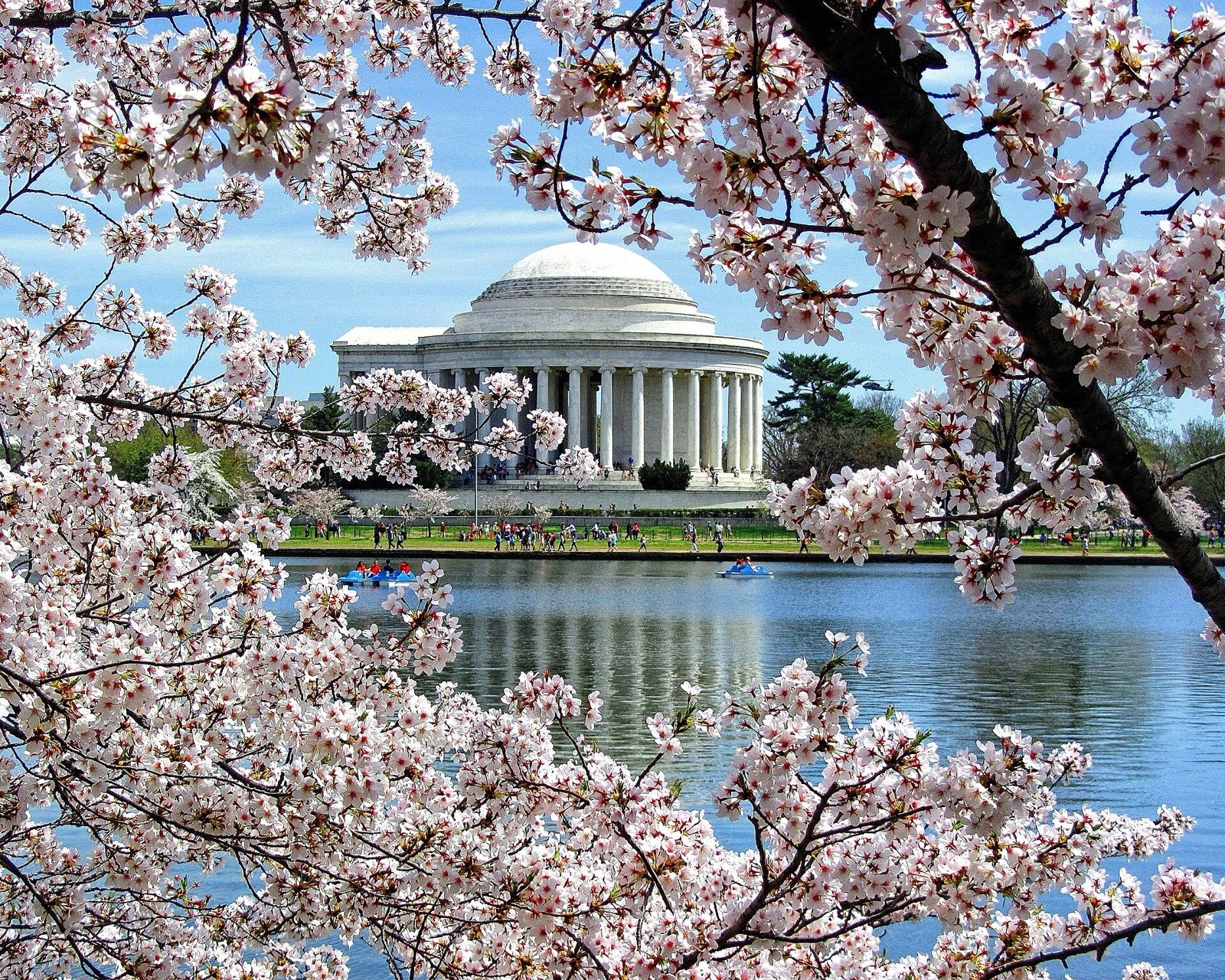
The Tidal Basin, Washington. Peak bloom fell on 26 March in 2026, according to the National Park Service. Photo : Jay Wald, Wikimedia Commons, CC BY-SA 4.0.
Spring is also the most violent season in the middle of the country. The National Weather Service places the tornado peak in April, May and June for Oklahoma, Texas and Kansas, and in March to May for Louisiana. It is a plains and Southeast risk, not a coastal one.
- Book the Southwest in March and April, before Phoenix and Moab start clearing 100 °F.
- Expect high passes in Colorado, Montana and Wyoming to stay shut into June.
- Watch for spring flooding along the Mississippi and Missouri corridors after snowmelt.
- Cherry blossom weekends in Washington fill hotels far in advance; the bloom itself is not bookable.
By May the numbers turn generous almost everywhere: 71 °F (22 °C) in New York, 71 °F (21 °C) in Chicago, 71 °F (22 °C) in Denver. Miami is already at 87 °F (30 °C) and beginning its wet season.
Summer, June to August: open, hot and expensive
Summer is the only season when the entire country is accessible, and that is exactly the problem. TSA averaged 2.69 million people screened a day in June and July 2026, and screened a record 10.4 million over Labor Day weekend 2025.
This is when the high country finally opens. Going-to-the-Sun Road in Glacier National Park opened fully on 22 June 2026, and access to Logan Pass closes on or before the third Monday in October. Yellowstone concentrates its year in the same window: the park's own figures put 23.6 percent of annual visits in July and roughly 64 percent across June, July and August, against 20,434 visits in a whole December.
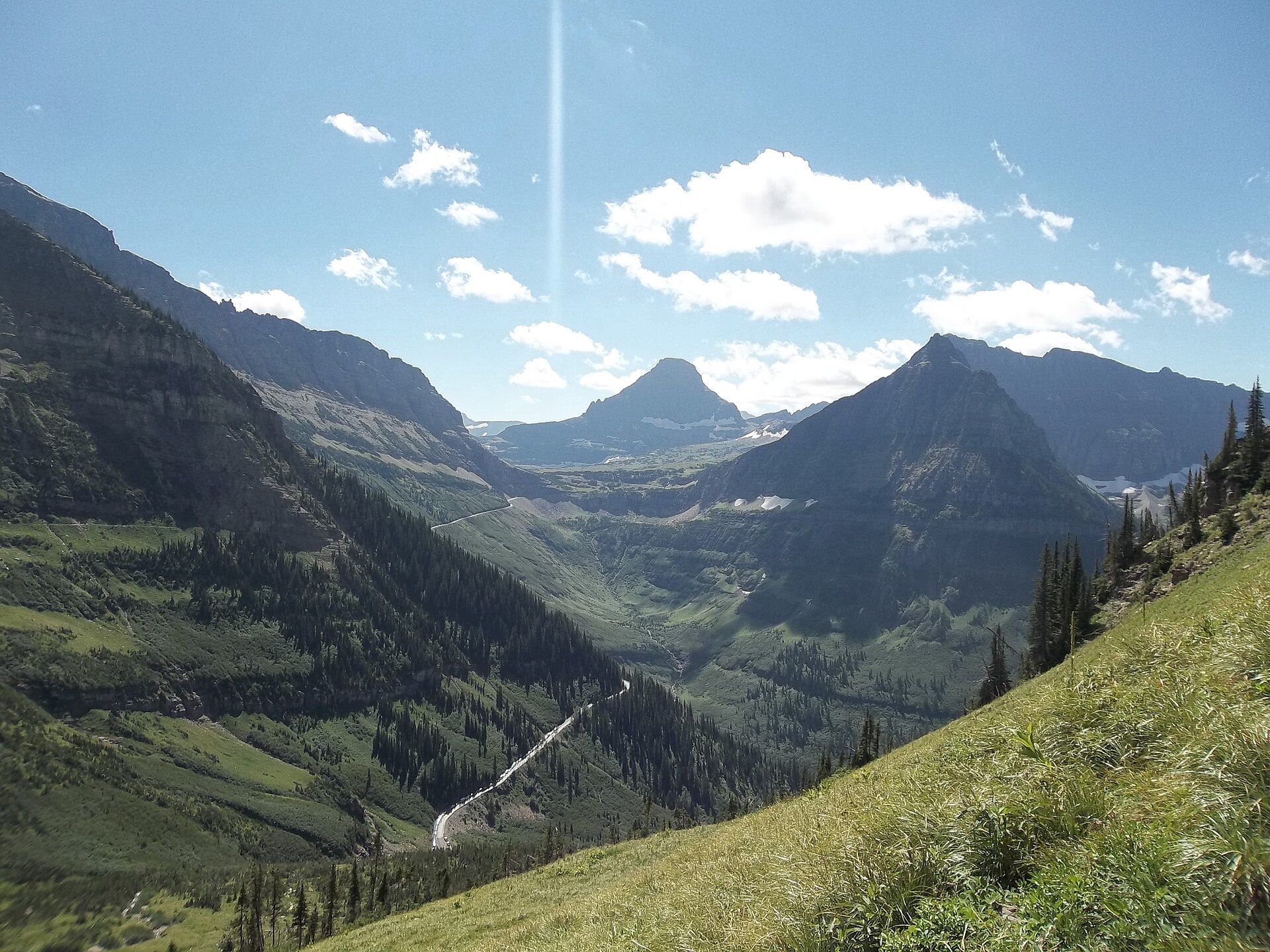
Going-to-the-Sun Road, Glacier National Park, Montana. It opened fully on 22 June in 2026. Photo : Mountain walrus, Wikimedia Commons, CC BY-SA 3.0.
Heat is the constraint, not rain. Denver reaches 90 °F (32 °C) in July, Miami 91 °F (33 °C) with a 78 °F (25 °C) overnight low that never lets buildings cool. The Southwest monsoon runs 15 June to 30 September according to the National Weather Service, delivering afternoon thunderstorms, dust storms and flash floods across Arizona and New Mexico.
- Start desert and canyon hikes before 8 a.m. from June to September.
- Do not enter a slot canyon or dry wash during monsoon season without checking the forecast.
- Reserve national park entry timed permits and lodges as soon as they open, often a year out.
- The Pacific coast is the summer exception: San Francisco and Los Angeles stay in the seventies.
Fall, September to November: the season that wins on points
September is the single strongest month in the American year. Water is still warm on both coasts, the crowds have gone back to school, and the mountains have not closed. New York averages 76 °F (25 °C), Denver 80 °F (26 °C), Chicago 76 °F (24 °C), and rain days fall to their annual low in October in New York at 5.6.

Central Park in autumn. New York records its fewest rain days of the year in October. Illustration : Top Luxury & Premium Hotel Booking in the US.
The caveat is the Atlantic. The National Hurricane Center puts the statistical peak of the season on 10 September, with most activity between mid-August and mid-October. That argues for the Southwest, the Rockies, the Pacific coast or New England in early September, and for Florida and the Gulf from late October.
Fall color moves down the map and down the mountainside. In Great Smoky Mountains National Park the display starts at high elevation and spreads to the valleys over several weeks, and the park notes that Clingmans Dome runs at least 10 degrees cooler than Cades Cove and Oconaluftee. October is one of its busiest months of the year.
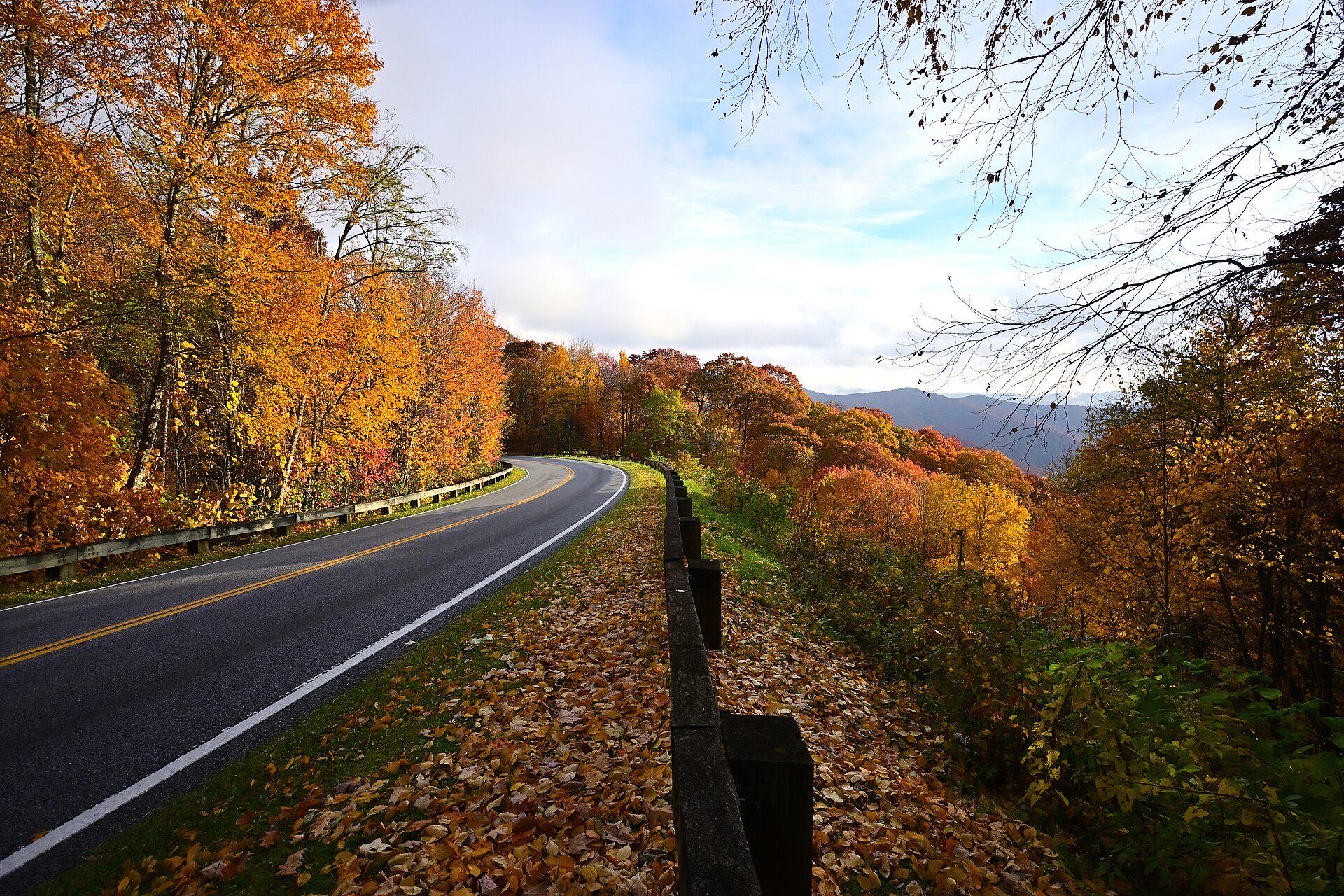
Newfound Gap Road, Great Smoky Mountains National Park, in late October. Photo : Andrew Heneen, Wikimedia Commons, CC BY 4.0.
- Early September: best balance of warmth, space and open roads nationwide.
- Late October: color in the southern Appalachians, cool nights in the desert, low crowds.
- Thanksgiving week: TSA prepared to screen more than 3 million travelers a day. Avoid flying.
Winter, December to February: two countries
Winter separates the United States into places you visit for sun and places you visit for snow, with very little in between.
Florida and southern California carry the sun half. Miami averages 76 °F (25 °C) in January with only 3.8 rain days, its driest stretch of the year. Los Angeles holds 66 °F (19 °C) but takes its rain then, 2.9 inches (73 mm) in January.
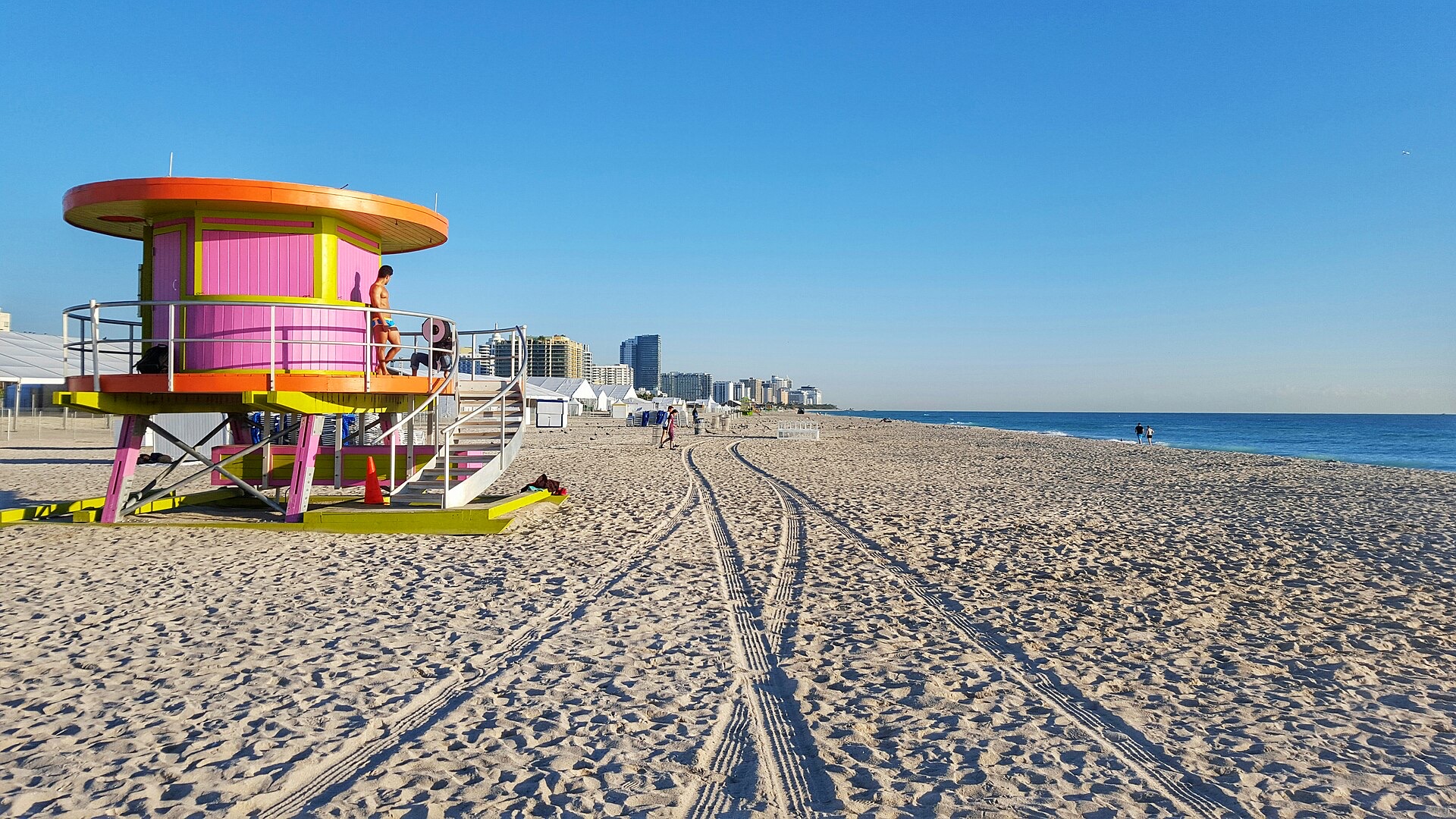
South Beach, Miami Beach, photographed in February. Miami averages 76 °F (25 °C) and 3.8 rain days in January. Photo : Cristo Vlahos, Wikimedia Commons, CC BY-SA 4.0.
The snow half runs from Colorado and Utah through Vermont and the Sierra Nevada. Denver's January low of 19 °F (-7 °C) understates the cold at altitude, and Chicago averages 11 inches (29 cm) of snow in January alone.
January is the cheapest and quietest month to move around the country. TSA screened an average of 2.12 million people a day in January 2026, the lowest monthly figure of the year and 21 percent below June.
- Christmas week and the days around New Year are the exception: demand spikes, then collapses.
- Northern plains cold is not a nuisance but a hazard; Minneapolis and Fargo run well below zero Fahrenheit at night.
- Many national park roads and lodges are closed: Yellowstone's interior roads are open only to oversnow vehicles.
- Hawaii is at its wettest, and the North Shore of Oahu gets its big surf.
The United States month by month
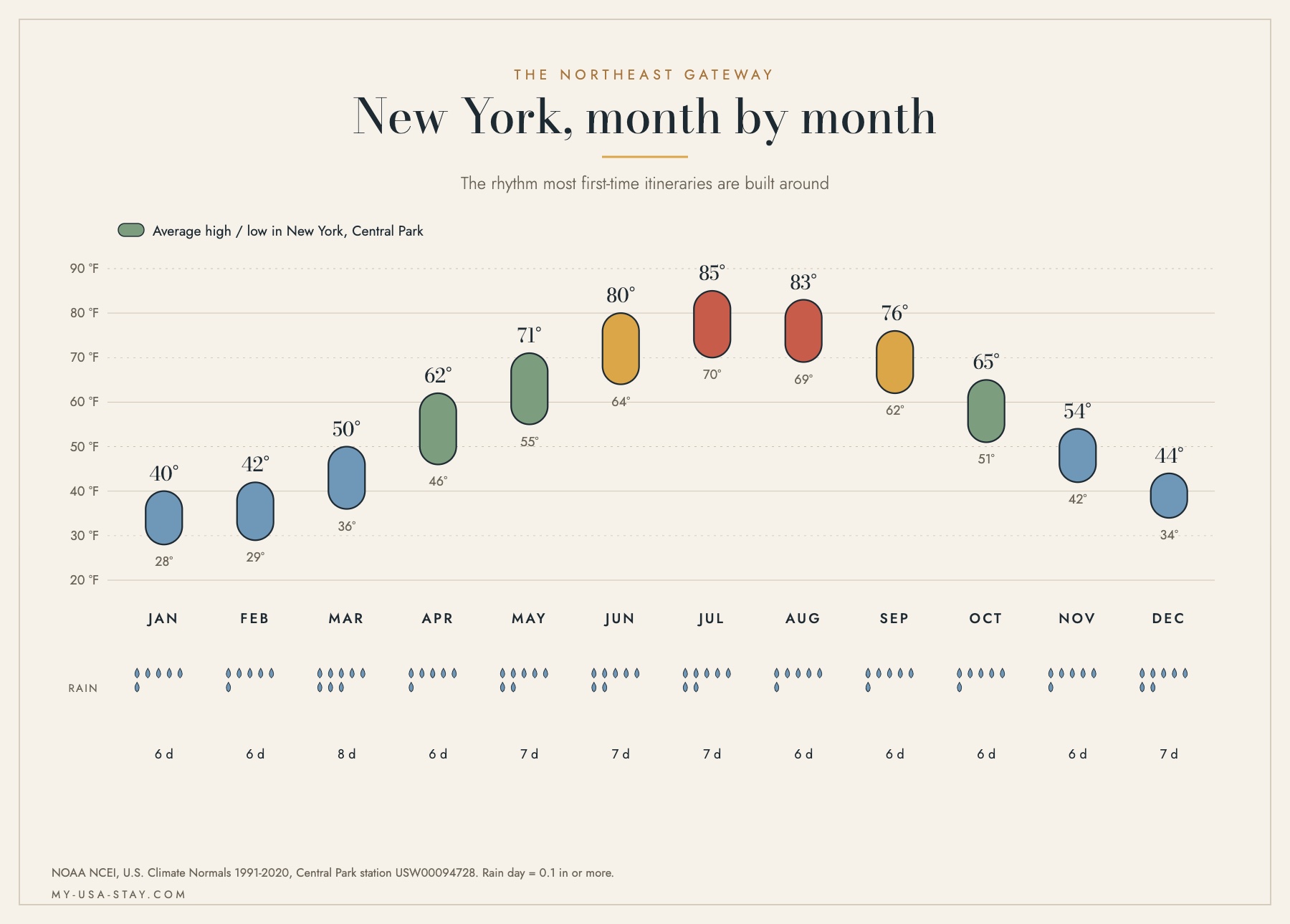
New York, Central Park. NOAA normals 1991-2020, rain day = 0.1 in or more.
Average daily high and low, in °F with °C in parentheses, at five NOAA reference stations. The rain day column gives New York and Miami side by side, to show how far apart two American years can be.
| Month | New York | Chicago | Denver | Los Angeles | Miami | Rain days NY / Miami | Verdict |
|---|---|---|---|---|---|---|---|
| January | 40/28 (4/-2) | 32/19 (0/-7) | 45/19 (7/-7) | 66/49 (19/10) | 76/61 (25/16) | 6.3 / 3.8 | Cheapest, coldest, sunniest south |
| February | 42/29 (6/-1) | 36/22 (2/-6) | 46/20 (8/-7) | 66/50 (19/10) | 78/63 (26/17) | 6.0 / 3.6 | Quiet, ski, Florida |
| March | 50/36 (10/2) | 47/31 (8/-1) | 56/28 (13/-3) | 66/52 (19/11) | 81/66 (27/19) | 7.5 / 3.5 | Desert perfect, blossom north |
| April | 62/46 (17/8) | 59/40 (15/5) | 62/34 (17/1) | 68/54 (20/12) | 84/70 (29/21) | 6.5 / 4.3 | Spring everywhere, storms midcontinent |
| May | 71/55 (22/13) | 71/51 (21/10) | 71/44 (22/6) | 69/58 (21/14) | 87/73 (30/23) | 7.3 / 6.9 | Warm, open, uncrowded |
| June | 80/64 (27/18) | 80/61 (27/16) | 83/53 (29/12) | 72/61 (22/16) | 89/76 (32/25) | 7.0 / 12.6 | Parks open, everyone travels |
| July | 85/70 (29/21) | 85/66 (29/19) | 90/60 (32/16) | 75/64 (24/18) | 91/78 (33/25) | 6.9 / 11.1 | Peak crowds, peak heat |
| August | 83/69 (29/21) | 83/65 (28/18) | 87/58 (31/15) | 77/65 (25/18) | 91/78 (33/25) | 6.5 / 13.3 | Hot, humid, stormy |
| September | 76/62 (25/17) | 76/57 (24/14) | 80/50 (26/10) | 76/64 (25/18) | 89/77 (32/25) | 6.2 / 13.1 | Strongest month, hurricane peak |
| October | 65/51 (18/11) | 63/45 (17/7) | 65/37 (19/3) | 74/60 (24/15) | 86/74 (30/23) | 5.6 / 9.0 | Color, space, cool |
| November | 54/42 (12/6) | 48/34 (9/1) | 53/26 (12/-3) | 71/54 (22/12) | 81/68 (27/20) | 5.7 / 4.7 | Calm until Thanksgiving |
| December | 44/34 (7/1) | 37/24 (3/-4) | 44/18 (7/-8) | 66/49 (19/10) | 78/64 (26/18) | 7.3 / 3.7 | Holidays, snow, sun |
Sources: NOAA NCEI, U.S. Climate Normals 1991-2020, stations USW00094728 (New York, Central Park), USW00094846 (Chicago O'Hare), USW00003017 (Denver International), USW00023174 (Los Angeles International), USW00012839 (Miami International). A rain day is a day with 0.1 in (2.5 mm) or more, the same definition for every column. Crowding figures: TSA checkpoint travel numbers, 2026 daily totals averaged by month.
The best time for what you want to do
Road trips
May, September and early October. Mountain passes are open, desert temperatures are survivable, and school traffic is low. The Pacific Coast Highway and the Blue Ridge Parkway both work in these windows. Avoid the Southwest in July and the northern plains after mid-November.
The Southwest road trip works in May and in late September, not in July. Illustration : Top Luxury & Premium Hotel Booking in the US.
National parks
Late May to June, then September. Glacier's Going-to-the-Sun Road opened fully on 22 June 2026, and the Grand Canyon North Rim reopened for the 2026 season on 15 May, with the campground back in service from 1 June 2026 and closing 15 October 2026. The North Rim remains a limited services area after the Dragon Bravo Fire of summer 2025, so plan lodging outside the park.
Cities
April, May, September and October. New York at 76 °F (25 °C) in September, Chicago at 71 °F (21 °C) in May, Boston and Philadelphia in the same window. Hotel demand in business cities dips at weekends, which is the opposite of resort towns.
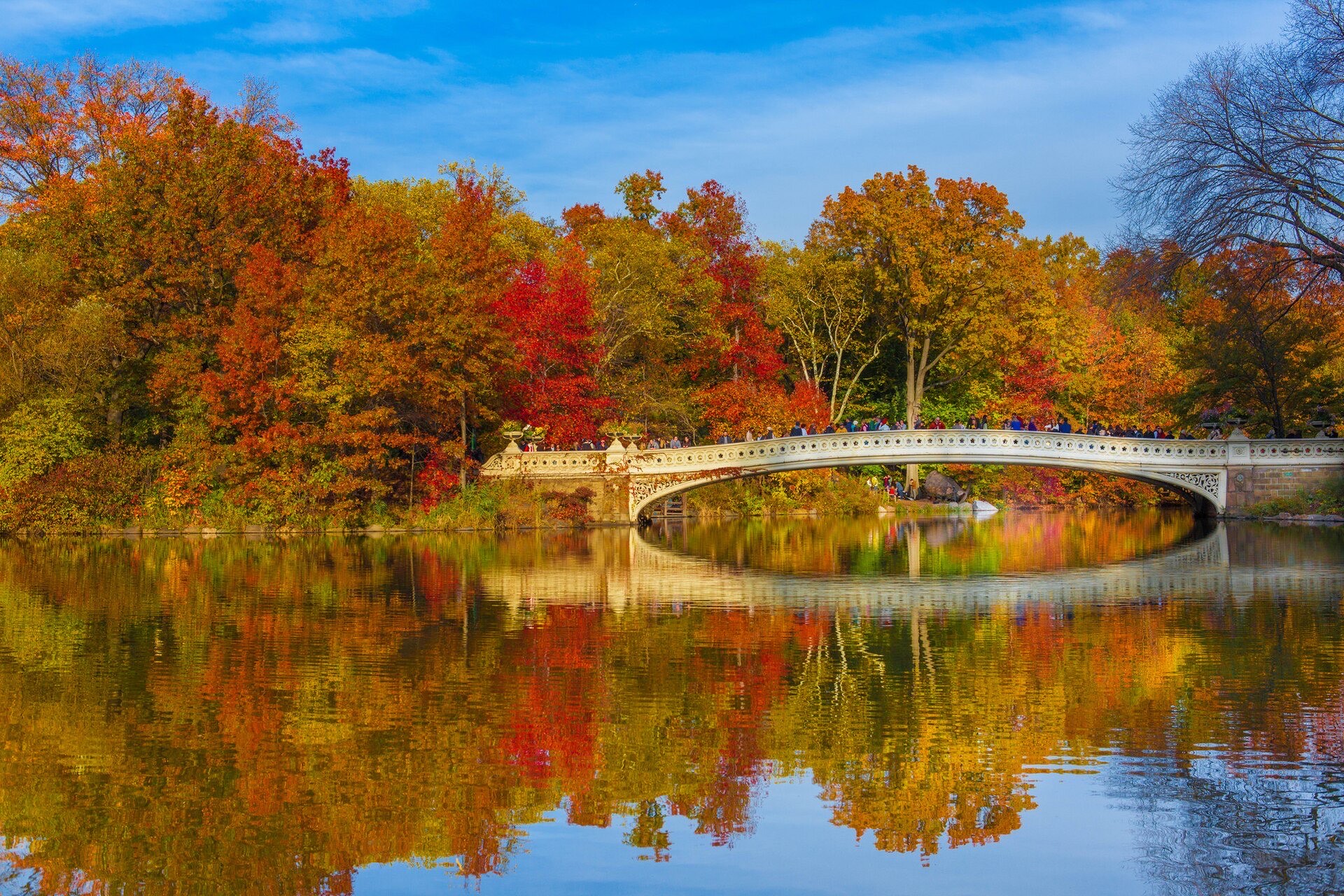
Bow Bridge, Central Park, New York, in late October. Photo : IIP Photo Archive, Wikimedia Commons, CC BY 2.0.
Beaches
Florida from December to April, when Miami is dry and warm. Southern California from July to October, when the ocean is at its warmest and the coastal cloud of May and June has burned off. New England and the Mid-Atlantic in August and September, when the water finally catches up with the air.

The Florida beach season runs against the rest of the country, from December to April. Illustration : Top Luxury & Premium Hotel Booking in the US.
Skiing
January to March in Colorado, Utah, Vermont and the Sierra Nevada. Late December brings crowds and thin early season cover; March brings the deepest base and longer days.
Value
January, early February, and the first three weeks of December. TSA's own daily counts show January 2026 averaging 2.12 million people a day against 2.69 million in June, the clearest demand signal available without paying for fare data.
Events that shape the year
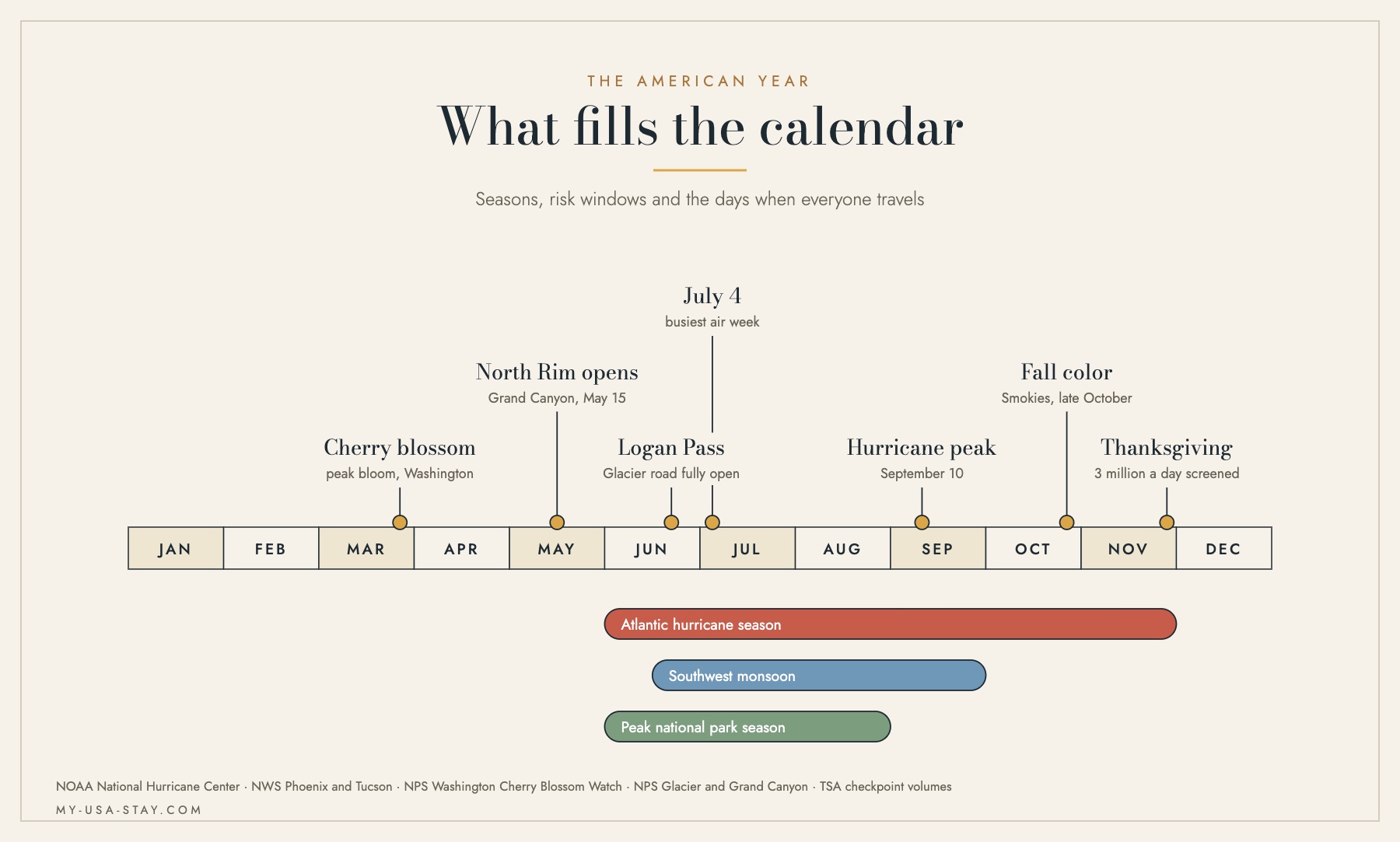
What fills the American calendar, from cherry blossom to Thanksgiving.
- Late March to early April: National Cherry Blossom Festival, Washington. Peak bloom fell on 26 March in 2026; the festival is scheduled around a date nobody controls.
- Late May: Memorial Day weekend. The unofficial start of summer, and the first heavy travel weekend of the year.
- 4 July: Independence Day. The densest air travel week of the American calendar.
- Early September: Labor Day weekend. TSA screened a record 10.4 million people over the 2025 holiday period.
- Late October: fall color in the southern Appalachians. October is among the busiest months in Great Smoky Mountains National Park, the most visited park in the country.
- Late November: Thanksgiving. TSA prepared to screen more than 3 million travelers a day in 2025.
- Late December: Christmas and New Year. Ski resorts, Florida and the big cities all peak at once.
Where to stay
The right base changes with the season, so these are addresses matched to the months above rather than a general list.
- The Whitby Hotel, New York: a Midtown base for the September and October window, walking distance from Central Park when the foliage turns.
- El Portal Sedona Hotel: red rock country in March and April, before the summer heat and the monsoon.
- The Gardens Hotel, Key West: the Florida dry season, December to April, in the quietest corner of Old Town.
- The Peninsula Chicago: a Magnificent Mile address for May and September, the two months Chicago is reliably pleasant.
- Hotel Bennett, Charleston: spring in the Lowcountry, before the humidity and the hurricane window.
- Espacio, the Jewel of Waikiki: Oahu works year round, with the driest months from May to September.
Browse more by region through our guide to where to stay across America.
FAQ
Which is the best month to visit the USA?
September is the best single month for most itineraries. New York averages 76 °F (25 °C), Denver 80 °F (26 °C), and air traffic drops sharply after Labor Day. The one reservation is the Atlantic coast, where NOAA places the hurricane peak on 10 September. For Florida and the Gulf, choose late October instead.
What are the cheapest months to visit the USA?
January and February are the cheapest and quietest months. TSA checkpoint data shows an average of 2.12 million people screened a day in January 2026 against 2.69 million in June, a fall of 21 percent. Demand collapses after the New Year holiday and stays low until spring break in mid-March.
What is the best time to visit the USA East Coast?
May, September and October. New York, Boston and Washington all sit between 65 and 76 °F (18 and 25 °C) in those months, and New York records its fewest rain days in October at 5.6. Avoid July and August humidity, and avoid the Carolinas and Florida at the September hurricane peak.
What is the best time to visit the USA West Coast?
September and October on the California coast, when the marine layer of May and June has cleared and the ocean is warmest. Los Angeles averages 76 °F (25 °C) in September with almost no rain. The Pacific Northwest is drier from July to September; Seattle and Portland take their rain from October to April.
What is the worst time to visit the USA?
Late June and early July, if crowds and cost matter. The busiest day in TSA history was 22 June 2025, with nearly 3.1 million people screened. August is the worst month for the Gulf and the Southwest, combining 91 °F (33 °C) in Miami with 13.3 rain days and the height of monsoon storms in Arizona.
When is hurricane season in the United States?
The Atlantic hurricane season runs 1 June to 30 November, with the peak on 10 September and most activity between mid-August and mid-October, according to NOAA's National Hurricane Center. The eastern Pacific season runs 15 May to 30 November. It affects Florida, the Gulf, the Carolinas and occasionally New England, not the West Coast or the interior.
When do the national parks open for the season?
High mountain parks open between mid-May and early July. Glacier's Going-to-the-Sun Road opened fully on 22 June 2026, and Logan Pass closes on or before the third Monday in October. The Grand Canyon North Rim opened 15 May 2026 and closes 15 October. Lower parks such as Zion and Joshua Tree stay open year round.
What is the weather like in the United States throughout the year?
It depends entirely on where you stand. In January, Miami averages 76 °F (25 °C) and Chicago 32 °F (0 °C). In July, Denver reaches 90 °F (32 °C) with cool nights while Los Angeles stays at 75 °F (24 °C). Rainfall is just as split: 21 rain days a year in Los Angeles, 90 in Miami.

_-_Flickr_-_Kirt_Edblom.jpg)


