The best time to visit Mexico is late November through April, the dry half of the year almost everywhere in the country. Cancún sits near 80 °F in January with a sea at 80 °F, Mexico City stays in the high 60s with barely any rain, and the Pacific coast goes weeks without a drop. Avoid June through October if you want dry beaches: that is the rainy season, the Atlantic hurricane season, and the peak of the sargassum year. See all our hotels in Mexico, or start from the home page.
The short answer
- Best overall: December to April. Dry nearly everywhere, warm sea on both coasts, no hurricanes.
- Best value: late April, May and early June. Winter crowds gone, rains not yet established, hurricane risk still low.
- Worst for a beach trip: June and July. The Caribbean sargassum peak in 2026 fell in June, measured from orbit at 33.6 million metric tons across the monitored Atlantic, Caribbean and Gulf regions.
- Rainy season: May to October inland and on the Pacific, June to October on the Caribbean coast. It rains hard, late in the day, and briefly.
- Hurricane season: June 1 to November 30 in the Atlantic and Caribbean, May 15 to November 30 in the eastern Pacific (NOAA National Hurricane Center). The Atlantic peak is September 10.
- Mexico City has no summer. Its monthly high never leaves the 68 to 78 °F band. What changes is rain, not temperature.
- Time zones move under you. Most of Mexico dropped daylight saving time in October 2022, so the gap with US clocks changes twice a year.
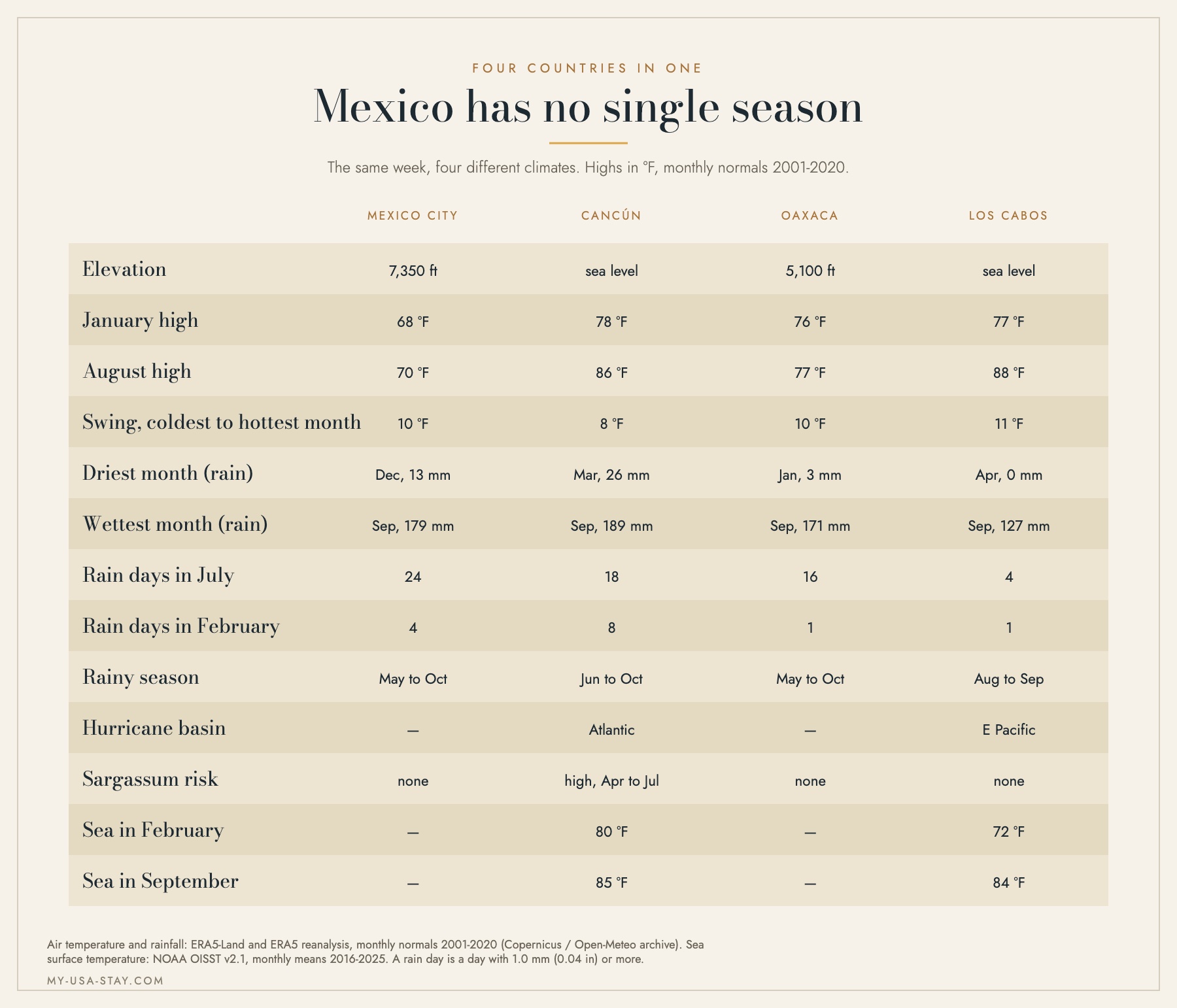
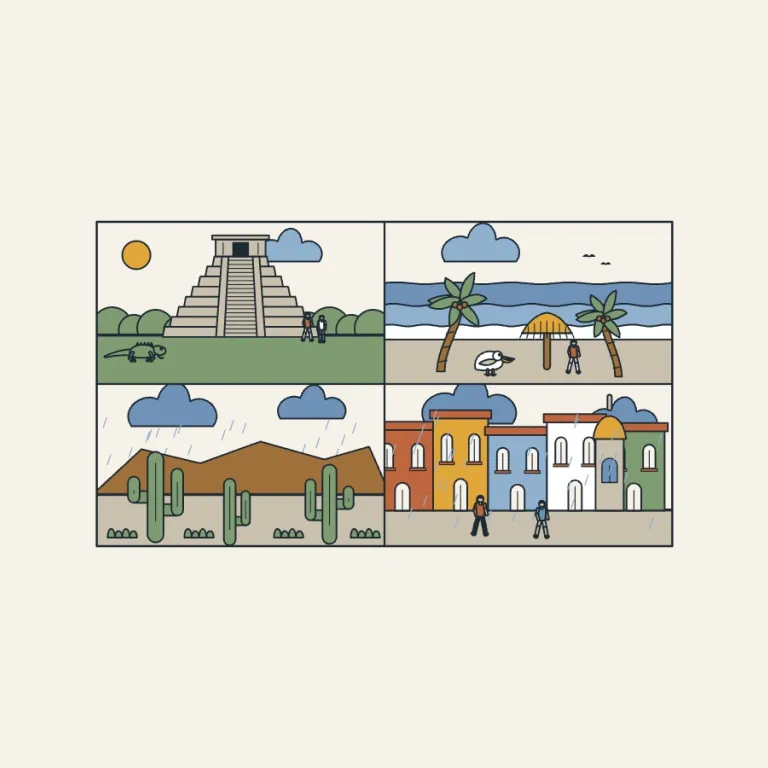
Four climates, one country: the same month is dry in Los Cabos, wet in Mexico City and humid in Cancun.
Understanding the climate in Mexico: four countries in one
Mexico does not have one climate, it has at least four, and they do not share a calendar. A single week in August can be cool and wet in the capital, hot and dry in Baja California Sur, and steamy on the Yucatán coast. The figures below come from ERA5-Land and ERA5 reanalysis, monthly normals for 2001 to 2020, with sea temperatures from NOAA OISST (2016 to 2025 means).
Mexico City is an altitude climate, not a tropical one. The city sits at 7,350 feet (2,240 m). Its warmest monthly high is 78 °F in April and its coolest is 68 °F in January and November: ten degrees of annual range, less than Chicago sees in a single April afternoon. Nights are the surprise. The January low averages 45 °F and the gap between day and night in the warmest month is about 26 °F. Pack a jacket for every month of the year, including July.
Oaxaca is the same idea, 1,200 feet lower and drier. At 5,100 feet, the city runs warmer by day, 85 °F in April, and cooler relative to its highs at night, around 51 °F in January. Its dry season is the most absolute in this comparison: 3 mm of rain in January, under one rain day per month from November to February.
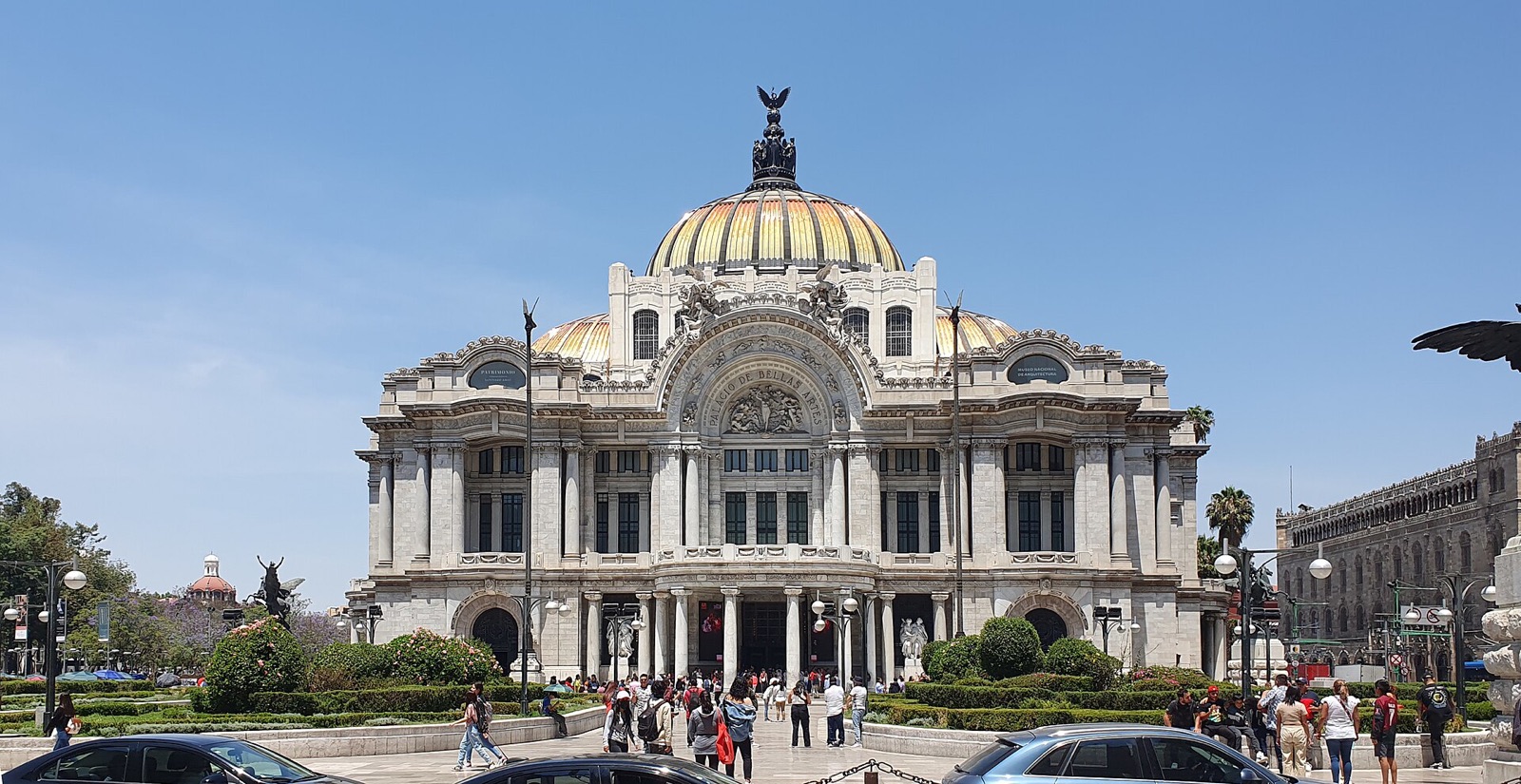
The Palacio de Bellas Artes, Mexico City. The capital sits at 7,350 feet and its monthly high never leaves the 68 to 78 degrees Fahrenheit band. Photo: José Luiz, Wikimedia Commons, CC BY-SA 4.0.

Cancún and the Riviera Maya are Caribbean, warm and humid year round. Monthly highs run from 78 °F in January to 86 °F in August, and the sea off Cancún never drops below 80 °F. Humidity, not heat, is what makes August hard. The drier months are March and April, with about 26 mm and 33 mm of rain. September and October are the wettest, near 190 mm each.
Los Cabos is a coastal desert, and its sea has a real winter. Cabo San Lucas gets under 25 mm of rain between January and June combined, and its wettest month, September, still only reaches 127 mm. The catch is the water. The Pacific off Los Cabos falls to 71 °F in March and April, fourteen degrees below the Caribbean at the same moment, then climbs to 84 °F from August to October. A February beach week in Los Cabos is a sunbathing trip; a February beach week in Tulum is a swimming trip.
One caution about the numbers you will see elsewhere. Global reanalysis grids average land and sea together, so on a narrow shoreline like Cancún or Cabo San Lucas they flatten the afternoon highs and understate the day to night swing. Where Mexico's Servicio Meteorológico Nacional publishes station normals, those are the values to trust.
The dry season, November to April: the reason to come
The dry season is why Mexico's high season exists, and it is genuinely dry. From late November the rain shuts off across the interior, the Pacific coast and, with a lag, the Caribbean side. Oaxaca records fewer than two rain days in each of November, December, January and February. Cabo San Lucas records about one. Mexico City drops to 3 rain days in December.

The Riviera Maya in February: the sea off Cancun holds 80 degrees Fahrenheit and sargassum is at its annual low. Illustration: my-usa-stay.com.
What you get for it:
- Clear mornings for the archaeological sites. Chichén Itzá, Teotihuacán, Palenque and Monte Albán are all open air, and there is almost no shade on any of them. Go at opening.
- The calmest sea of the year on the Caribbean side, and by January and February the lowest sargassum of the cycle.
- Whales in Baja. Gray whales are in the Baja California Sur lagoons from roughly late December to April, with February and March the peak, and humpbacks pass Los Cabos over the same months.
- Monarch butterflies inland. The Monarch Butterfly Biosphere Reserve, spanning Michoacán and the State of Mexico, ran its 2025-2026 visitor season from 21 November to 21 March, with peak numbers from January to mid-February.
What it costs you: this is when everyone else comes. Christmas and New Year, US spring break in March, and Semana Santa are the three walls of the year. In 2027 Holy Week runs 22 to 28 March, and it is a domestic holiday as much as a foreign one, so coastal towns fill with Mexican families and inland colonial cities empty out.
Two precautions that are specific to the dry season:
- Mexico City's ozone season runs March to June. The Comisión Ambiental de la Megalópolis forecast five to fifteen environmental contingency days for 2026, when driving restrictions tighten and outdoor exercise is discouraged. Strong sun and weak ventilation over the valley are what cause it.
- Nights inland are cold. A December night in Oaxaca or San Cristóbal is not a tropical night, and many colonial hotels have no heating.
The rainy season, May to October: cheaper, greener, wetter
Mexico's rainy season is an afternoon event, not an all-day one. Inland and on the Pacific it runs roughly May to October; on the Caribbean coast it starts later, in June, and ends later, in October. In Mexico City, July averages 24 rain days and September 179 mm, yet mornings are frequently clear and the storm arrives after 4pm. In Oaxaca, June brings 170 mm across about 18 rain days, and the landscape turns from brown to green within a fortnight.
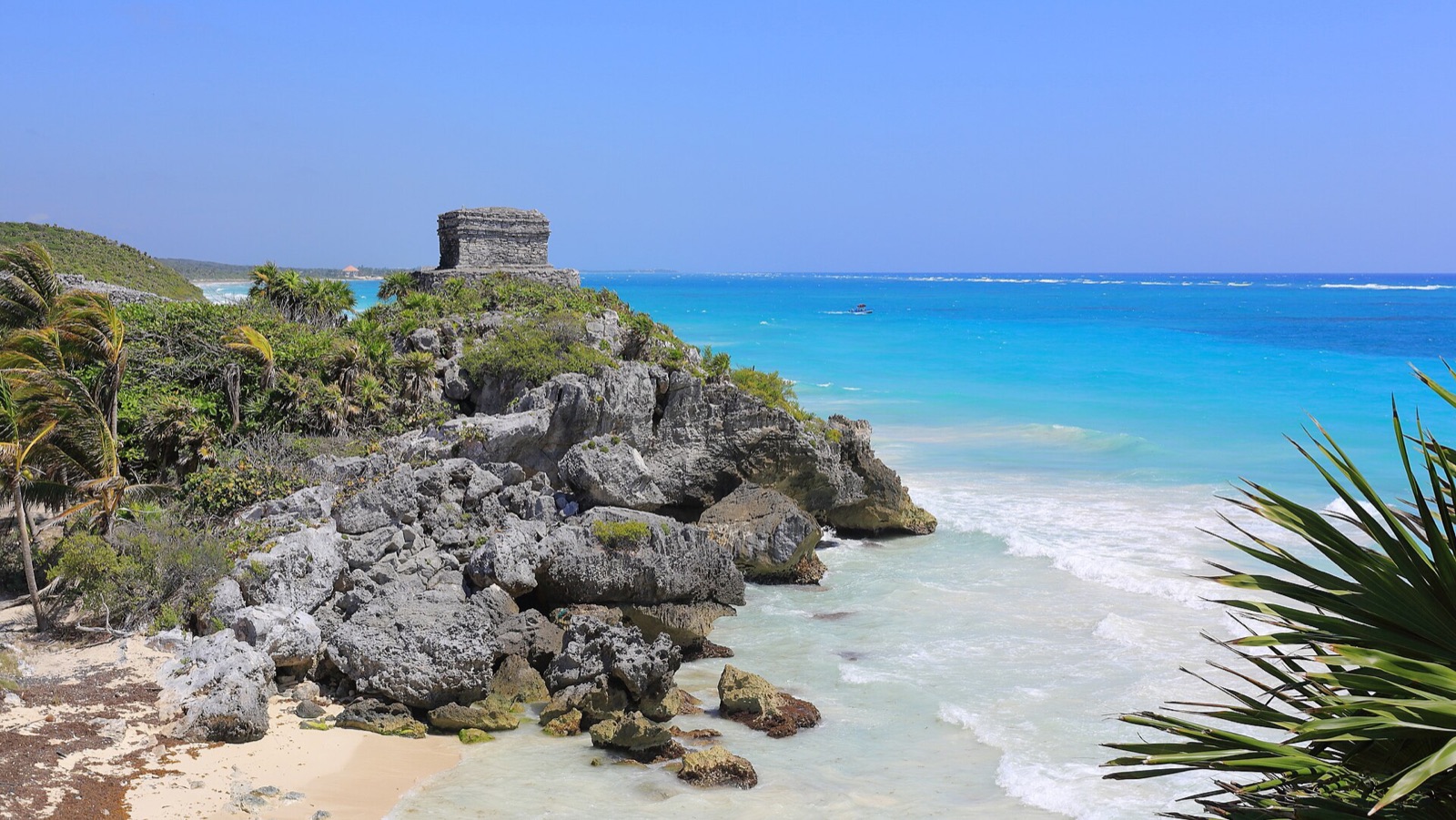
Tulum, Quintana Roo. The Caribbean coast starts its rainy season in June and ends it in October, a month later than inland Mexico. Photo: Martin Falbisoner, Wikimedia Commons, CC BY-SA 4.0.

The Pacific and the Caribbean behave differently. Cancún's wettest months are September and October near 190 mm; Cabo San Lucas gets essentially nothing until August, then takes 59 mm in August and 127 mm in September, almost all of it from tropical systems passing offshore.
Precautions for the wet half of the year:
- Book morning activities and keep afternoons loose. Cenote swims, ruins and diving are morning things from June to October.
- Mosquito-borne illness is seasonal. Dengue cases in Mexico rise with the rains and peak in the late summer and autumn. Repellent is a rainy-season item, not a year-round one.
- Mountain roads in Oaxaca, Chiapas and Guerrero close after landslides. Allow slack on overland days in September.
- Check the cancellation terms on anything booked between August and October on either coast.
What you gain is real: the lowest room rates of the year, the greenest landscapes, waterfalls at Agua Azul and Hierve el Agua at full flow, and archaeological sites you can photograph without a crowd in the frame.
Sargassum: the season that actually decides a Caribbean beach trip
Sargassum, not rain, is what ruins beach weeks on the Mexican Caribbean, and it has its own calendar. The University of South Florida Optical Oceanography Laboratory measures the floating seaweed from satellite and publishes a bulletin at the end of every month. The 2026 series is the clearest picture available of when the coast is clean and when it is not.
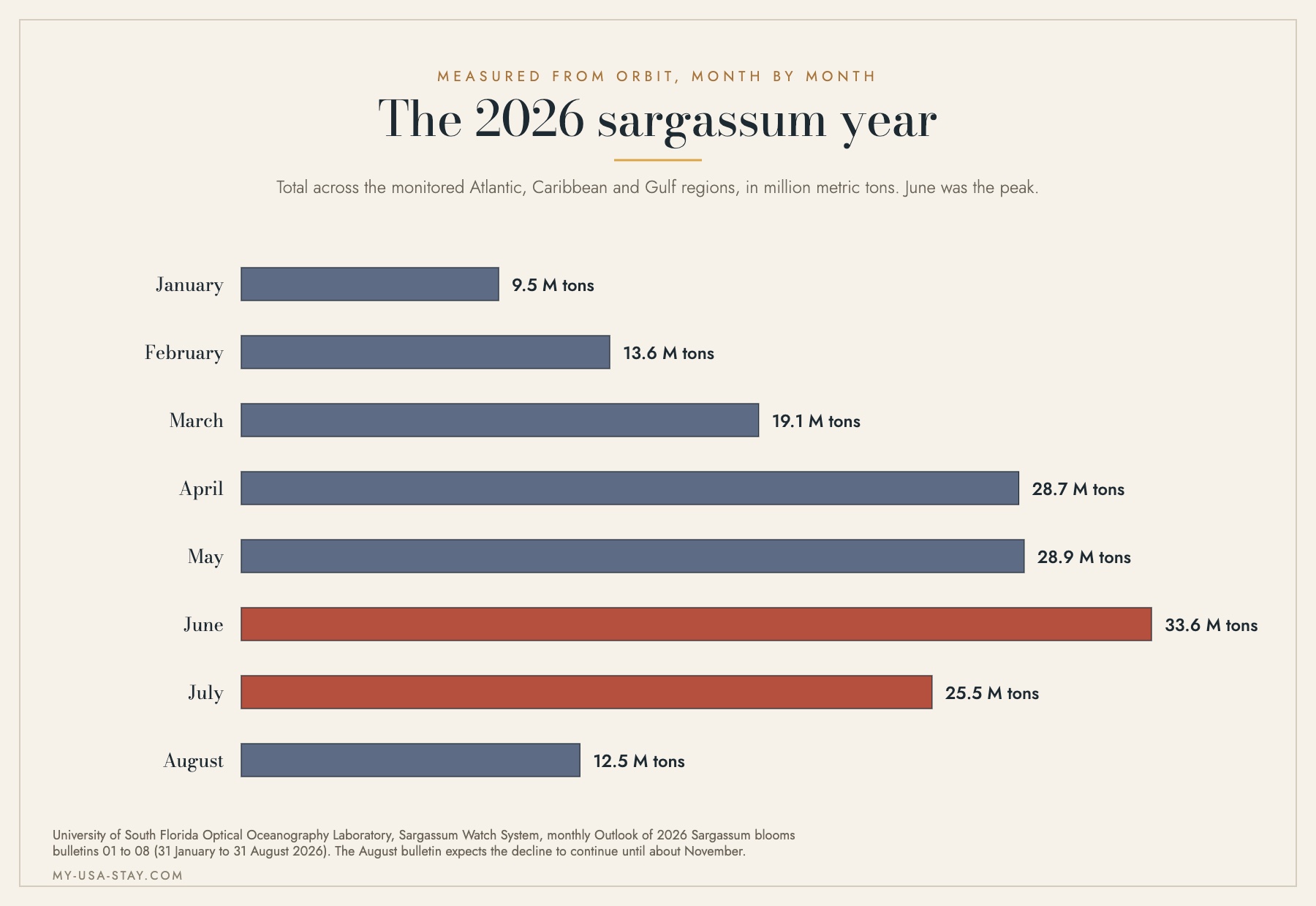
The 2026 sargassum year as measured from orbit by the University of South Florida, month by month.
The lab's own bulletins tell the story month by month. Caribbean sargassum grew from 0.45 million tons in December 2025 to 1.7 million in January 2026, and beaching was already reported on the Mexican Caribbean coast that month. Totals set monthly records through March and April. June was the peak, with 5 million metric tons in the Gulf alone, nearly double the previous record set in 2025. In July, the lab wrote that every region had begun to decrease and called it a good sign. By August the belt had halved, and the August bulletin expected the decline to continue until about November.
Three practical conclusions:
- The clean window is roughly late November to March. That is when the bloom is at its annual low and before the spring build-up reaches the coast.
- May, June and July are the months to avoid if a clear turquoise sea is the point of the trip.
- Landings are local and change by the day. A single headland can be clear while the beach next to it is buried. Isla Mujeres' western shore, Isla Holbox and the Pacific side of the country are all outside the belt.
Sargassum does not affect the Pacific coast at all. Puerto Vallarta, Los Cabos and the Oaxacan coast are unaffected by it in any season, which is the strongest single argument for switching coasts in early summer.
Hurricane season: two coasts, two calendars
Mexico is the only major beach destination in North America with two separate hurricane seasons running at once. The NOAA National Hurricane Center dates the Atlantic season, which covers Cancún, the Riviera Maya and the Gulf coast, from June 1 to November 30, with a statistical peak on September 10 and the busiest stretch from mid-August to mid-October. The eastern Pacific season, which covers Los Cabos, Puerto Vallarta and the Oaxacan coast, opens two weeks earlier on May 15, closes on the same date, and peaks in late August with activity spread more evenly across the season.
That difference matters when you are choosing between coasts in a given month. Late May is quiet in the Atlantic and already open in the Pacific. Early June is the reverse in practice, since Atlantic activity that early is rare. September is the worst month on both sides and the cheapest for that reason.
Mexico month by month
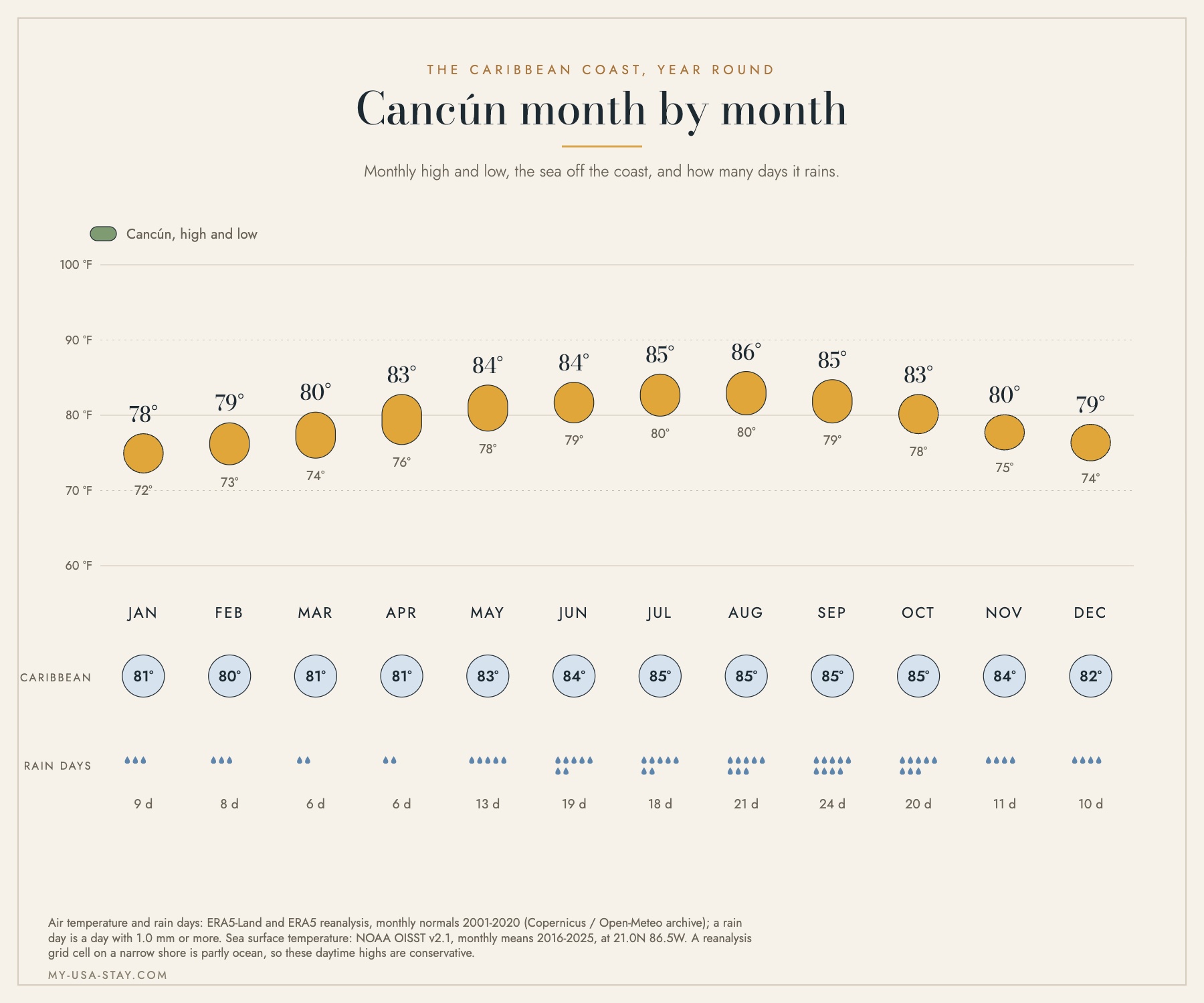
Cancun through the year: monthly highs and lows, the Caribbean sea temperature and the number of rain days.
| Month | Cancún high / low | Sea, Caribbean | Mexico City high / low | Cancún rain days | Verdict |
|---|---|---|---|---|---|
| January | 78 / 72 °F | 81 °F | 68 / 45 °F | 9 | Peak season, excellent |
| February | 79 / 73 °F | 80 °F | 72 / 47 °F | 8 | Driest, busiest, best |
| March | 80 / 74 °F | 81 °F | 75 / 49 °F | 6 | Spring break, crowded |
| April | 83 / 76 °F | 81 °F | 78 / 52 °F | 6 | Warm, dry, good value |
| May | 84 / 78 °F | 83 °F | 77 / 54 °F | 13 | Rains begin, sargassum |
| June | 84 / 79 °F | 84 °F | 73 / 55 °F | 19 | Sargassum peak, cheap |
| July | 85 / 80 °F | 85 °F | 70 / 54 °F | 18 | Hot, wet, family season |
| August | 86 / 80 °F | 85 °F | 70 / 54 °F | 21 | Hottest, humid, stormy |
| September | 85 / 79 °F | 85 °F | 69 / 54 °F | 24 | Wettest, hurricane peak |
| October | 83 / 78 °F | 85 °F | 69 / 51 °F | 20 | Still wet, improving |
| November | 80 / 75 °F | 84 °F | 68 / 47 °F | 11 | Turning point, very good |
| December | 79 / 74 °F | 82 °F | 68 / 46 °F | 11 | Dry, festive, expensive |
Air temperature and rain days: ERA5-Land and ERA5 reanalysis, monthly normals 2001-2020 (Copernicus, via the Open-Meteo archive); a rain day is a day with 1.0 mm or more. Sea surface temperature: NOAA OISST v2.1, monthly means 2016-2025, measured off Cancún at 21.0°N 86.5°W. Reanalysis grids flatten daytime highs on narrow shorelines, so treat the Cancún highs as conservative and prefer the Servicio Meteorológico Nacional station normals where you need exact figures.
The best time for what you want to do
Match the month to the activity, because Mexico rewards that more than most countries. The same week is wrong for one plan and perfect for another.
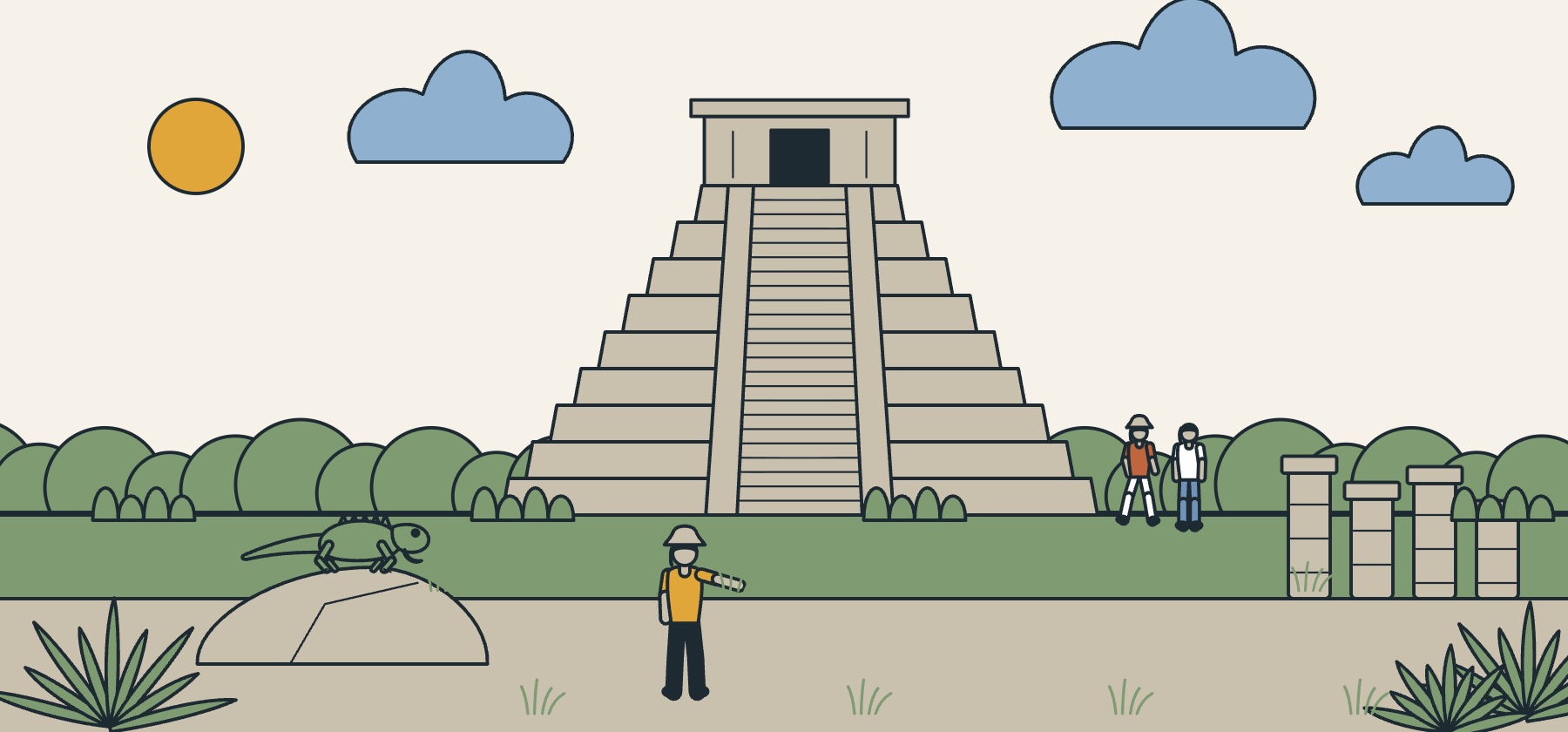
Chichen Itza has almost no shade. The dry season from November to February is when the site is comfortable at opening time. Illustration: my-usa-stay.com.
- Swimming and snorkelling in the Caribbean: December to March. Sea at 80 to 81 °F, lowest sargassum, best visibility in the cenotes.
- Whale watching in Baja: February and March. Gray whales in the lagoons, humpbacks off Los Cabos.
- Whale sharks off Isla Mujeres and Holbox: mid-June to mid-September. The season sits squarely inside the wet months, which is the trade-off.
- Ruins and hiking: November to February. Cooler air, no rain, and shade is scarce at every site.
- Surfing the Pacific: May to October. The southern hemisphere swell reaches Puerto Escondido and the Oaxacan coast in the summer.
- Monarch butterflies: January to mid-February. Reachable as a long day trip or an overnight from Mexico City.
- Budget travel: September. The wettest month, the hurricane peak, and the lowest rates of the year in that order.
- Diving Cozumel: any month, best December to April, when the water is clearest and the rain is gone.
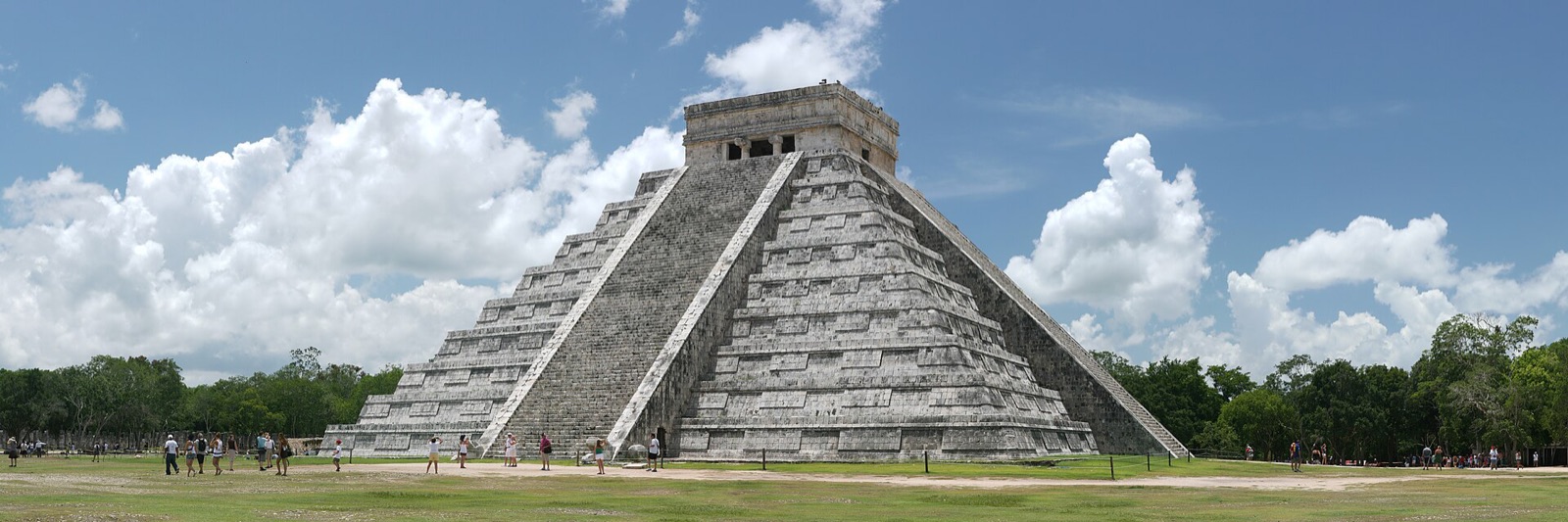
The Temple of Kukulcan, Chichen Itza. INAH counted more than two million visitors at the site across 2025. Photo: Daniel Schwen, Wikimedia Commons, CC BY-SA 4.0.

Events that shape the year
Three dates move prices and availability across whole regions, and two of them move every year.
Día de Muertos, 1 and 2 November. UNESCO inscribed the indigenous festivity dedicated to the dead on its Representative List of the Intangible Cultural Heritage of Humanity in 2008. Oaxaca, Pátzcuaro in Michoacán and Mexico City are the three places that fill first, and Oaxaca hotels are commonly sold out months ahead. It also falls at the best possible moment climatically: the rains have stopped and the high season has not started.

A Dia de Muertos ofrenda. The festivity, held on 1 and 2 November, was inscribed by UNESCO in 2008. Photo: Mario Yaír TS, Wikimedia Commons, CC BY-SA 4.0.

Semana Santa, the week before Easter. It runs 22 to 28 March in 2027. Domestic demand, not foreign demand, is what fills the coasts. Beach resorts are at their fullest and their most expensive; colonial cities are quiet and several museums close on Good Friday.
The March equinox at Chichén Itzá. On 20 to 22 March 2026 the site opened specially for the shadow that runs down the staircase of the Temple of Kukulcán between about 3pm and 5pm. The equinox drew 32,872 people in a single day, and INAH counted more than two million visitors at the site across 2025. If you want the pyramid to yourself, pick any other week of the dry season.
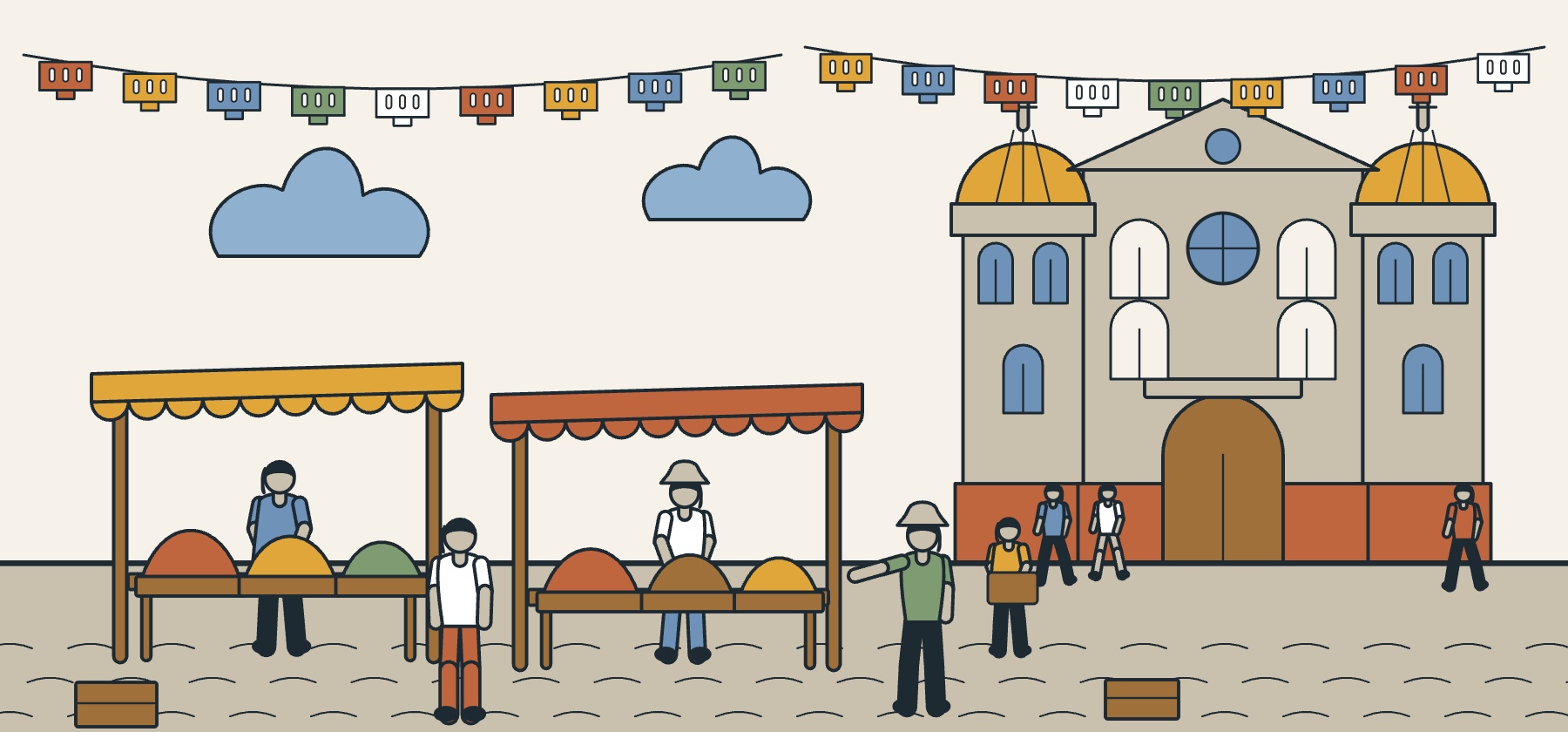
Oaxaca in late July, during the Guelaguetza. Its rain falls in the evening, which is why the festival works in the wet season. Illustration: my-usa-stay.com.
La Guelaguetza, Oaxaca, late July. The two Lunes del Cerro fall on the Mondays following 16 July; in 2026 they were 20 and 27 July, with performances at 10am and 5pm at the Auditorio Guelaguetza. It is the one strong reason to be inland in the middle of the rainy season, and Oaxaca's rain is an evening affair anyway.
Add the American calendar to the Mexican one. Thanksgiving week, Christmas, New Year and March spring break are when US demand for Cancún and Los Cabos is at its highest, and they are visible in airfares months in advance.
Where to go, by region and by month
The right answer to "when" usually depends on "where", and Mexico gives you the option of switching coasts rather than switching months.
Riviera Maya and the Yucatán Peninsula: December to April. Warm sea all year, but sargassum and rain both argue for winter. Playa del Carmen, Tulum and Akumal are the places most exposed to landings.
Yucatán inland: November to February. Mérida, Valladolid and the cenote country are punishing in May, which is the hottest month before the rains break there.
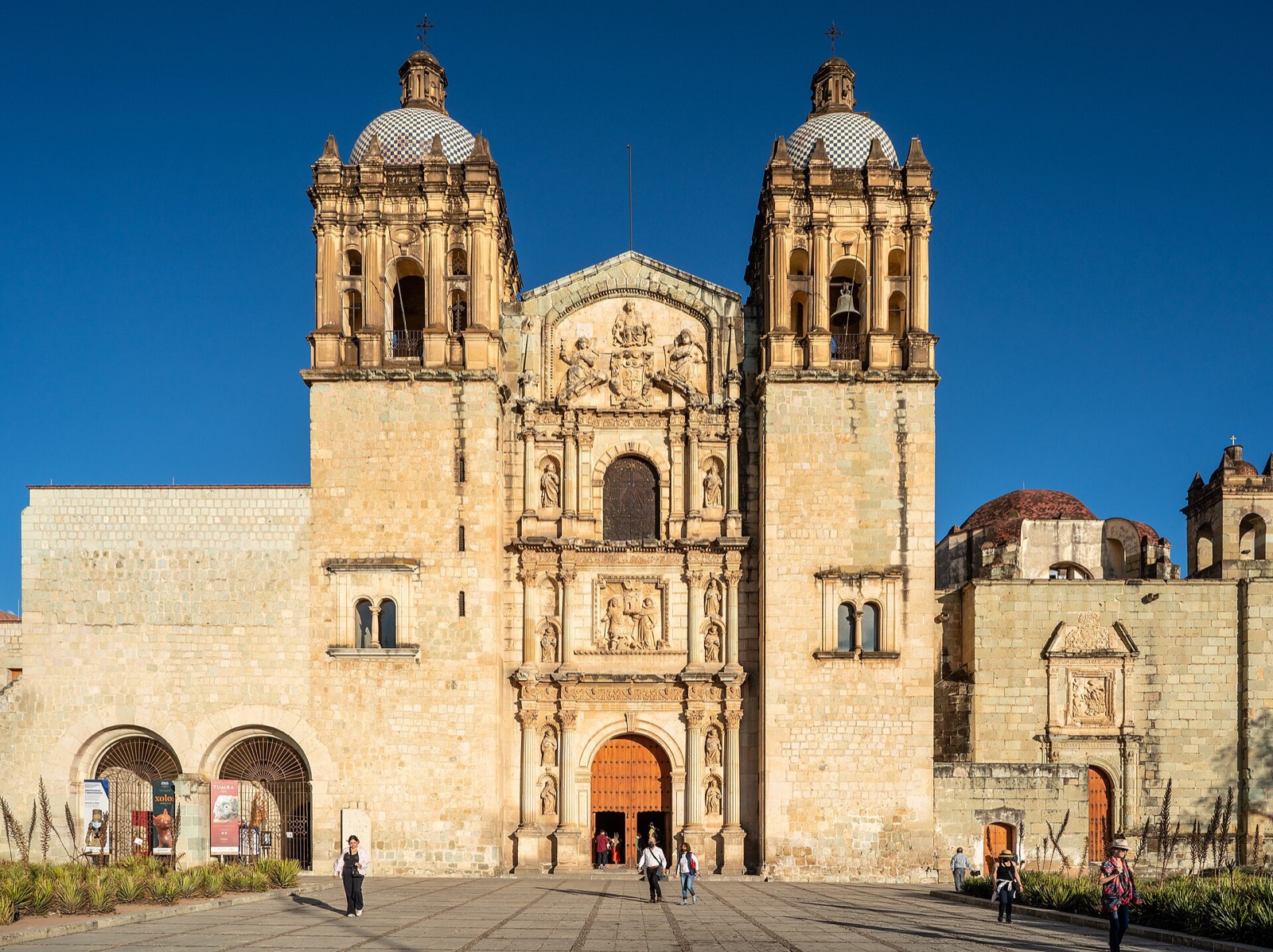
Santo Domingo de Guzman, Oaxaca. At 5,100 feet the city records fewer than two rain days a month from November to February. Photo: nan palmero, Wikimedia Commons, CC BY 2.0.

Los Cabos: November to May for land, July to October for the water. This is the one region where the best air months and the best sea months do not overlap. The Pacific there is 71 °F in April and 84 °F in September.
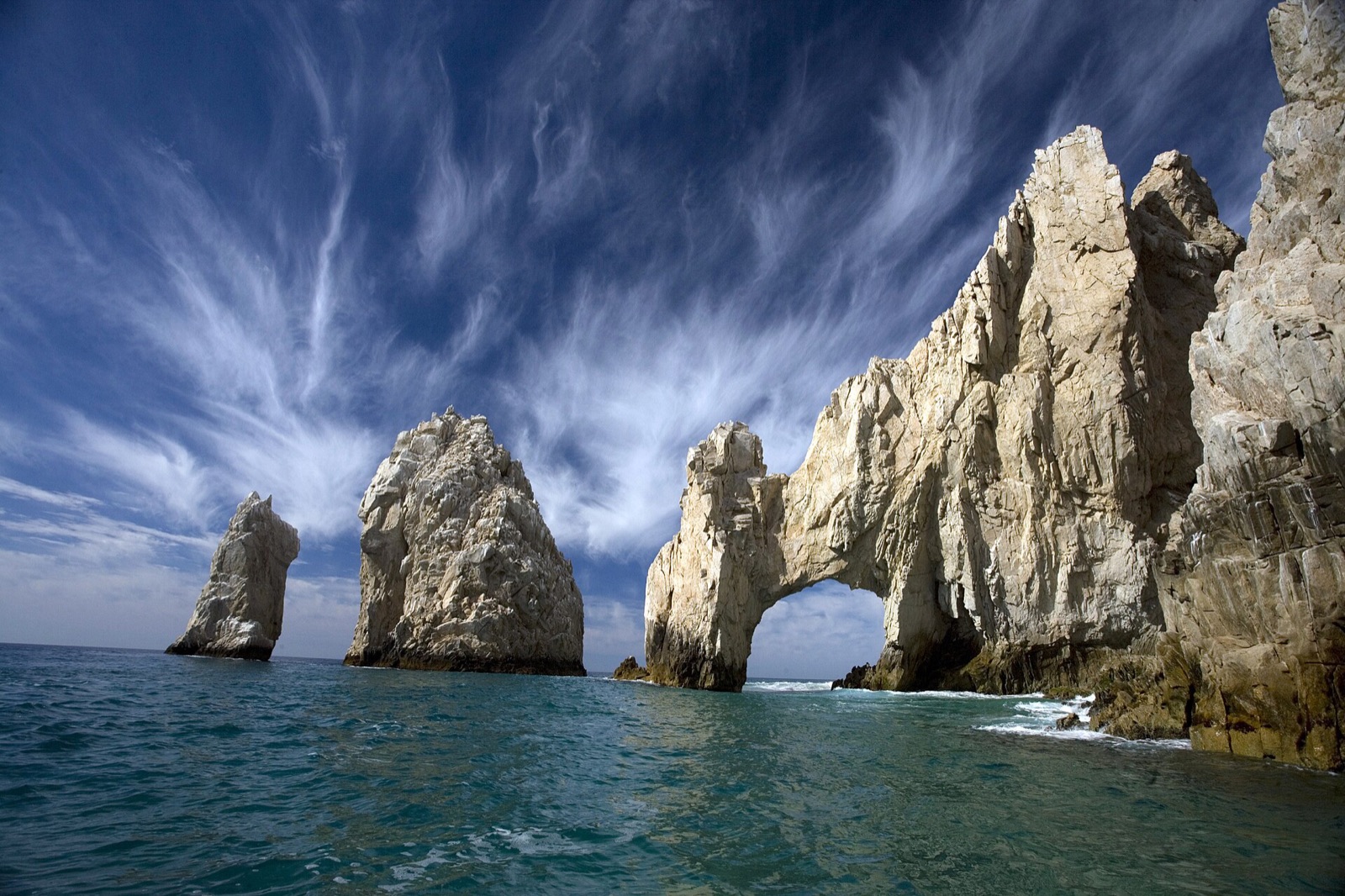
El Arco, Cabo San Lucas. The Pacific here drops to 71 degrees Fahrenheit in April and reaches 84 in September. Photo: Comisión Mexicana de Filmaciones, Wikimedia Commons, CC BY-SA 2.0.

Puerto Vallarta and the Pacific coast: December to April. Dry, warm, humpbacks in the bay from December to March, and no sargassum in any month.
Mexico City: any month, best March to May and October to November. The capital is a year-round city; the choice is between dry-and-hazy spring and green-and-showery summer. The State of Mexico next door holds Teotihuacán and part of the monarch reserve, both best from November to March.
Getting there from the United States
Mexico is the shortest international flight most Americans will ever take, and the entry rules are among the simplest.
Flights. Cancún is a little over two hours from Miami, about four from New York and about four and a half from Chicago. Mexico City is roughly two and a half hours from Houston and four and a half from New York. Los Cabos is about two and a half hours from Los Angeles. Cancún, Mexico City, Guadalajara, Puerto Vallarta and Los Cabos all take direct flights from a long list of US airports, which is why fares move so sharply with the American school calendar rather than the Mexican one.
Time difference, and the trap. Mexico abolished daylight saving time on 30 October 2022, keeping it only in the state of Baja California and 33 municipalities along the US border. Everywhere else the clock is now fixed all year, so the gap with your home clock changes twice a year rather than staying put. From March to early November, Mexico City is one hour behind Chicago and Cancún is one hour behind New York. From November to March they line up again. Los Cabos is on the same clock as Los Angeles in summer and one hour ahead of it in winter. Check it before you book an early flight home.
Entry requirements. US citizens do not need a visa to visit Mexico as tourists. You need a valid passport book for air travel. Since Mexico moved to the Forma Migratoria Múltiple Digital, air arrivals no longer receive a paper form: the immigration officer records your entry and you download the FMMd yourself from the Instituto Nacional de Migración site, where it stays available for 60 days after arrival. The permit is valid for a single entry and up to 180 days, but the officer decides the number of days granted at the border, and 30 or 90 is now common. Look at what you were actually given before you leave the airport. Check the US Department of State country information page for Mexico for current advisories before you travel.
If you are comparing a Mexican trip against staying closer to home, our guide to the best time to visit the USA covers the same ground for domestic destinations.
FAQ
What is the best month to visit Mexico?
February is the strongest single month. It is the driest month of the year in Oaxaca and Cancún, the sea off Cancún holds about 80 °F, sargassum is near its annual low, and there is no hurricane risk on either coast. The trade-off is price: February sits inside the peak season, so book flights and hotels well ahead.
What is the cheapest month to go to Mexico?
September is the cheapest month across most of Mexico. It is the wettest month in Cancún, Mexico City and Oaxaca, and it contains the statistical peak of the Atlantic hurricane season on 10 September, so demand collapses. Late April, May and early June offer a better compromise: rates fall after Easter while the weather is still largely dry.
What is the rainy season in Mexico?
The rainy season runs roughly May to October inland and on the Pacific coast, and June to October on the Caribbean coast. Rain typically arrives in the late afternoon as a short heavy storm rather than lasting all day. Mexico City averages 24 rain days in July, Cancún 24 in September, and Cabo San Lucas only 11 in its wettest month.
What months are worst for sargassum in Mexico?
May, June and July are the worst months for sargassum on the Mexican Caribbean coast. The University of South Florida measured the 2026 peak in June, at 33.6 million metric tons across all monitored regions, with 5 million tons in the Gulf alone. The lowest levels come between late November and March, which is the cleanest window for a beach trip.
When is hurricane season in Mexico?
Mexico has two hurricane seasons. The Atlantic season, affecting Cancún, the Riviera Maya and the Gulf coast, runs 1 June to 30 November and peaks on 10 September. The eastern Pacific season, affecting Los Cabos, Puerto Vallarta and the Oaxacan coast, runs 15 May to 30 November and peaks in late August. Both dates are set by the NOAA National Hurricane Center.
Which month is the hottest in Mexico?
It depends on the region, which is the point. August is the hottest month in Cancún at about 86 °F and in Cabo San Lucas at about 88 °F. Inland it is April, before the rains: Oaxaca peaks at 85 °F and Mexico City at 78 °F. Mexico City's warmest month is April, not August, because the summer rains cool it down.
Do Americans need a passport or a visa for Mexico?
US citizens need a valid passport book to fly to Mexico and do not need a tourist visa. Air arrivals no longer get a paper tourist card: your entry is recorded digitally and you download the Forma Migratoria Múltiple Digital from the Instituto Nacional de Migración website within 60 days. The permit allows up to 180 days, but the officer decides the actual number granted.
Is Mexico good to visit in August?
August works inland and on the Pacific, less so on the Caribbean. Mexico City stays at 70 °F with morning sun and afternoon storms, and Oaxaca is green and mild at 77 °F. Cancún in August is the hottest and among the most humid months, with 21 rain days, and it sits inside both the sargassum season and the Atlantic hurricane peak.
What is the worst time to visit Mexico?
For a beach holiday on the Caribbean side, June and July are the worst: peak sargassum, high humidity and the start of hurricane risk. For value, Christmas week and Semana Santa are the worst, when domestic and international demand collide. September is the wettest and stormiest month, but it is also the cheapest, so it is a bad month only if weather matters more than price.
Read next
- All our hotels in Mexico, region by region
- Riviera Maya, the coast most affected by the sargassum calendar
- Los Cabos, where the best air months and the best sea months do not overlap
- Mexico City, a destination with almost no seasonal temperature range
- Best time to visit the USA, the same question for destinations closer to home