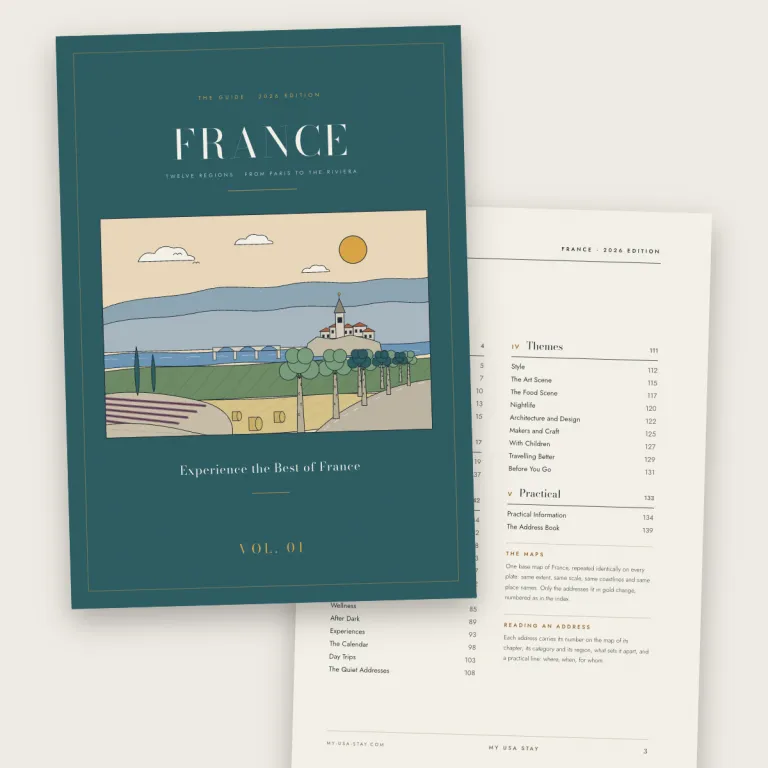
France received 102 million international visitors in 2025, according to the French Ministry for Tourism, and arrivals from the United States rose by more than 10% over the year before. Most of them see the same façades, stand in the same queues and book the same ten tables. Our 2026 guide to France was written for the traveler who wants something else: fewer places, chosen for a reason, and the practical detail that makes them work on the day.
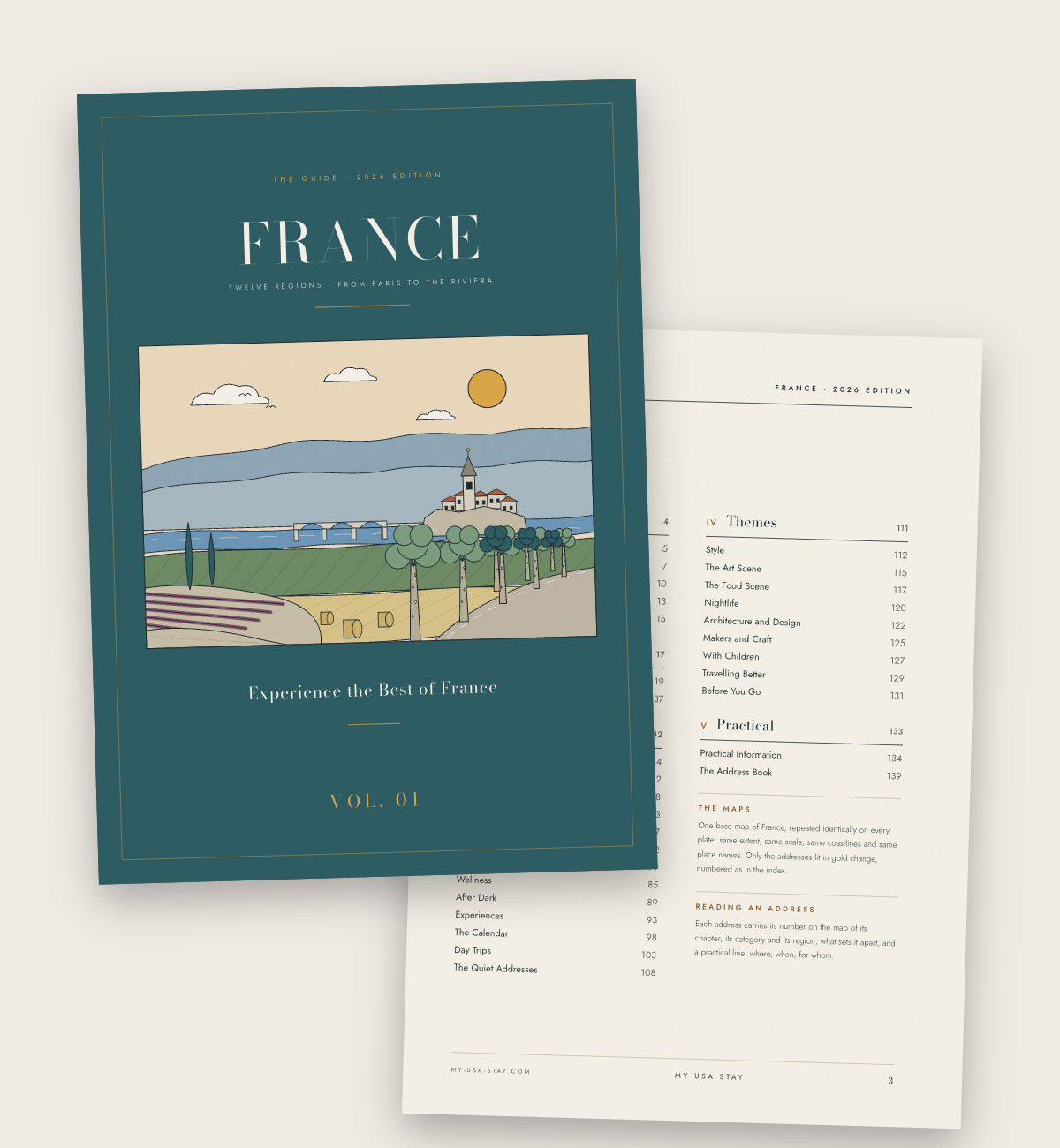
What is inside
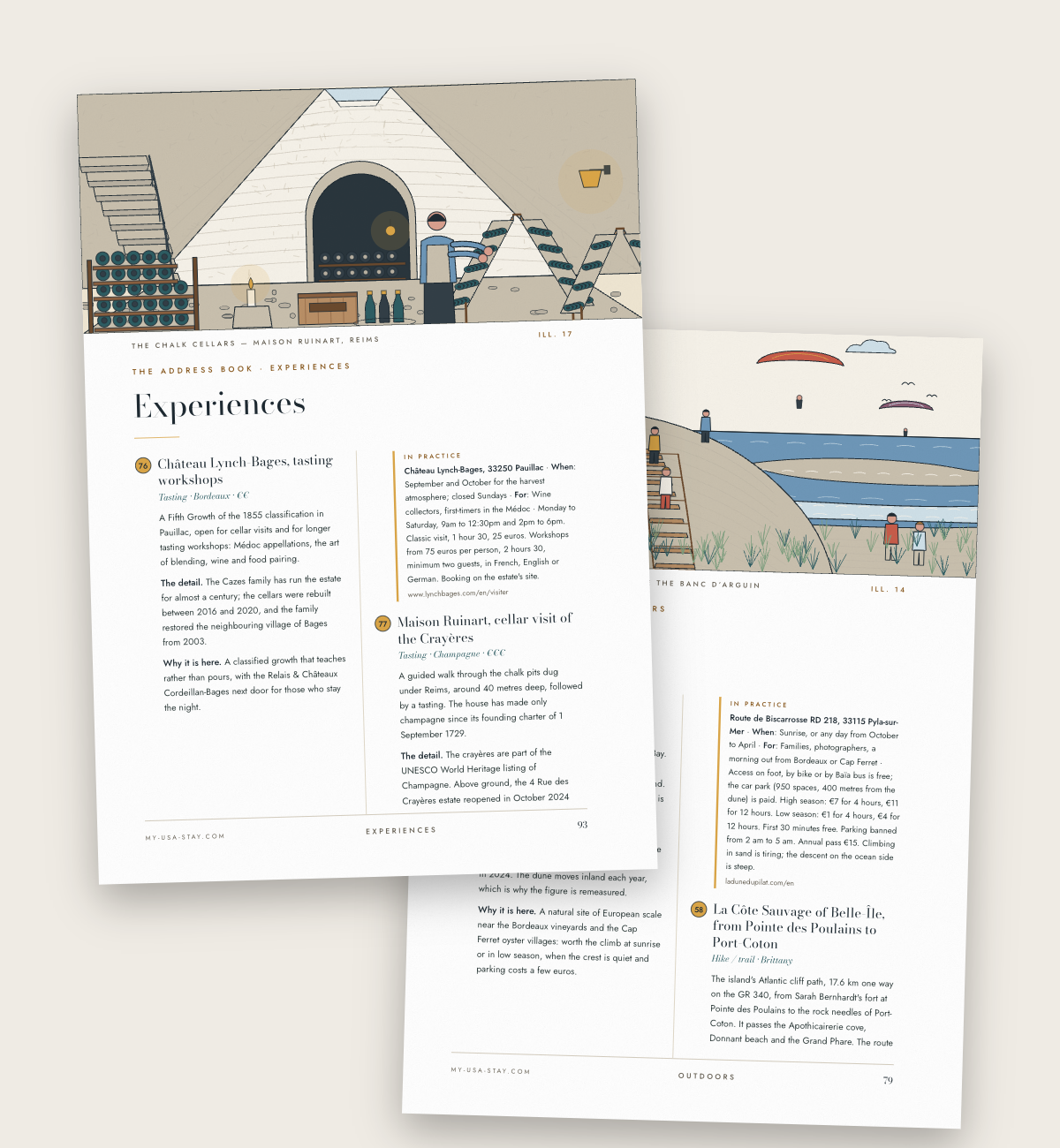
141 plates. 102 numbered addresses, from a hotel inside a classified-growth vineyard south of Bordeaux to a bakery in Paris. 26 maps. 30 illustrations. Three itineraries. Five parts: the opening, the territory, the address book, the themes, and the practical chapters.
The address book is the heart of it: 10 hotels, 12 restaurants, 8 bars, 6 places for coffee and early hours, 10 shops, 10 entries for culture and heritage, 8 outdoors, 5 for wellness, 6 after dark, 8 experiences, 8 dated events, 6 day trips, and 5 quiet addresses for travelers who already know the country.
Twelve regions rather than one country
France is too large to be read as a single destination, so the guide cuts it into twelve territories, chosen for what they give a traveler rather than drawn along administrative lines: Paris, Around Paris, Champagne, the Loire Valley, Brittany, Burgundy, Lyon, the French Alps, Provence, the French Riviera, Bordeaux and the Basque Coast. Each one says where it begins and ends, whom it suits, and whether to sleep there or only pass through.
The addresses are spread as they really are. Paris holds 27 of them, the French Riviera 13, Champagne and Bordeaux 8 each, Brittany and Provence 7, and eight more sit outside the twelve regions, from the crossing of the bay of Mont-Saint-Michel on foot to the Pic du Midi. Paris carries the largest share for a plain reason given in the book: 13 of the 33 Palace hotels in France are there, and every other territory is measured from its stations.
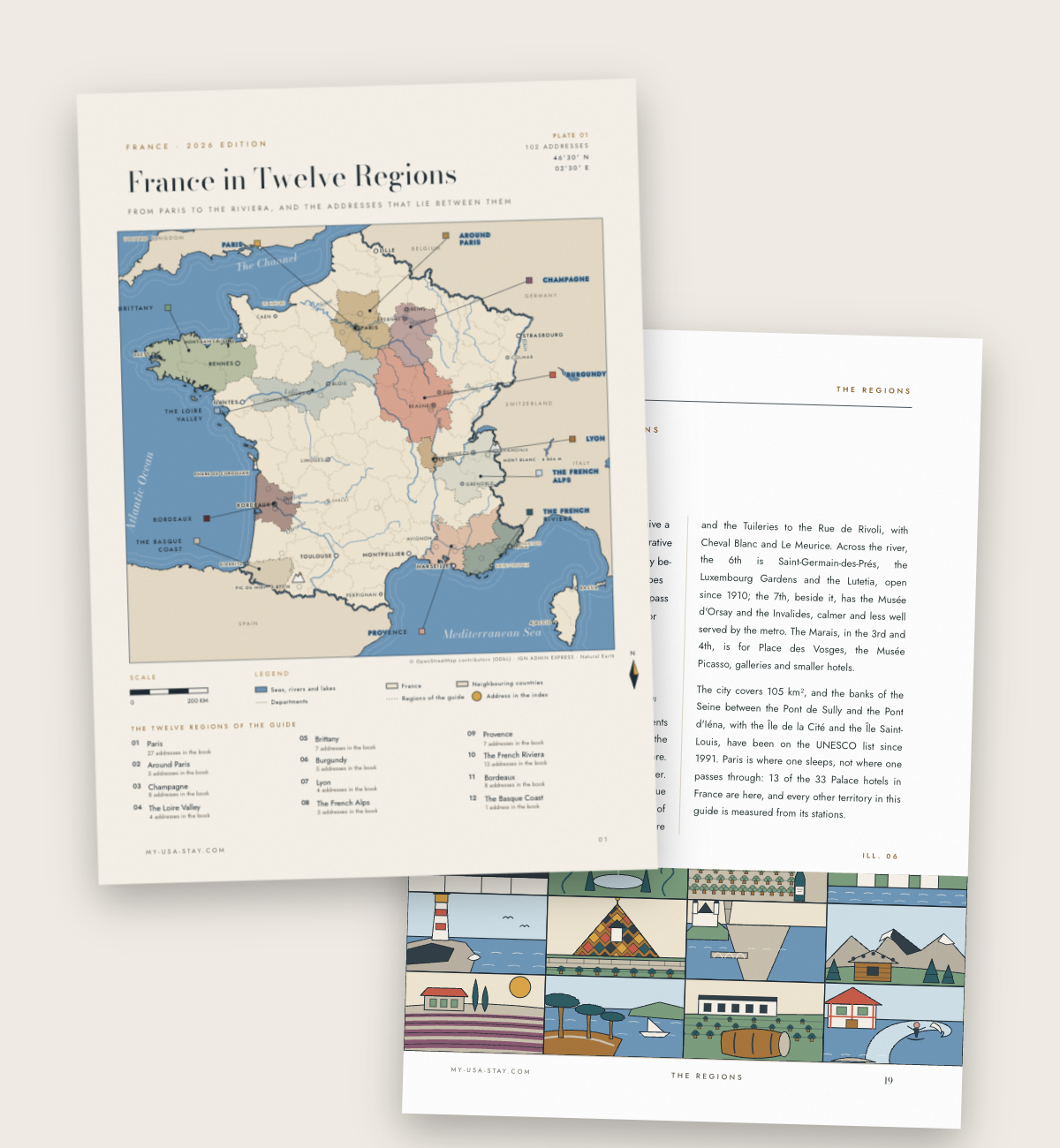
Twenty-six maps on a single base map
Every map in the guide is the same drawing of France: same extent, same scale, same coastlines, same place names, repeated identically plate after plate. Only the addresses lit in gold change, numbered as in the index. One map shows the whole book, one covers each of the twelve regions, one each chapter of addresses.
The point is to read the country without learning a new map each time. On the Where to Stay plate, ten numbers spread from Brittany to the Riviera say more about how to plan the trip than a paragraph could.
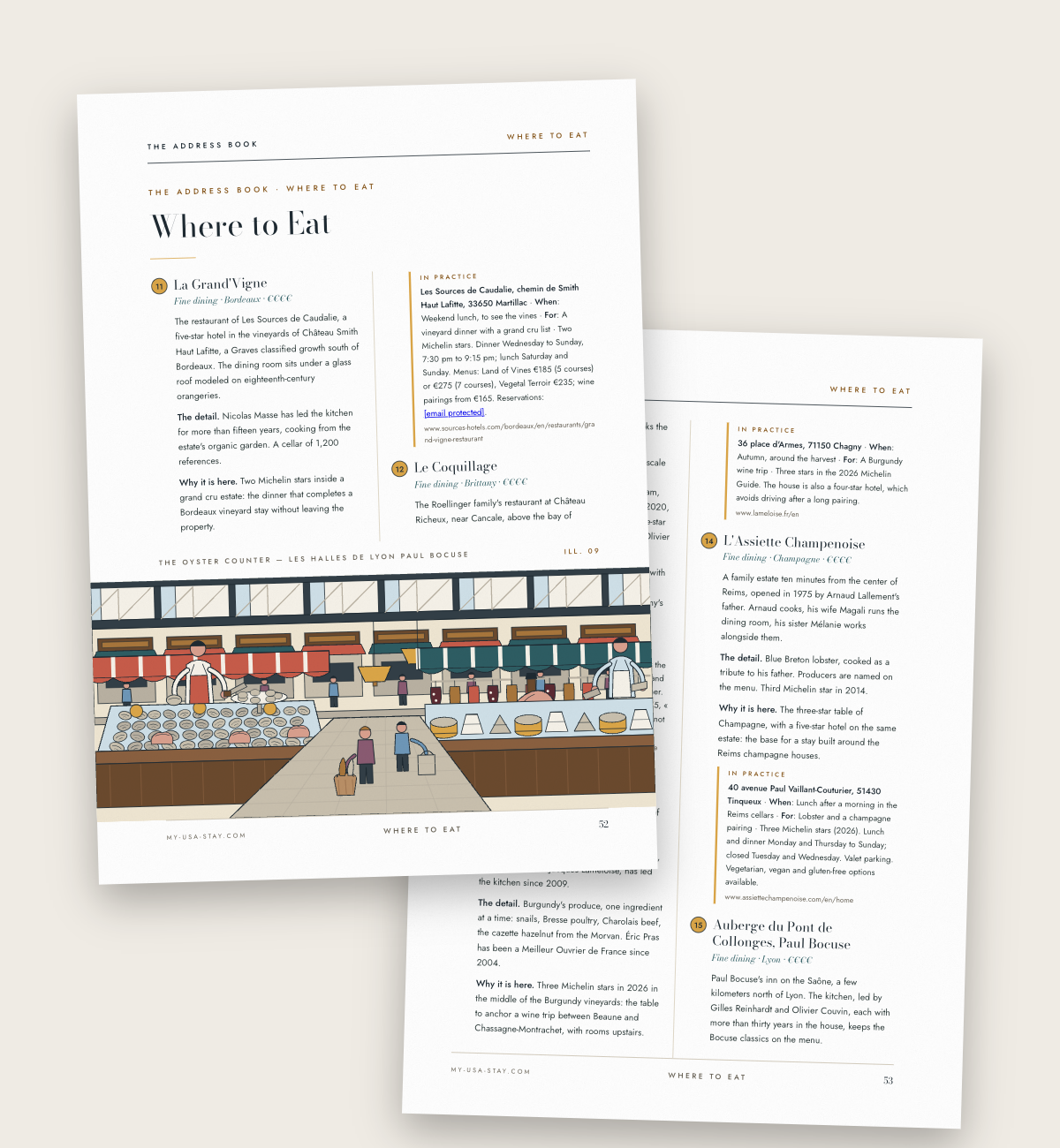
Every address says why it is here
Each entry carries its number, its category, its region, a detail that sets it apart and a line that says why it is in the guide, then a practical block: where, when, for whom. Les Sources de Caudalie is address number one: a 62-room hotel and wine spa opened in June 1999 in the vineyards of Château Smith Haut Lafitte, which kept its Palace distinction in the list Atout France published in June 2026. It is there because most Bordeaux châteaux can only be visited for an hour, and here the hotel, the spa and a two-star restaurant sit inside the vineyard.
Le Bistrot Paul Bert is there for the opposite reason: a Paris bistro where the table is booked by phone only. A guide that listed only the first kind would be a rate card. One that listed only the second would miss what brings many of our readers to France.
Three itineraries, written for a given day of the week
In France the closing days decide the order of a trip, so each itinerary is written for a specific day and built only from addresses in the book.
One day in Paris, a Friday on the Right Bank, from the Rue de Rivoli to the Samaritaine. It starts at Librairie Galignani, the first English-language bookshop on the Continent, founded in 1801. On a Tuesday the Bourse de Commerce is closed, which is why the day is a Friday.
Five days with Paris as a base, Thursday to Monday: Champagne, Vaux-le-Vicomte, two modern houses and Chantilly, back in the same hotel every night. Reims is 45 to 50 minutes by TGV from Gare de l'Est.
Eight days from Burgundy to the Italian border, Thursday to the following Thursday, in September or October, by train and then by car for Provence.
Written for a reader coming from the United States
The guide is in English and it starts from where our readers start. The practical chapters say what to settle before leaving the United States: a US passport covers up to 90 days in any 180-day period across the Schengen area, the new Entry/Exit System has recorded short-stay visitors at the first Schengen border since 10 April 2026, and ETIAS has not started yet. Rules, prices and numbers were checked in September 2026.
It also explains the frameworks a visitor meets on arrival: the Palace distinction, the MICHELIN Guide, the French school holidays staggered across three zones, and the seasonal houses of the coast and the mountains, which open and close on fixed dates.
When to read it
Before booking rather than after. The Riviera houses reopen in spring, the mountains close at the same moment, and the tables that set an itinerary are closed on different days of the week. The guide dates what can be dated so that a trip can be built around the calendar instead of against it. It opens in the browser, and it is free.