The best time to visit Italy is late April to mid June, and again September into October. Those weeks give you Rome between 65 and 81 °F, a Tyrrhenian sea that reaches 74 °F by June, and a fraction of the summer crowd: ISTAT counted 95.6 million overnight stays in August 2025 against 34.8 million in April. Avoid the week around August 15, when Ferragosto empties the cities and shuts the shops. This guide breaks the year down month by month with real numbers, and our Italy hotel pages cover where to sleep once your dates are fixed. Start at my-usa-stay.com.
The short answer
- Best overall: late April to mid June, and September to mid October. Warm, open, and far below peak occupancy.
- Worst for crowds: August. ISTAT recorded 95.6 million overnight stays that month in 2025, 17.9 % of the entire year.
- Worst for heat: July and August, when Rome and Palermo both average a 87 °F high and Italy's health ministry runs daily heat bulletins for 27 cities.
- The date to know: August 15, Ferragosto. A national holiday that closes family-run restaurants, bakeries and shops, often for a week either side.
- Cheapest and quietest: November through February, apart from Christmas week. November alone drew 20.0 million overnight stays, less than a quarter of August.
- Best for swimming: June to October. The sea off Naples sits at 81 °F in August and is still 73 °F in late October, warmer than it is in May.
- Rain: the wettest month in Rome, Milan and Venice is November, not winter. Milan takes 6.0 inches.
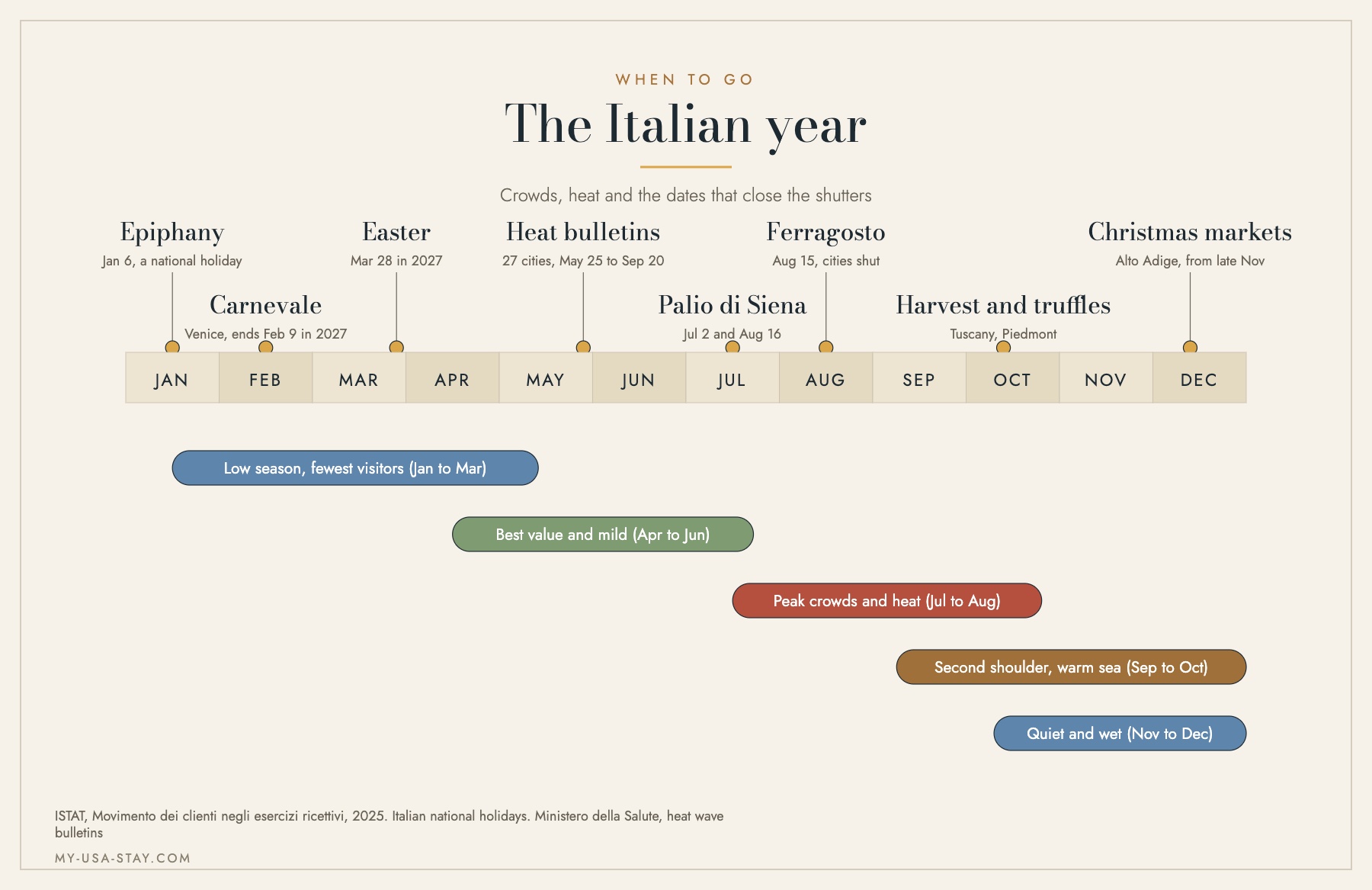
The Italian year at a glance: when the crowds arrive, when the heat bulletins run, and the dates that close the shutters.
Understanding the climate in Italy
Italy is not one climate, it is at least two, and the gap between them is widest in winter. The country runs roughly 750 miles from the Alps to Sicily, which is the distance from Boston to Charleston, and the weather behaves accordingly.
In January, Milan averages a high of 44 °F and a low of 30 °F. Palermo, on the same days, averages 57 °F and 48 °F. That is 13 °F apart by day and 18 °F apart at night. In August the two cities converge to within 2 °F of each other by day, both at 86 to 87 °F. Italy is two countries in January and one country in August. Every packing decision follows from that.
The rain pattern flips too, and this is what most guides get wrong. Rome, Venice and Palermo follow the Mediterranean rhythm: wet autumn and winter, dry summer. Palermo receives 0.2 inches across the whole of July, spread over 1.7 rain days. Milan does the opposite. Its driest month is January, at 2.3 inches, and its wettest are May and November. Milan also counts 115 rain days a year against Palermo's 99. The Po valley city is wetter than the Sicilian one, which is the reverse of what most travellers expect.
Figures here come from the ERA5-Land reanalysis (monthly normals 2001 to 2020) served through the Open-Meteo archive, with rainfall from ERA5 and sea temperatures from NOAA's OISST v2.1 dataset, averaged 2016 to 2025.
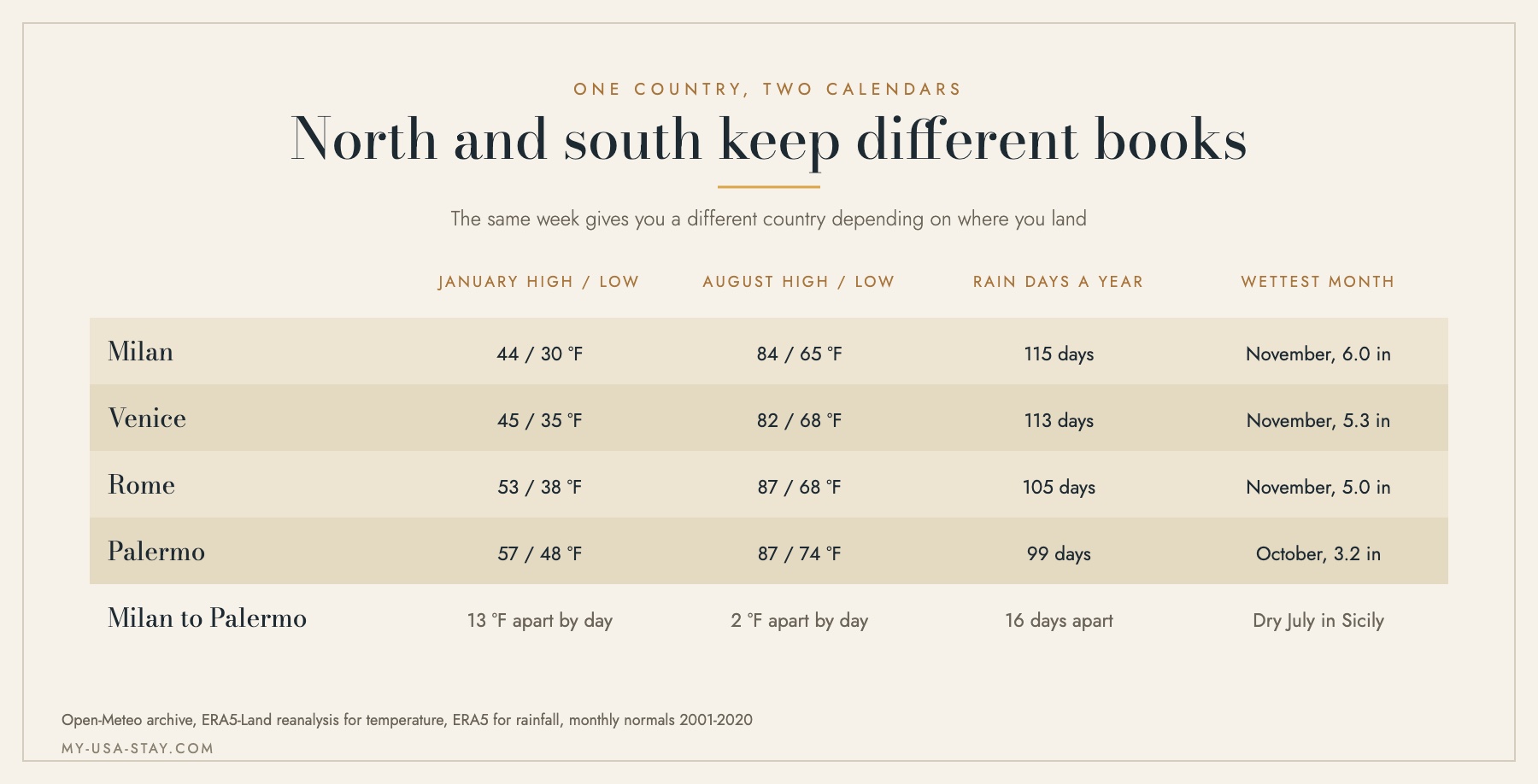
Milan and Palermo are 13 degrees apart by day in January and within 2 degrees of each other in August.
Altitude does the rest. The Dolomites and the Alto Adige valleys hold snow from December into April while Naples is in shirtsleeves, which is why a single Italian week can involve a ski lift and a beach without either being out of season.
Spring: March to May
Spring is the best-value half of the good season. Rome climbs from a 59 °F average high in March to 72 °F in May, and crowds only start to build at the end of it: ISTAT's overnight stays run at 26, 36 and 45 on an index where August is 100.
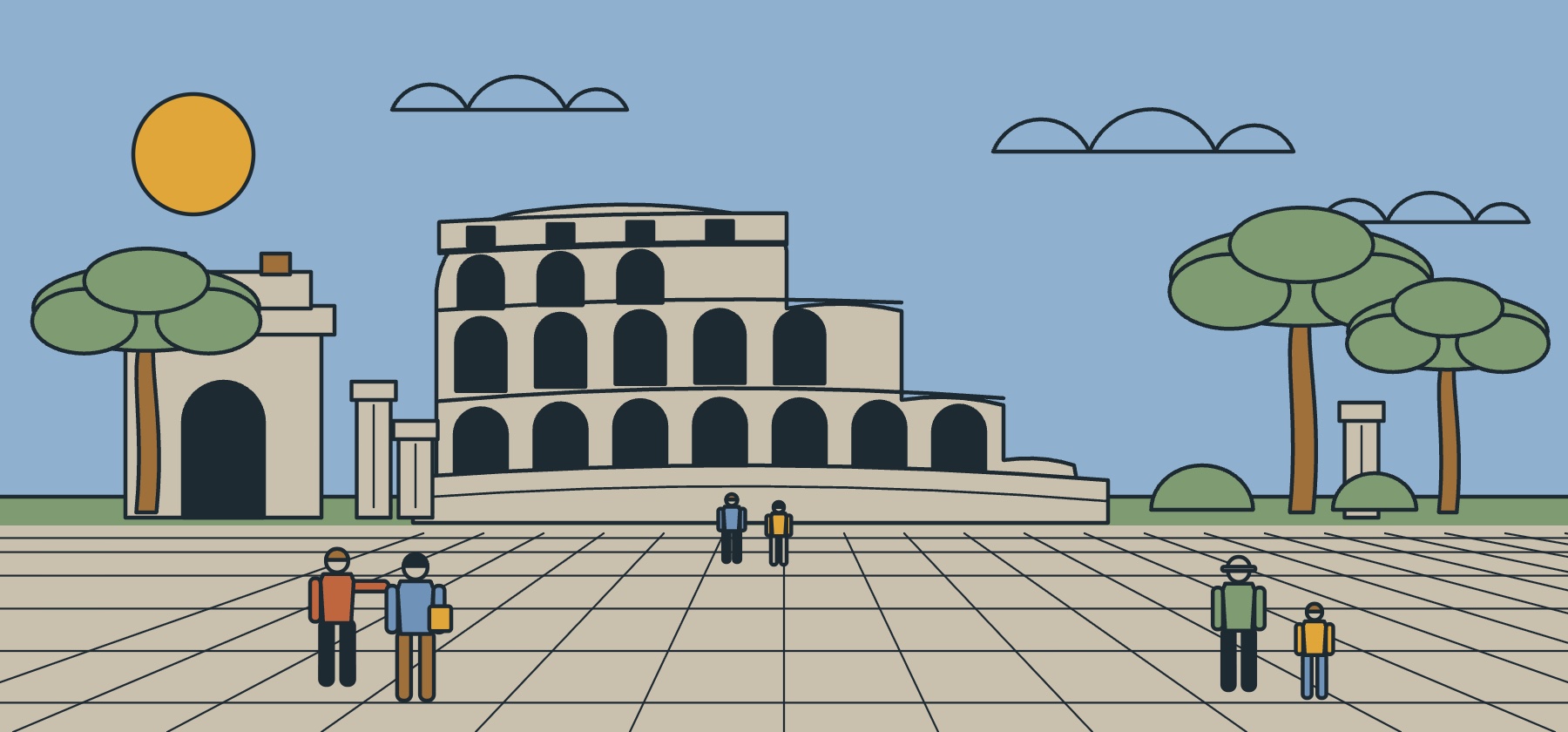
The Colosseum and the Via Sacra at opening time. The park lets the first visitors in at 8.30 am. Illustration: my-usa-stay.com.
Precautions for a spring trip:
- March is still wet. Rome averages 10 rain days and 3.2 inches, and Venice can see high water. Pack a shell, not an umbrella, because the wind in the lagoon destroys umbrellas.
- Easter falls on 28 March 2027. Rome fills for Holy Week and prices follow, so book accommodation and Vatican access months out.
- April 25 (Liberation Day) and May 1 are national holidays. Italians take long weekends around them and the coast fills early.
- The sea is not ready. Off Naples it sits at 60 °F in April and 65 °F in May. Spring is for cities and hills, not swimming.
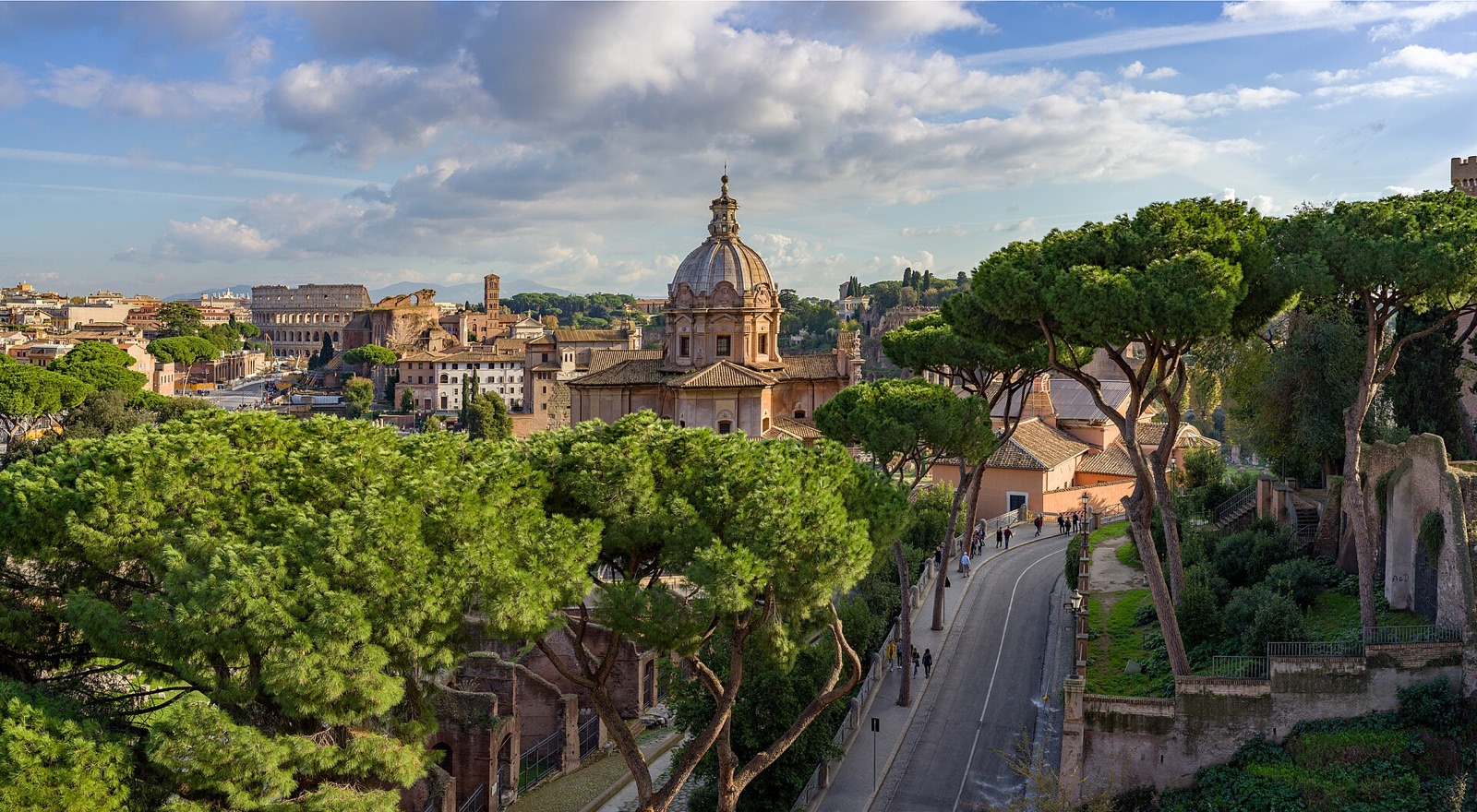
The Roman Forum seen from the Vittoriano. The archaeological areas open at 9 am and are unshaded. Photo: Wolfgang Moroder, Wikimedia Commons, CC BY-SA 3.0.

What spring is good for: the archaeological sites, which are punishing in July. The Parco archeologico del Colosseo opens the Colosseum at 8.30 am and the Roman Forum at 9.00 am, with last admission at 6.15 pm from 29 March to 30 September. Tickets carry a compulsory time slot and go on sale exactly 30 days before the visit date, so a May trip booked in February cannot buy them yet. They are also nominative: the name on the ticket is checked against ID at the gate.
Summer: June to August
Summer in Italy is hot, expensive and full, and the second half of it is structurally different from the first. June is still manageable, with Rome at 81 °F and a crowd index of 68. July and August are another matter: both Rome and Palermo average 87 °F highs, Palermo's nights stay at 74 °F, and the crowd index hits 92 and 100.
Heat in Italian cities is a public-health matter, not a talking point. The Ministero della Salute publishes a daily heat-wave bulletin for 27 cities including Rome, Florence, Milan, Venice, Naples, Bologna and Palermo, from 25 May to 20 September, Monday to Friday. It grades risk on four levels. Level 1 is a pre-alert, level 2 means high temperatures with effects on vulnerable people, and level 3, the red one, means level 2 conditions have persisted for three or more consecutive days. American news coverage of an Italian "red alert" is usually this bulletin. It is worth checking before booking an August day of walking.
Ferragosto: the week Italy closes
August 15 is Ferragosto, a national holiday, and the single most underrated date in the Italian calendar for American visitors. Family-run restaurants, bakeries, butchers, dry cleaners and neighbourhood shops close, often from the weekend before to the weekend after. Big museums and chain businesses stay open. The trattoria you researched may not.
The ISTAT numbers show exactly what happens, and they are counterintuitive. In 2025, total overnight stays rose from 87.9 million in July to 95.6 million in August. But stays by foreign visitors fell, from 47.8 million to 44.1 million. What rose was domestic travel: Italian overnight stays jumped from 40.1 million in July to 51.5 million in August, a rise of more than a quarter in one month. August is the month Italians go on holiday, which is why the cities empty and the coast, the lakes and the mountains do not.
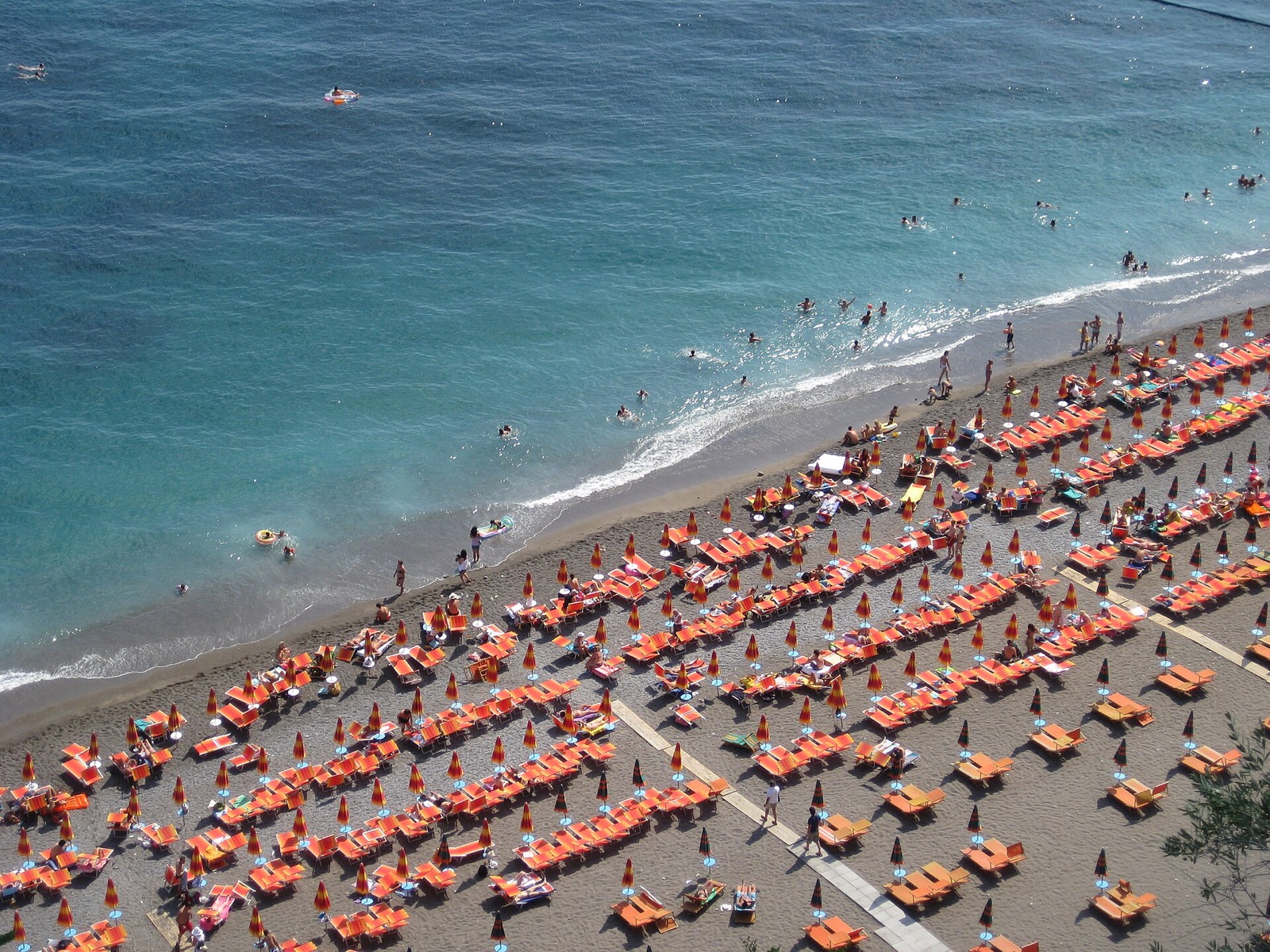
Positano in high summer. In August the Amalfi Coast competes with the whole of Italy on holiday. Photo: VV Nincic, Wikimedia Commons, CC BY 2.0.

Practical consequences:
- If you want cities in August, the week of the 15th is the emptiest Rome or Milan gets all year. Residents leave. Some restaurants shut, but the streets and the queues thin out.
- If you want coast in August, you are competing with the entire country. Positano, the Amalfi Coast, Sardinia and the lakes are at their fullest precisely then.
- Check opening dates rather than assuming. Many independent businesses post their chiusura estiva on the door in late July.
- Book restaurants that stay open. In August the survivors fill fast.
Autumn: September to November
September is the strongest month on the calendar if you can only pick one. Rome averages 78 °F, the sea off Naples is still 77 °F, and the crowd index drops from 100 to 61 in a single turn of the month. October drops again to 38 while the sea holds 73 °F, warmer than it was in June.
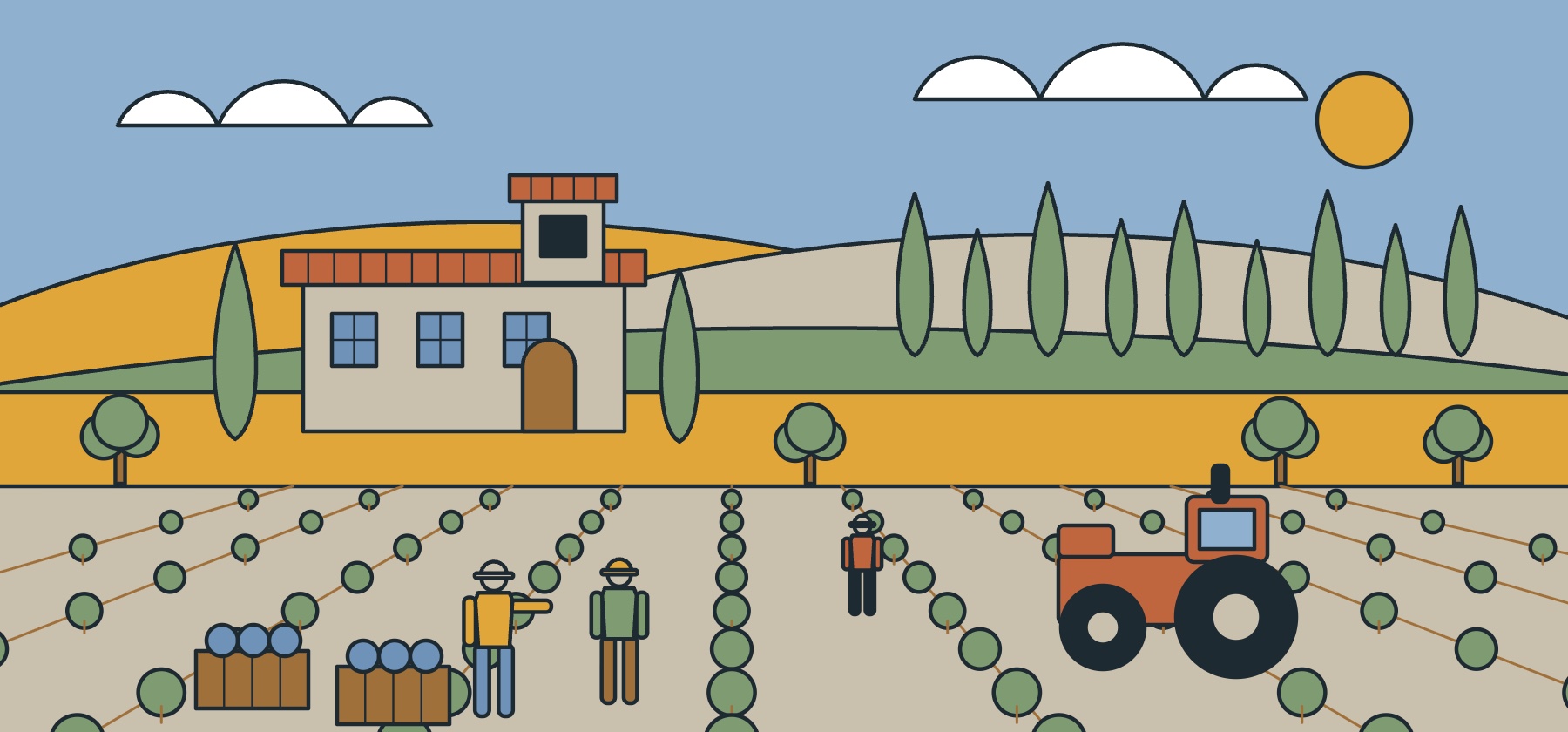
The Sienese hills in September. Harvest runs through October in Tuscany and Piedmont. Illustration: my-usa-stay.com.
Autumn is also when Italy becomes proportionally the most international. In October 2025, 69.8 % of overnight stays were by foreign visitors, the highest share of any month, against 46.1 % in August. The Italians have gone home and the country belongs to travellers again.
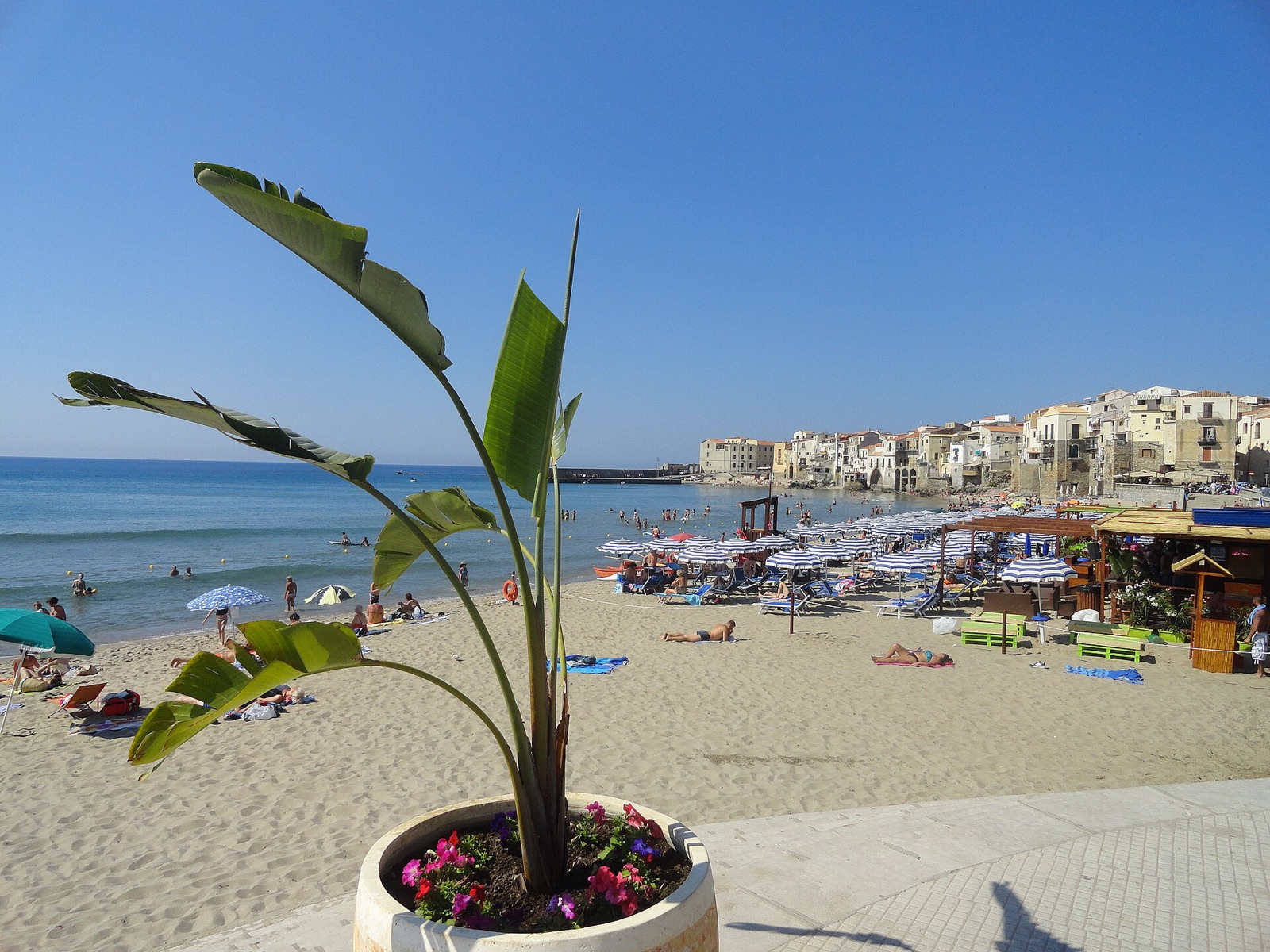
Cefalu in Sicily. The sea off the south stays swimmable into late October. Photo: l0da_ralta, Wikimedia Commons, CC BY 2.0.

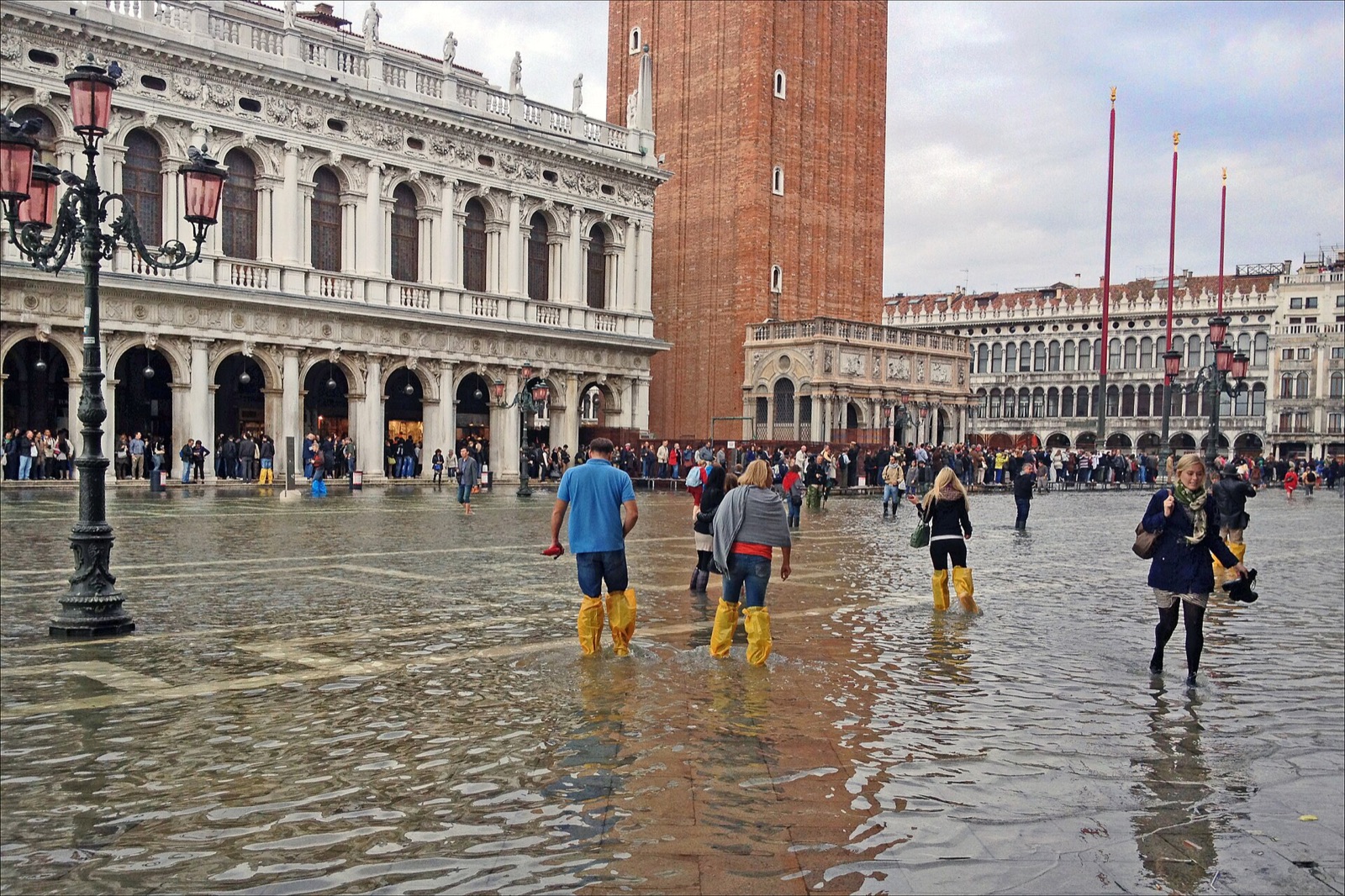
Acqua alta in St Mark's Square. High water season in Venice runs through autumn. Photo: Jean-Pierre Dalbera, Wikimedia Commons, CC BY 2.0.

Precautions:
- November is the wettest month in Rome (5.0 inches), Milan (6.0 inches) and Venice (5.3 inches). It is also the quietest month of the year, at a crowd index of 21.
- Venice high water season runs through autumn. Boardwalks go up in St Mark's Square and the city posts tide forecasts, but shoes and patience are required.
- Colosseum hours contract sharply. From 1 to 24 October last admission moves to 5.30 pm, and from 25 October to 3.30 pm, with the park closing at 4.30 pm. An afternoon flight arrival in November means the site is effectively a next-day visit.
- Grape harvest runs September into October in Tuscany and Piedmont, and white truffle season follows from October. Both push rural accommodation demand well above the trend of the month.
Winter: December to February
Winter splits into two Italies again. Milan averages 44 °F and 30 °F in January under Po valley fog; Palermo averages 57 °F and 48 °F with 10.8 rain days. Rome sits in between at 53 °F and 38 °F, cold enough for a coat and mild enough to walk all day.
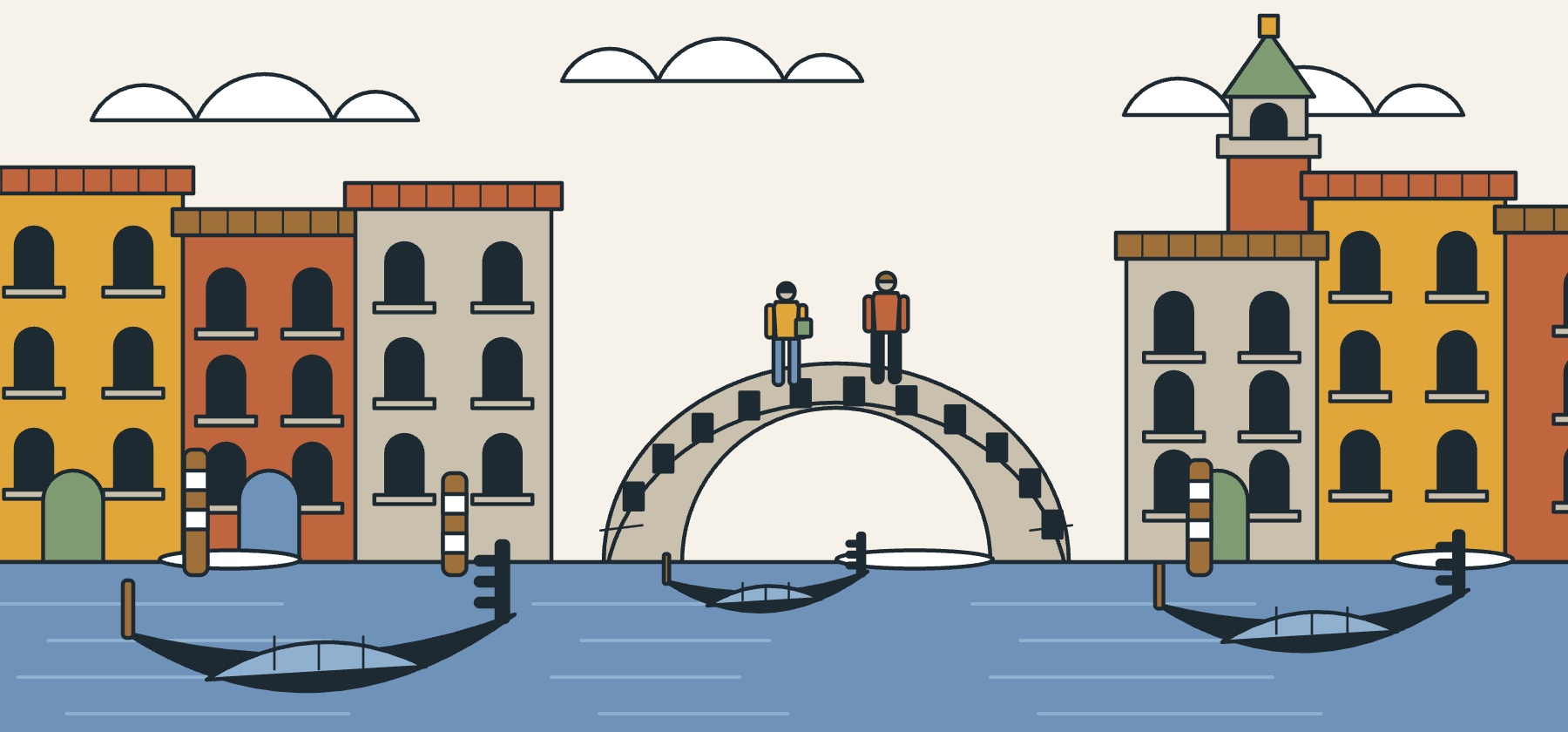
Venice in winter, between Epiphany and Carnival, is the quietest the city gets. Illustration: my-usa-stay.com.
Crowd indices in January, February and December are 23, 24 and 25, roughly a quarter of August. The exception is Christmas week: December stays climbed to 24.4 million in 2025, above both January and February, and Alpine and city-centre prices rise with them.
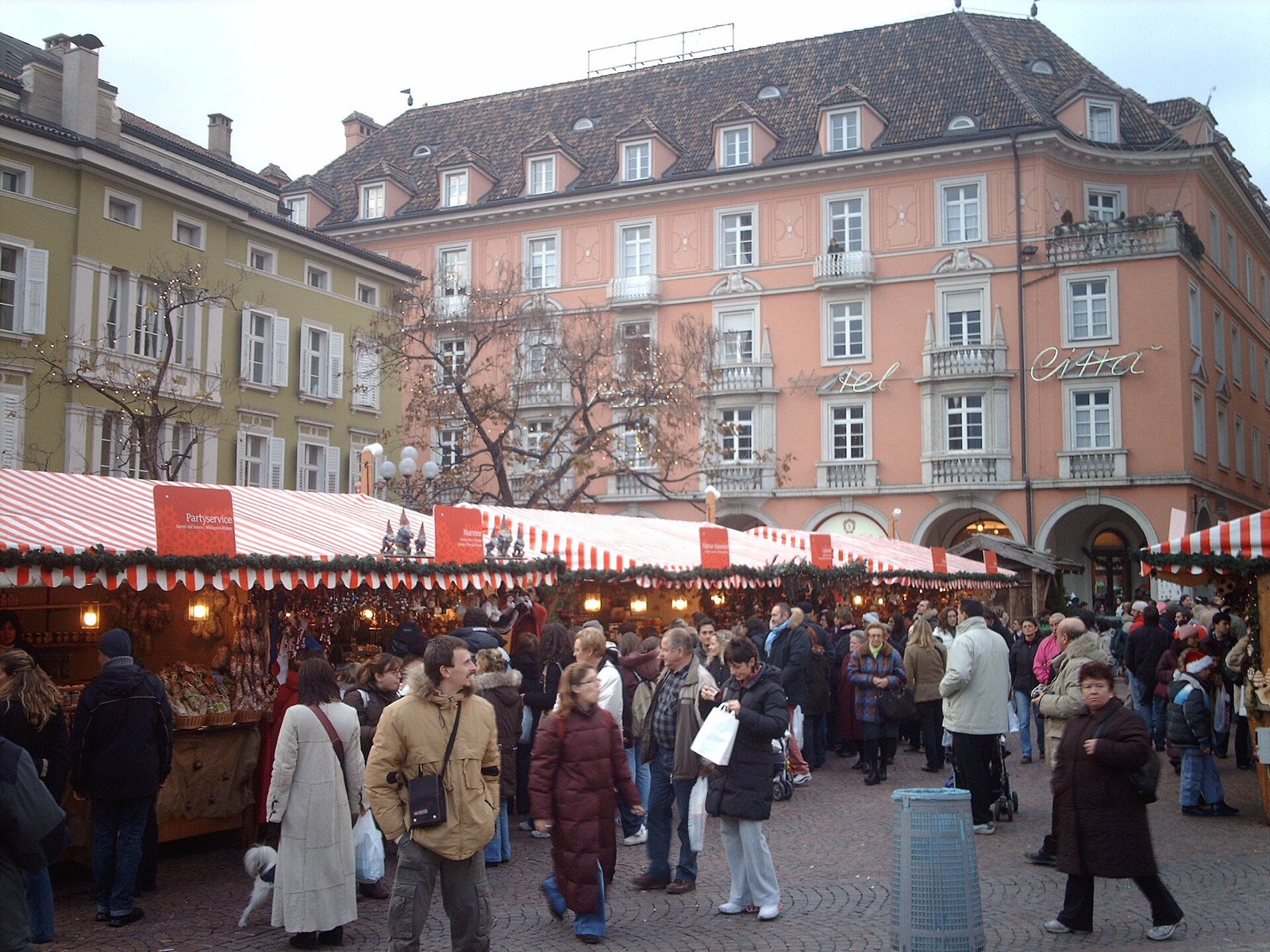
The Christkindlmarkt in Bolzano. Alto Adige markets run from late November to early January. Photo: Skafa, Wikimedia Commons, CC BY-SA 2.5.

Dates that shape the winter:
- January 6, Epiphany, is a national holiday and closes much of the country. It is the real end of the Italian Christmas season, not December 26.
- The Venice Carnival ends on Shrove Tuesday, 9 February 2027. The full programme is published on the official carnevale.venezia.it site from October of the preceding year.
- Christmas markets in Alto Adige, notably Bolzano, run from late November to early January and are the main winter draw in the north.
- Major museums close on 1 January and 25 December, including the Colosseum park, the Uffizi and the Last Supper.
Italy month by month
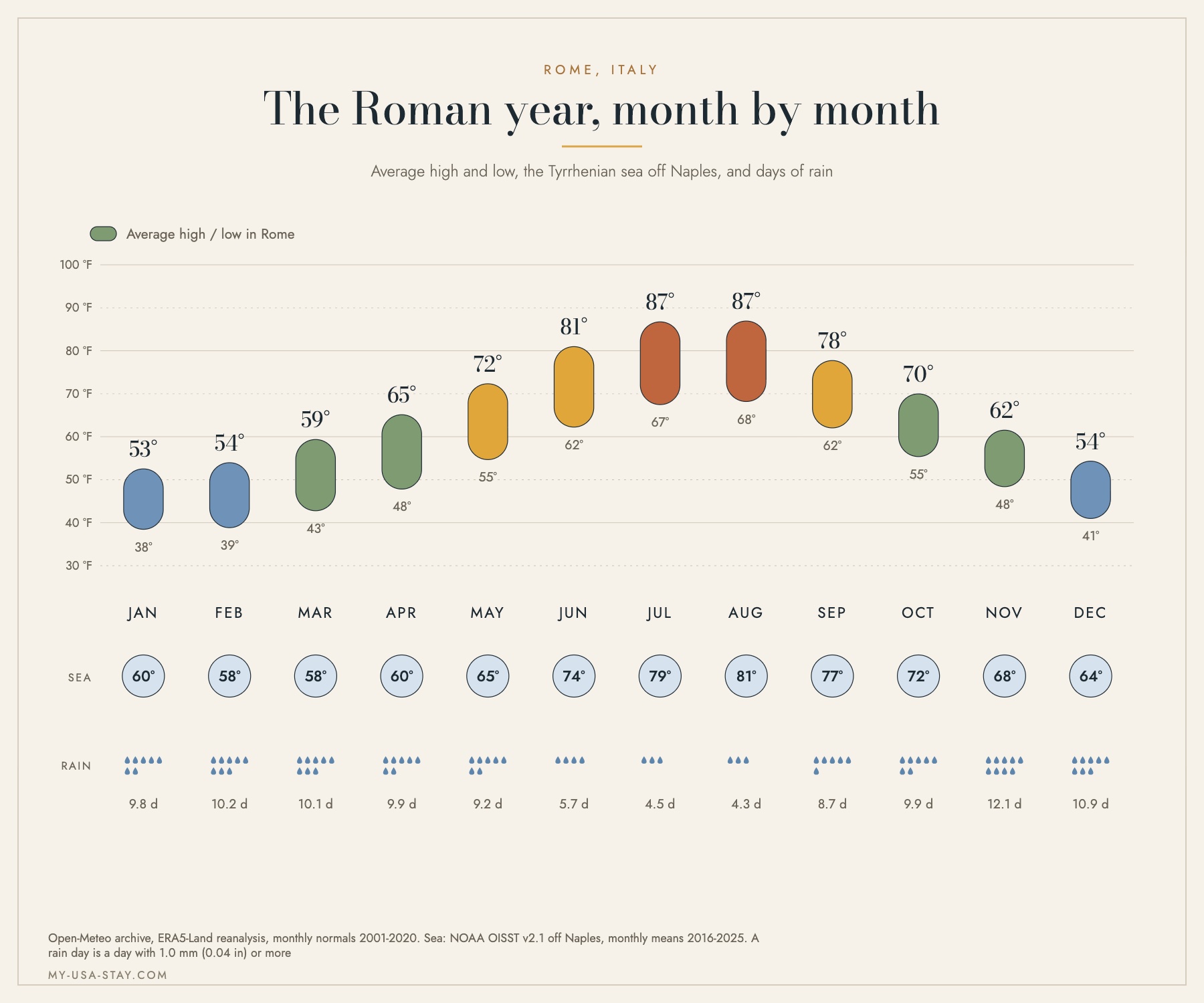
Rome month by month, with the Tyrrhenian sea off Naples and the number of rain days.
| Month | Rome high / low | Palermo high / low | Sea off Naples | Rain days, Rome | Crowds | Verdict |
|---|---|---|---|---|---|---|
| January | 53 / 38 °F | 57 / 48 °F | 60 °F | 10 | 23 | Cheap, cold, empty |
| February | 54 / 39 °F | 57 / 47 °F | 58 °F | 10 | 24 | Carnival, still quiet |
| March | 59 / 43 °F | 62 / 50 °F | 58 °F | 10 | 26 | Waking up, wet |
| April | 65 / 48 °F | 66 / 54 °F | 60 °F | 10 | 36 | Excellent for cities |
| May | 72 / 55 °F | 73 / 60 °F | 65 °F | 9 | 45 | Best all-round month |
| June | 81 / 62 °F | 81 / 68 °F | 74 °F | 6 | 68 | Warm, sea opens |
| July | 87 / 67 °F | 86 / 73 °F | 79 °F | 5 | 92 | Hot and full |
| August | 87 / 68 °F | 87 / 74 °F | 81 °F | 4 | 100 | Peak, Ferragosto closures |
| September | 78 / 62 °F | 80 / 69 °F | 77 °F | 9 | 61 | The sweet spot |
| October | 70 / 55 °F | 74 / 64 °F | 73 °F | 10 | 38 | Warm sea, thin crowds |
| November | 62 / 48 °F | 66 / 57 °F | 68 °F | 12 | 21 | Wettest, emptiest |
| December | 54 / 41 °F | 59 / 51 °F | 64 °F | 11 | 25 | Markets, then closures |
Air temperatures: ERA5-Land reanalysis, monthly normals 2001 to 2020, via the Open-Meteo archive. Rainfall: ERA5; a rain day is a day with 1.0 mm (0.04 in) or more. Sea: NOAA OISST v2.1, Tyrrhenian point off Naples, monthly means 2016 to 2025. Crowds: index built from ISTAT, Movimento dei clienti negli esercizi ricettivi, monthly overnight stays 2025, with August set at 100.
The best time for what you want to do
The right month depends less on the country than on the trip you are buying.
- Rome, Florence and the classic circuit: April, May, late September and October. Sites are outdoors and mostly unshaded, and the crowd index in those months runs between 36 and 61.
- Beaches and islands: mid June to early October. The sea off Naples clears 74 °F from June and holds 73 °F through October. The Adriatic off Venice is cooler, peaking at 80 °F in August.
- Food and wine: September and October for the harvest in Tuscany and Piedmont, November and December for white truffle and olive oil.
- Skiing in the Dolomites: January to March, with the Alto Adige valleys holding snow longest.
- Travelling with children: late May, June and September. Heat is bearable, days are long, and queues are shorter than in July. Our guide to hotels that genuinely understand families covers what to look for.
- Lowest prices: November, January and February outside holidays, when the crowd index falls to 21 to 24.
- Art with room to see it: winter weekdays. The Uffizi in Florence charges €25 on the day and €29 pre-purchased, and since 1 January 2026 the ticket drops to €16 for anyone entering from 4 pm. It closes on Mondays.
Book these three months ahead, whatever your dates
Three Italian sights are capacity-limited in a way that punishes late planning, and the constraint is the same in February as in August.
- The Last Supper, Milan. Leonardo's mural admits 40 people at a time for 15 minutes. Tickets cost €15 and are released quarterly, with extra seats every Wednesday at noon for the following week. The museum opens Tuesday to Sunday, 8.15 am to 7 pm, last admission 6.45 pm, closed Mondays.
- The Colosseum, Rome. Sales open only 30 days ahead, with a compulsory entry slot. Entry is free on the first Sunday of every month, plus 25 April, 2 June and 4 November, which also makes those the busiest days of the month.
- The Uffizi, Florence. Pre-purchase carries a premium over the door price, but the door price assumes there is a ticket left.
Events that shape the year
Italian holidays move prices and close doors more reliably than festivals do. The eleven national holidays are 1 January, 6 January, Easter Monday, 25 April, 1 May, 2 June, 15 August, 1 November, 8 December, 25 December and 26 December.
- Venice Carnival, ending Shrove Tuesday, 9 February 2027. Venice accommodation sells out and rates roughly follow.
- Easter, 28 March 2027. Rome peaks for Holy Week; the rest of the country takes Easter Monday as a countryside day.
- Palio di Siena, run in the Piazza del Campo on 2 July and 16 August every year, as fixed by the Comune di Siena. The August edition falls inside the Ferragosto week and Siena is unreachable on a whim.
- Ferragosto, 15 August. See above; it is the structural event of the Italian year.
- Harvest and truffle season, September to December in Tuscany, Piedmont and Umbria.
- Christmas markets in Alto Adige, late November to early January.
Where to go, region by region
Italy rewards matching the region to the month rather than the reverse.
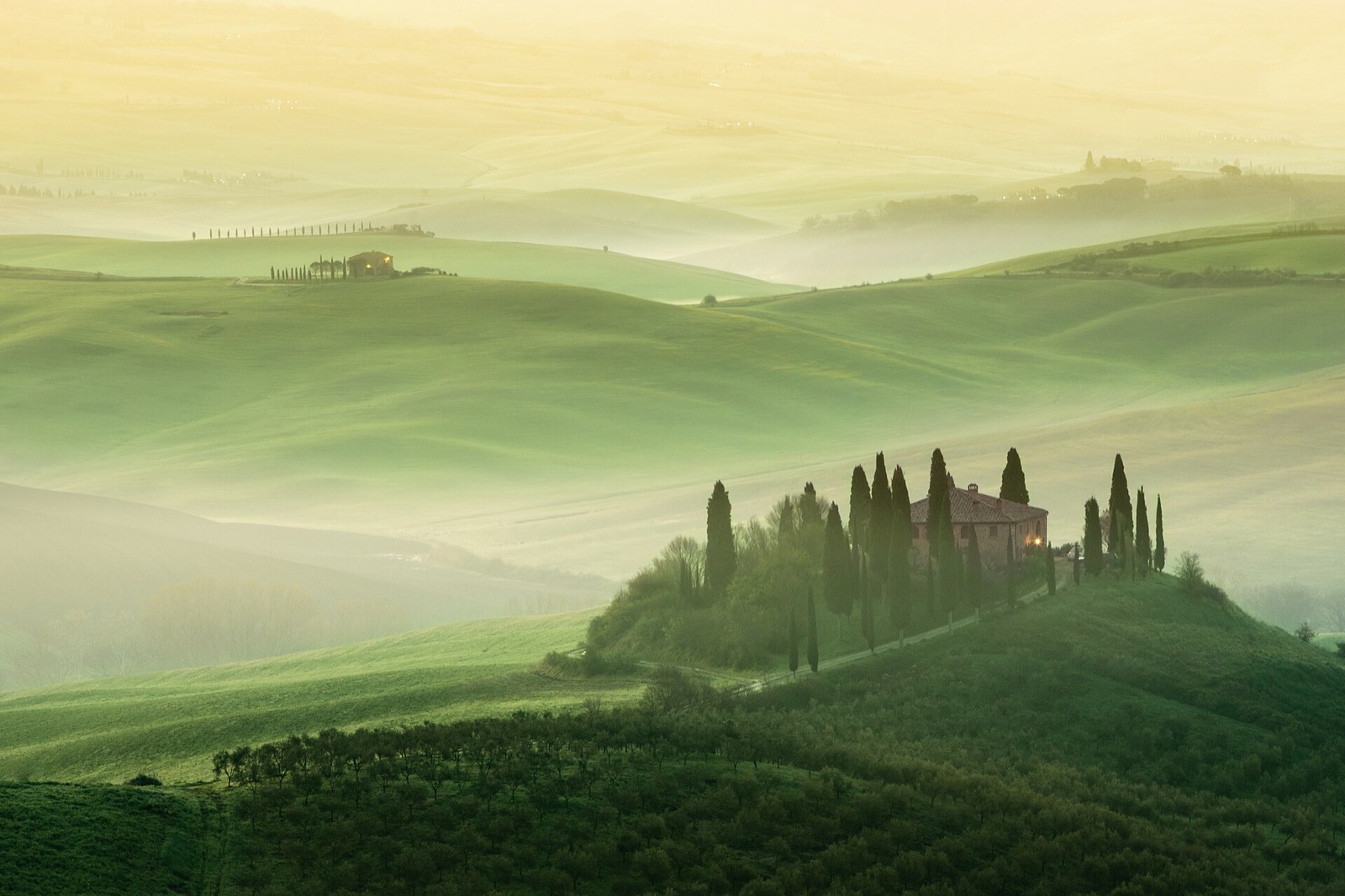
The Val d'Orcia in Tuscany. Central Italy has the widest usable window of the three regions. Photo: Salvatore Gerace, Wikimedia Commons, CC BY 2.0.

The north covers Milan, Venice, the lakes and the Dolomites. It is the coldest and, counterintuitively, the rainiest part of the country, with Milan at 115 rain days a year. Go in May, June and September for the lakes, January to March for the mountains. Our northern Italy hotel pages cover the area.
Central Italy is Rome, Florence, Tuscany and Umbria. This is the widest usable window: April to June and September to October are all comfortable, and winter city breaks work because Rome rarely freezes. See our central Italy pages, plus Tuscany and Lazio.
The south and the islands run from Naples and the Amalfi Coast down through Puglia, Sicily and Sardinia. The season stretches furthest here: Palermo is above 66 °F from April to November, and the sea stays swimmable into late October. May, June, September and October are the value months. See our southern Italy pages and Campania.
For the addresses themselves, our free Italy guide collects 106 addresses, 21 maps and three itineraries.
Getting there from the United States
More than 20 nonstop routes connect the United States to Italy, the most there have ever been, flown by Delta, United, American and ITA Airways. Flying time is about 8 hours 30 minutes from New York to Rome Fiumicino and 11 to 12 hours from Los Angeles.
The catch is seasonality, and it is the single most useful thing to know when picking dates. Rome and Milan are served year round from several US hubs. Naples, Venice, Palermo, Olbia and Bari are largely summer-only. A June trip to Sicily can be nonstop; the same trip in late October usually means a connection through Rome, Milan or a European hub, which adds three to five hours door to door. If your itinerary depends on a regional airport, check that the route still flies in your month before fixing the dates.
Time difference. Italy is 6 hours ahead of New York and 9 hours ahead of Los Angeles for most of the year. Twice a year that changes, because the two continents switch clocks on different dates: the European Union moves on the last Sunday of March and the last Sunday of October, the United States on the second Sunday of March and the first Sunday of November. In those two gaps, roughly two weeks in March and one week around the start of November, Italy is only 5 hours ahead of the East Coast. It matters for connecting flights booked in local time.
Entry requirements. US citizens travel to Italy without a visa for tourism, for up to 90 days in any 180-day period across the Schengen area. Since 10 April 2026 the EU Entry/Exit System has been fully operational, after a phased rollout that began on 12 October 2025. It registers every entry and exit electronically and replaces passport stamping. Non-EU travellers give a facial image and fingerprints, except children under 12. Expect the first crossing to take longer than it used to, especially on a summer morning at Fiumicino or Malpensa. ETIAS, the separate pre-travel authorisation for visa-exempt nationals, is not yet in force.
American dates that move Italian prices. Transatlantic fares track US demand as well as Italian. Spring break in March, Memorial Day, the Fourth of July, Labor Day and Thanksgiving all lift fares out of the United States, independently of what the Italian calendar is doing. The cheapest combination is a quiet Italian month that is also a quiet American one: early November, late January, early February. For the reverse trip, see our guide to the best time to visit the USA.
FAQ
What are the best months to visit Italy?
Late April to mid June and September to mid October. In those months Rome averages between 65 and 81 °F, the sea off Naples runs from 60 to 77 °F, and Italian overnight stays sit well below the August peak of 95.6 million recorded by ISTAT in 2025. September is the strongest single month, combining summer sea temperatures with a crowd level almost 40 per cent lower.
What is the cheapest month to go to Italy?
November, followed by January and February outside the Christmas and New Year window. ISTAT counted 20.0 million overnight stays in November 2025 against 95.6 million in August, roughly one fifth. Less demand means lower accommodation rates. The trade-off is weather: November is the wettest month in Rome, Milan and Venice, and daylight is short.
What month does Italy shut down for vacation?
August, and specifically the week around Ferragosto on 15 August. Family-run restaurants, bakeries and neighbourhood shops close, sometimes for two or three weeks. ISTAT data shows why: Italian overnight stays rose from 40.1 million in July 2025 to 51.5 million in August, while foreign stays actually fell. The country is on holiday, not at work.
Is Rome too hot in August?
Rome averages a high of 87 °F and a low of 68 °F in August, with only about four rain days. That is hot rather than extreme, but the sites are unshaded stone and the Ministero della Salute runs daily heat bulletins for Rome through 20 September. Plan outdoor visits before 11 am, and treat a red-level day as a museum day.
What is a red alert in Italy?
It is level 3 of the Ministero della Salute heat-wave bulletin, published daily Monday to Friday for 27 Italian cities from 25 May to 20 September. Level 3 means level 2 conditions, temperatures posing a health risk, have persisted for three or more consecutive days. It is a health advisory for vulnerable people, not a travel ban.
What is the rainiest season in Italy?
Autumn, and November specifically. Rome takes 5.0 inches that month, Venice 5.3 and Milan 6.0, each city's annual maximum. Summer is the driest season in the centre and south, with Palermo receiving just 0.2 inches across July. Milan is the exception nationally: its driest month is January, not July.
What is the least crowded month to visit Italy?
November. On an index where August equals 100, November sits at 21, the lowest of the year, ahead of January at 23 and February at 24. October, at 38, is the quietest month that still offers warm weather and a sea off Naples at 73 °F. December rises again to 25 because of the Christmas period.
Do Americans need a visa for Italy?
No. US citizens may visit Italy for tourism without a visa for up to 90 days in any 180-day period across the Schengen area. Since 10 April 2026 the EU Entry/Exit System has been fully operational: it records entries and exits electronically, takes a facial image and fingerprints from travellers aged 12 and over, and replaces passport stamping.