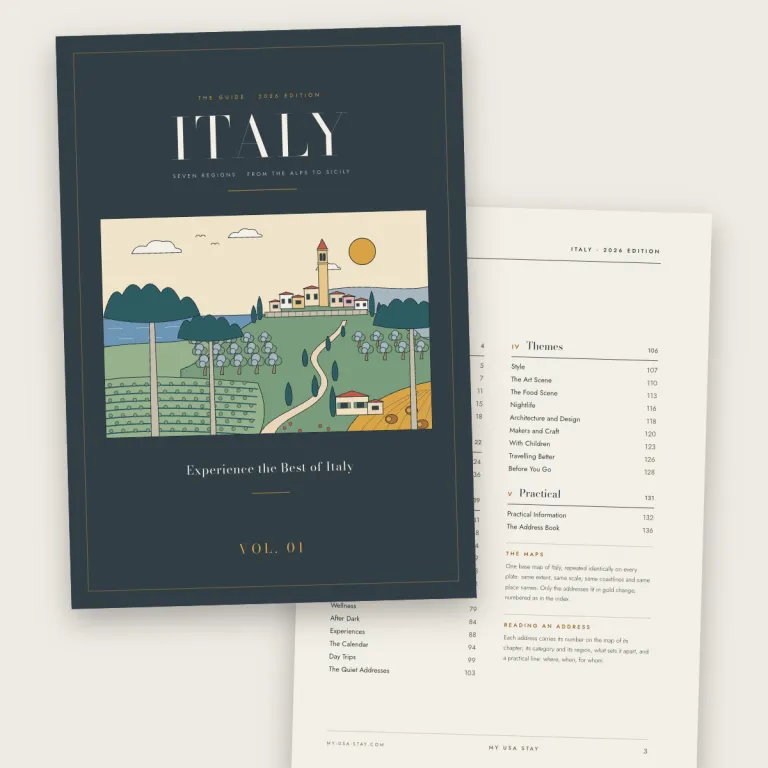
More than 4 million travelers from the United States visited Italy in 2025, according to ENIT, the Italian national tourism agency. The average trip ran 8.6 nights, and most of them landed in Rome. Many spend those nights in trains, fitting four cities into one week. Our 2026 guide to Italy was written for the traveler who would rather choose: two or three bases, fewer places, each one chosen for a reason, and the practical detail that makes them work on the day.
What is inside
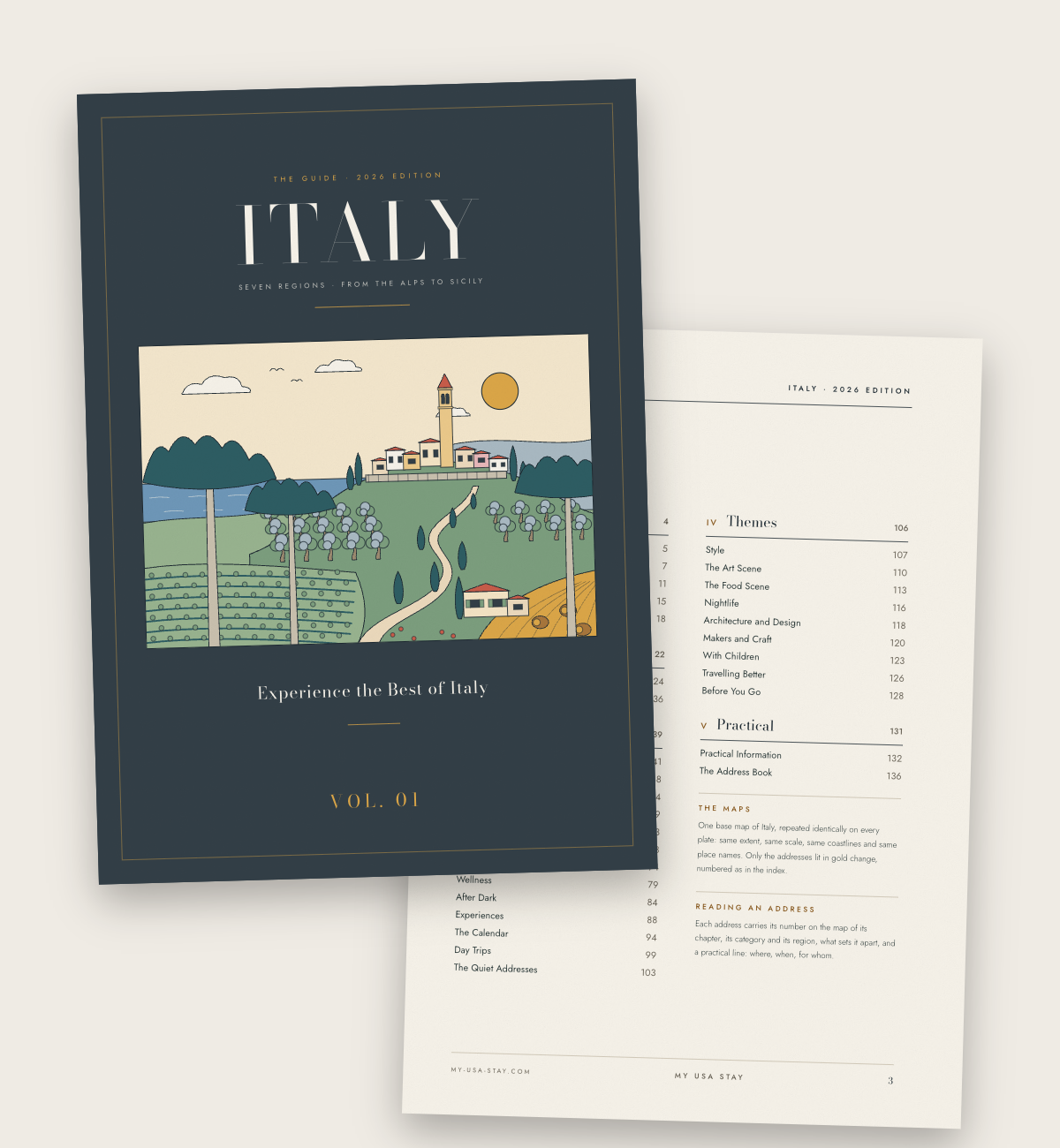
138 plates. 106 numbered addresses, from a family hotel opened in Positano in 1951 to a street food shop in Genoa that still bakes in an eighteenth-century wood oven. 21 maps. 30 illustrations. Three itineraries. Five parts: the opening, the territory, the address book, the themes, and the practical chapters.
The address book is the heart of it: 12 hotels, 12 restaurants, 8 bars, 6 places for coffee and early hours, 10 shops, 10 entries for culture and heritage, 8 outdoors, 6 for wellness, 6 after dark, 8 experiences, 9 dated events, 6 day trips, and 5 quiet addresses for travelers who already know the country.
Seven regions rather than one country
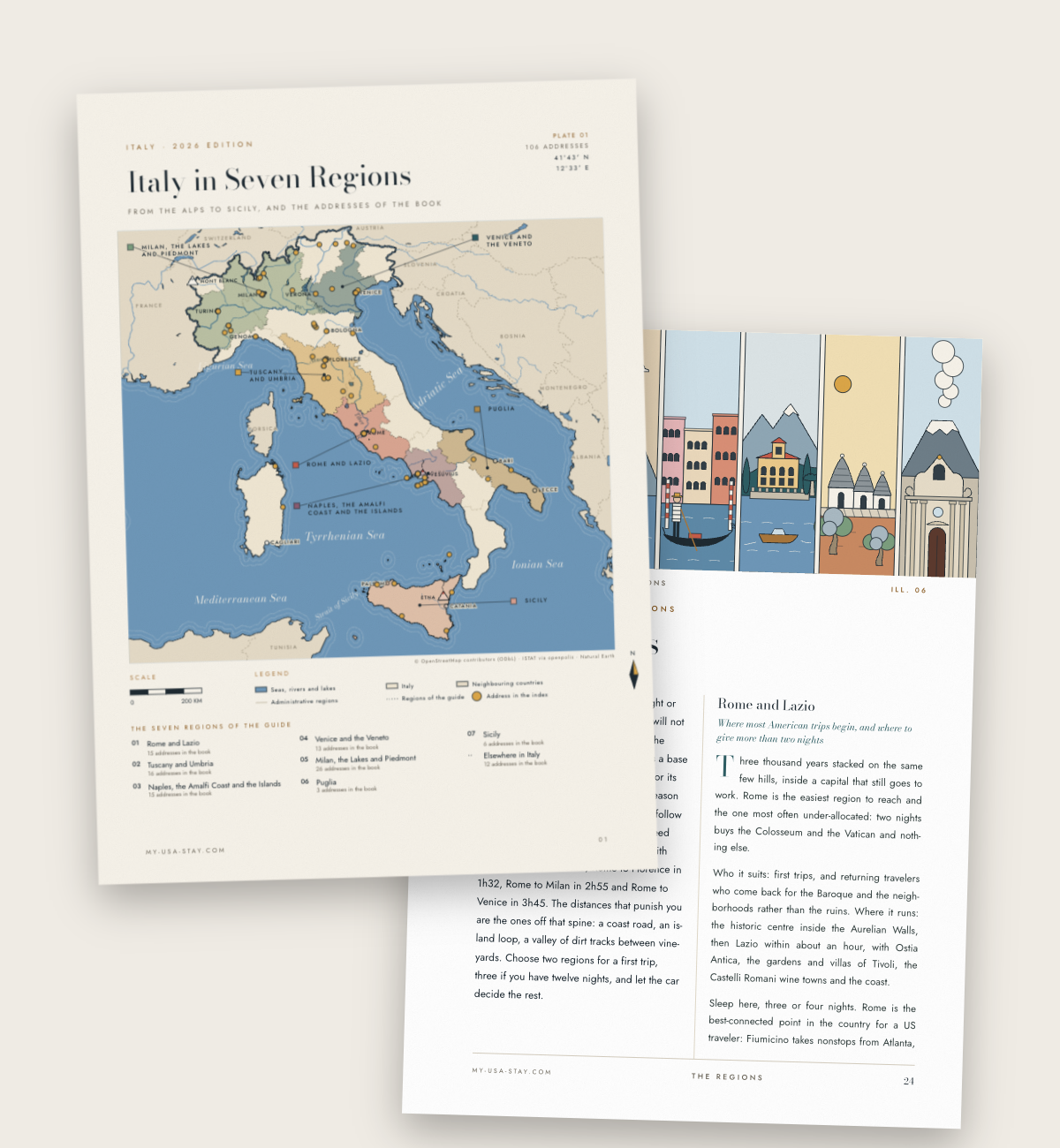
Italy is twenty regions that were separate states until 1861, and the eight or nine nights most American trips allow will not cover it. The guide works from seven: Rome and Lazio, Tuscany and Umbria, Naples with the Amalfi Coast and the islands, Venice and the Veneto, Milan with the Lakes and Piedmont, Puglia, and Sicily. Each one is a base you can settle into, with its own airport or its own train, its own season and its own reason to stay.
The addresses are spread as they really are. Milan, the Lakes and Piedmont hold 26 of them, Tuscany and Umbria 16, Rome and Naples 15 each, Venice 13, Sicily 6 and Puglia 3. Twelve more sit outside the seven regions, from Osteria Francescana in Modena to a cove in Sardinia reachable only on foot or by boat. Its advice: two regions for a first trip, three with twelve nights.
Twenty-one maps on a single base map
Every map in the guide is the same drawing of Italy: same extent, same scale, same coastlines, same place names, repeated identically plate after plate. Only the addresses lit in gold change, numbered as in the index. One map shows the whole book, one covers each of the seven regions, and one each chapter of addresses.
Every address says why it is here
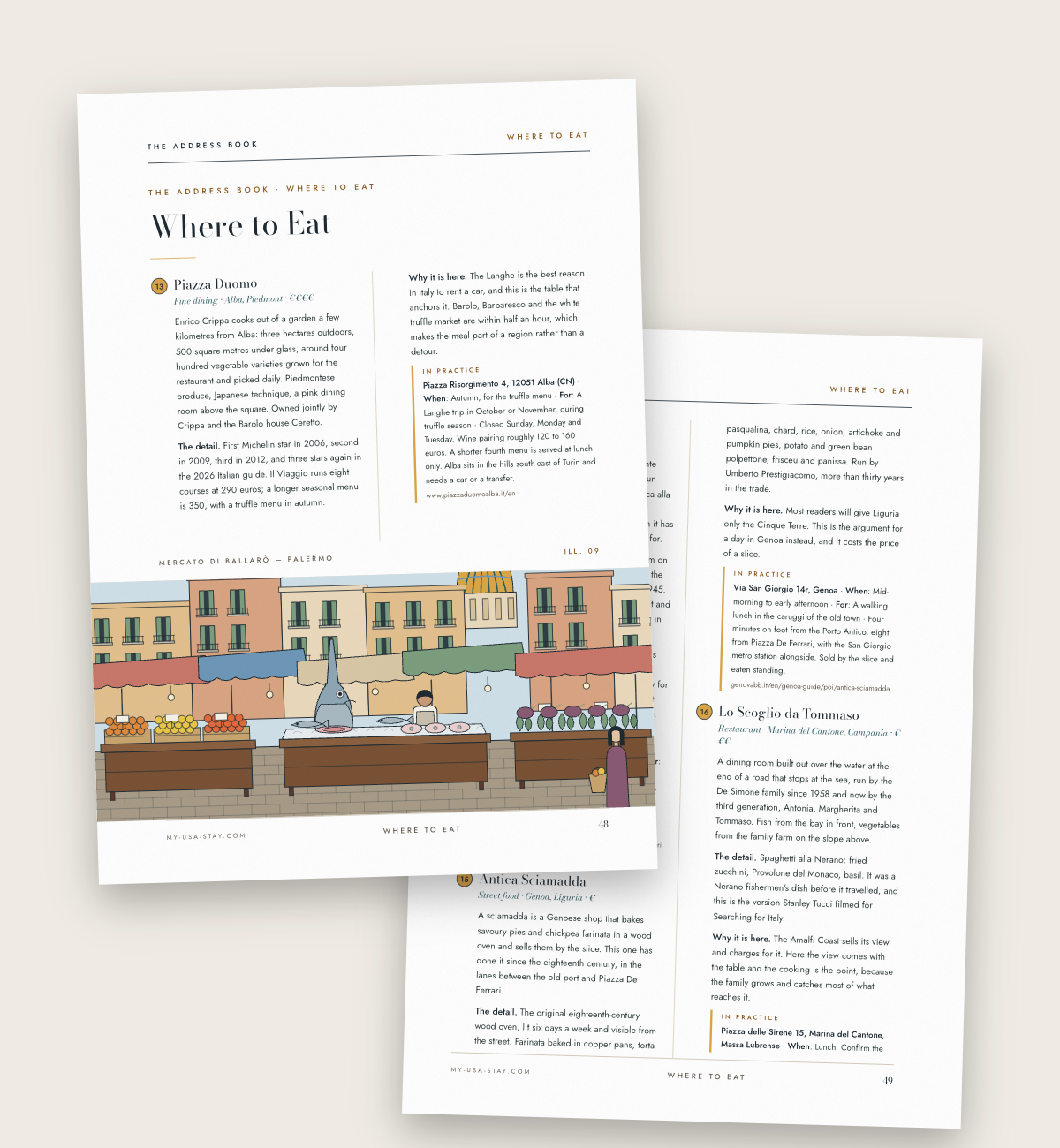
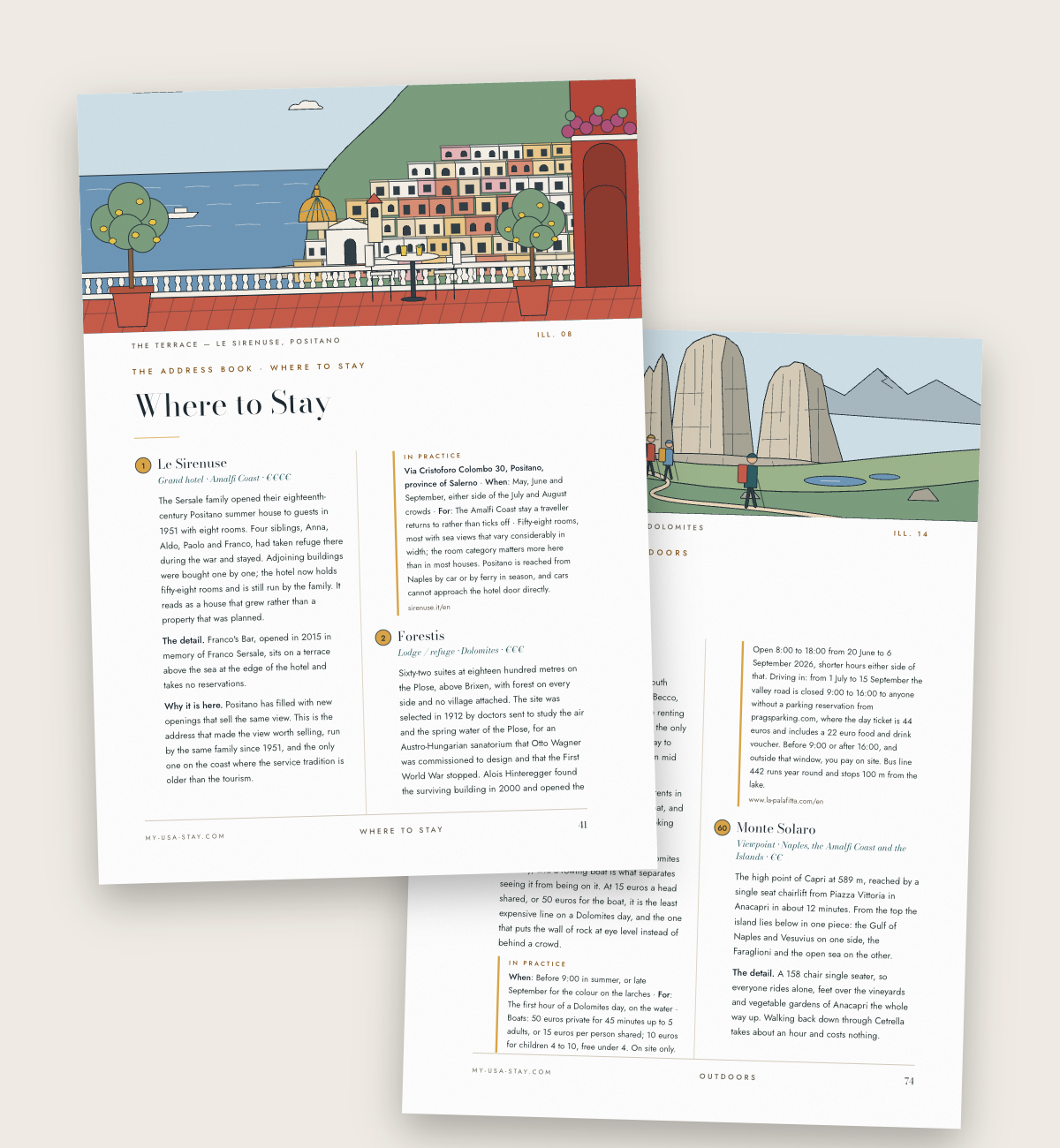
Each entry carries its number, its category, its region, a detail that sets it apart and a line that says why it is in the guide, then a practical block: where, when, for whom. Le Sirenuse is address number one. The Sersale family opened their Positano summer house to guests in 1951 with eight rooms; it now has fifty-eight and the family still runs it. It is there because Positano has filled with new openings that sell the same view, and this is the house that made the view worth selling.
Antica Sciamadda is there for the opposite reason: a Genoese shop selling savoury pies and chickpea farinata by the slice, eaten standing. The guide's argument is that most readers give Liguria only the Cinque Terre, and that a day in Genoa costs the price of a slice.
Three itineraries, from four nights to fourteen
Fewer bases, longer stays, the train whenever it exists, and a first day written as a jet-lag day.
Four nights in Rome, one city and no transfers. Day three is the one to book first: the Galleria Borghese admits visitors in two-hour slots capped at 180 people, and reservation is mandatory for every ticket.
Nine nights in Rome, Florence and the Tuscan countryside, the average American trip spent on two bases and a car. The car is picked up outside the walls, because around 300 Italian towns run a limited traffic zone filmed by cameras, with fines that can arrive up to 360 days later.
Fourteen nights from Venice to the Amalfi Coast, April to October, flying into Venice and out of Naples, with no stop shorter than three nights.
Written for a reader coming from the United States
The guide is in English and it starts from where our readers start. The practical chapters say what to settle before leaving: a US passport covers stays of up to 90 days in any 180-day period across the Schengen Area, the EU Entry/Exit System now records a photo and fingerprints at the first border, and ETIAS is not yet in operation. Facts were checked in September 2026.
It also explains the coperto on the bill, which is a cover charge and not a tip, and why every hotel asks for your passport at check-in.
When to read it
Before booking rather than after. The Amalfi Coast opens at Easter and closes in early November, the grand houses on Lake Como are shut until March, and much of the country closes its own restaurants around Ferragosto in August. The guide dates what can be dated so that a trip can be built around the calendar instead of against it. The guide's page gives access to the download. It opens in the browser, and it is free.