The best time to visit the United Kingdom is mid-May to mid-June, when London averages a high of 65 to 71°F (18 to 22°C), gardens are at their peak and the day in Edinburgh runs past 16 hours. September is the quieter twin: warm sea, thin crowds, lower rates. Avoid Edinburgh in August unless you want the Fringe, and think hard about late November to January, when the sun sets in Scotland before 3:40 p.m. Rain is not the problem Americans expect: London records 24.2 inches a year, half of New York. Start with our hotel guides.
The short answer
- Best overall: mid-May to mid-June, for long days, dry ground and gardens in flower.
- Best value: September and early October, when the sea off the south coast is still 62 to 64°F and school traffic has stopped.
- Warmest: July, with a London average high of 75°F (23.9°C) and 206 hours of sunshine.
- Wettest month in London: November, at 2.6 inches. The wettest place is Wales, not England.
- Longest day: around 21 June, 17 hours 37 minutes in Edinburgh and 16 hours 39 minutes in London.
- Shortest day: around 21 December, 6 hours 58 minutes in Edinburgh. Sunset is at 3:40 p.m.
- Period to plan around: 7 to 31 August in Edinburgh, when the Fringe fills every bed in the city.
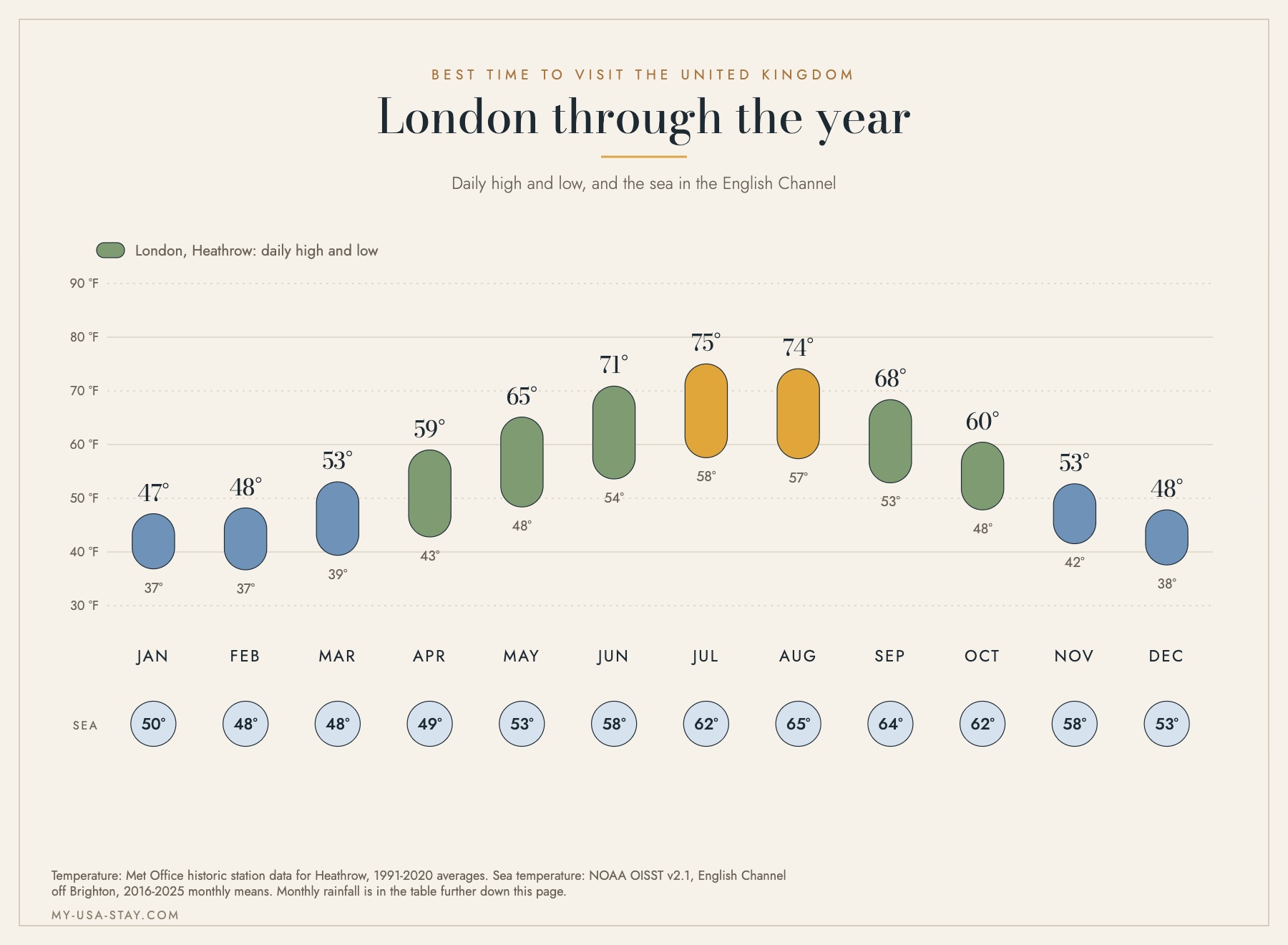
London runs from a 47°F high in January to 75°F in July, and the Channel peaks at 65°F in August.
Understanding the climate in the United Kingdom
Britain has a maritime climate with a narrow temperature range and a wide rainfall range: the difference between two British cities is almost always about water, not heat. The Met Office publishes 30-year averages for individual stations, and the numbers below are its 1991-2020 figures.
London, measured at Heathrow, is the warmest and by far the driest of the big cities: a July high of 75°F (23.9°C), a January high of 47°F (8.4°C) and 24.2 inches of rain a year. Cardiff, 130 miles west, shares almost the same temperatures, a July high of 67°F (19.4°C), but collects 47.3 inches of rain at its Bute Park station, roughly double London. That is the real geography of British weather: the Atlantic dumps on the western hills first, and the eastern half of the island stays in the rain shadow.
Scotland is cooler but not wetter on the side most visitors reach. Edinburgh averages a July high of 64°F (17.7°C) and a January high of 43°F (5.9°C), and the nearest long-running east coast station, Leuchars in Fife, records only 28.1 inches of rain a year. The west is a different story: Paisley, beside Glasgow, collects close to 48 inches.
Cornwall is the mild outlier. At Camborne, the January average high is 49°F (9.2°C) with an overnight low of 41°F, warmer in midwinter than Edinburgh is in April. It is also the one corner of Britain where subtropical gardens survive outdoors. The trade is rain, 42.4 inches a year, and wind off the Atlantic.
Altitude matters more than latitude above the valley floor: the Cairngorms, Snowdonia and the Lake District hold snow long after the towns below them are green.
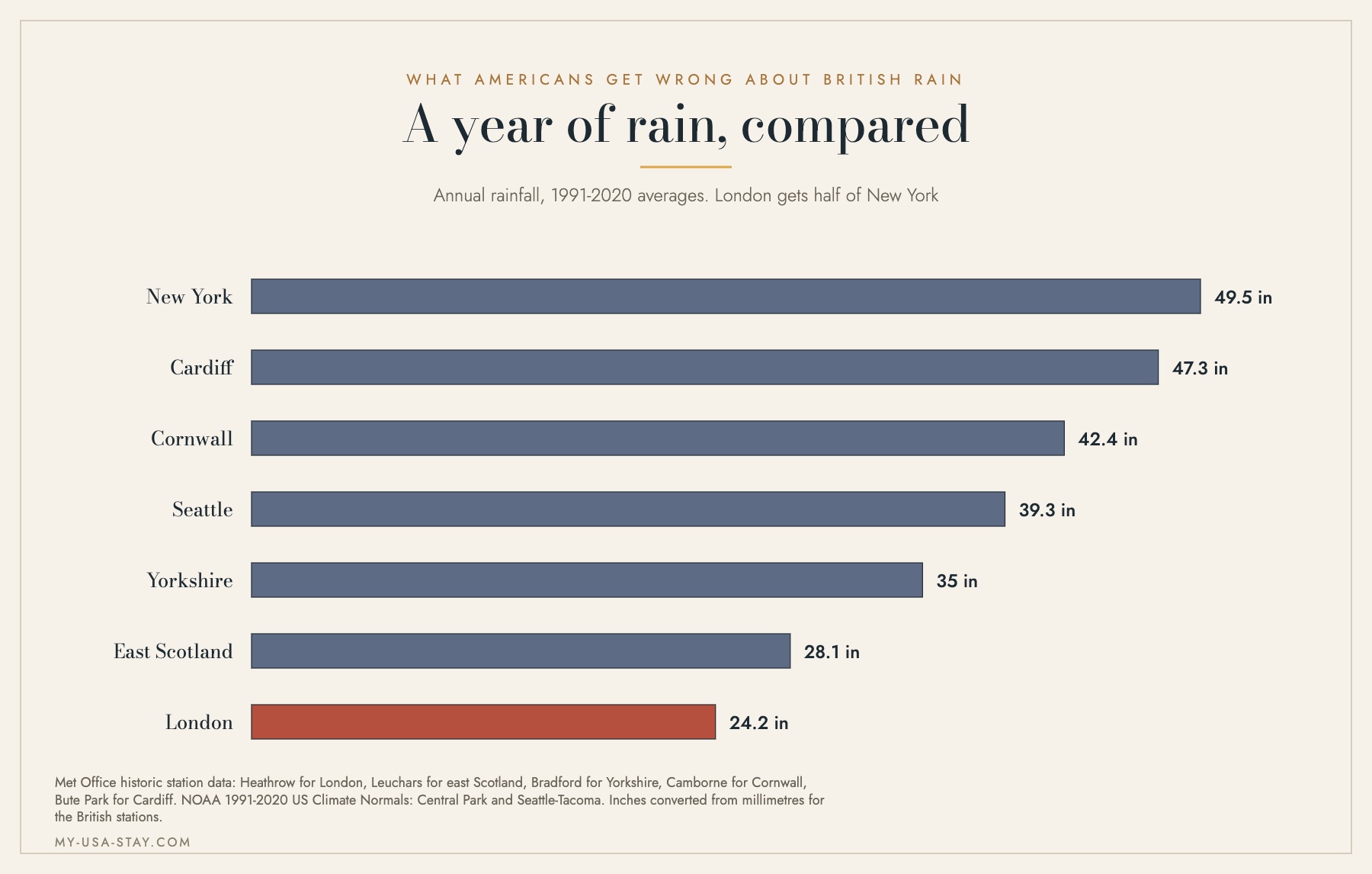
London takes 24.2 inches of rain a year, half of New York and well under Seattle.
How wet is Britain, really
Less than you have been told, and more often. London Heathrow records 24.2 inches of rain a year against 49.5 inches at New York Central Park and 39.3 inches at Seattle-Tacoma, on the same 1991-2020 basis published by NOAA. Even Cardiff, one of the wettest British cities, sits below New York.
What is true is the frequency. Rain reaches London on roughly 125 days a year counting every day with a millimetre or more, according to ERA5 reanalysis, about one day in three. It arrives as showers that pass, not as the downpours of an American thunderstorm summer. Pack a light shell, not an umbrella, and do not rebuild your day around a forecast.
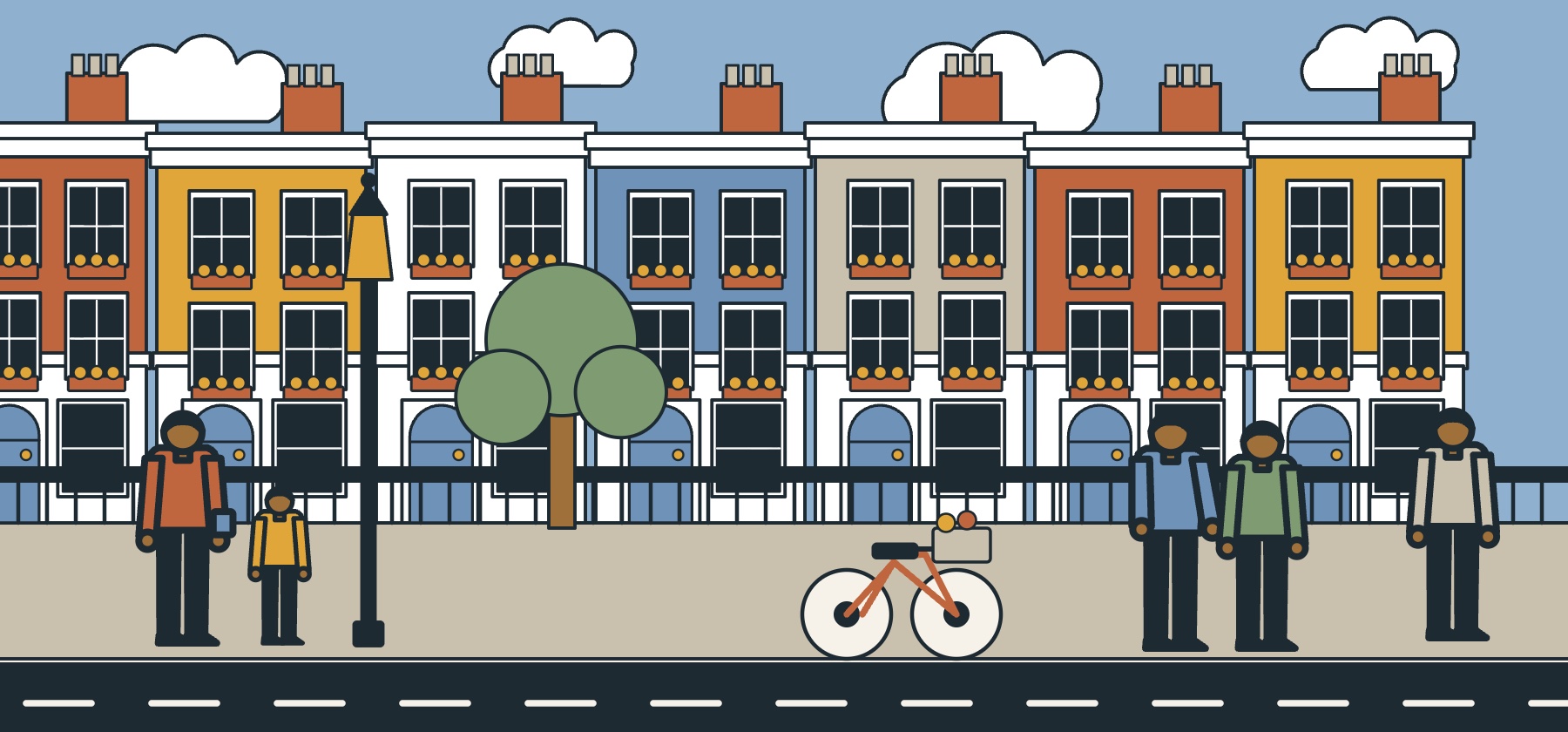
Notting Hill in spring, when London gains almost two hours of daylight a month. Illustration: my-usa-stay.com.
How long the day lasts, and why it decides your trip
Daylight, not temperature, is what separates a good British trip from a frustrating one, and almost no guide gives you the number. Britain sits between 50 and 59 degrees north, further north than every one of the lower 48 states. London is level with Calgary. Edinburgh is level with Ketchikan, Alaska.
The swing is extreme. On the 15th of June, Edinburgh gets 17 hours 34 minutes between sunrise and sunset. On the 15th of December, it gets 7 hours 01 minutes. That is a ten and a half hour difference in the same city. London swings from 16 hours 37 minutes to 7 hours 52 minutes. Inverness, at the top of the Great Glen, ranges from 17 hours 59 minutes down to 6 hours 39 minutes.
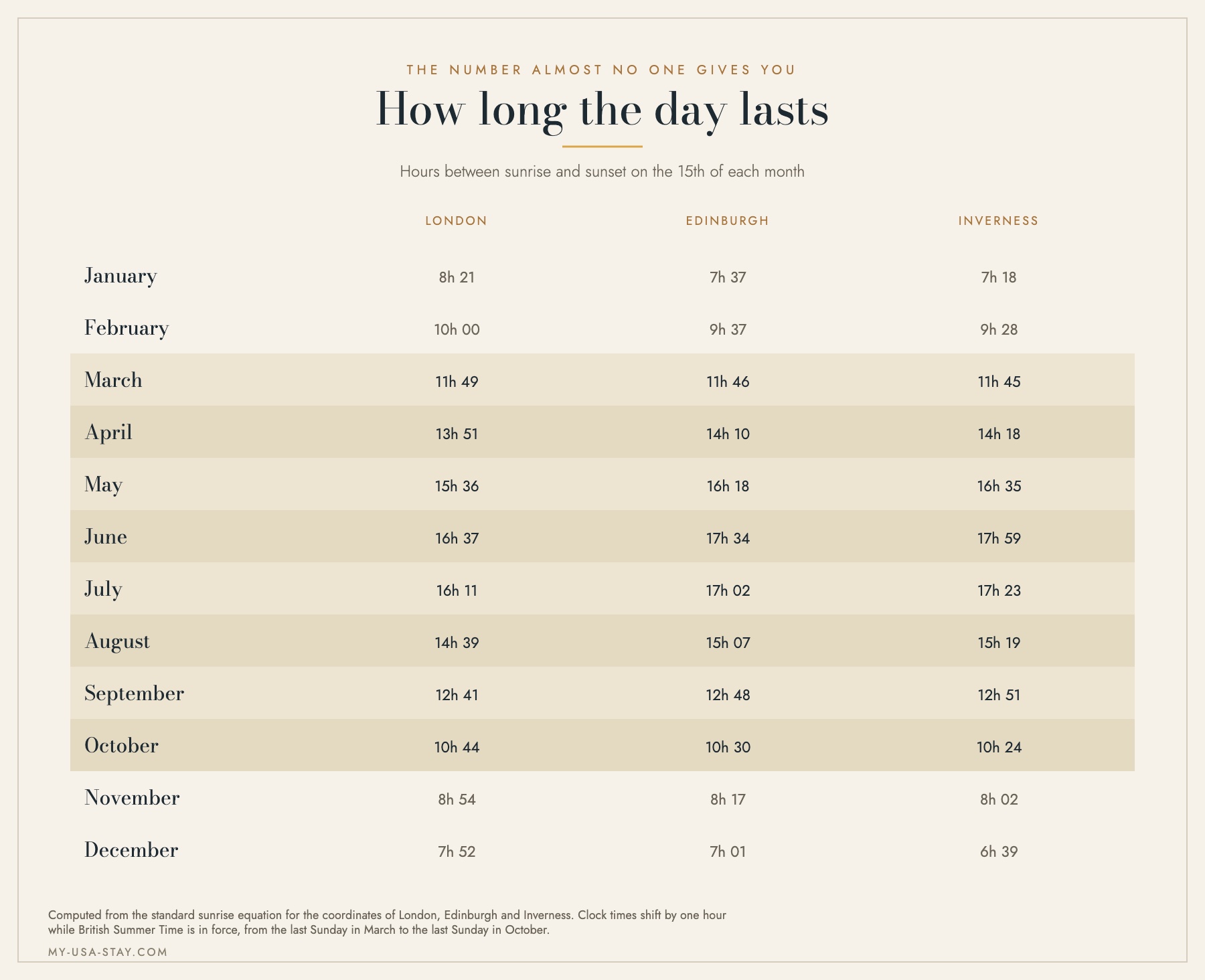
The number that decides a British itinerary: Edinburgh swings from 17h34 in June to 7h01 in December.
In late June the Scottish sky never goes properly dark. On the solstice in Edinburgh, the sun sets at 10:03 p.m. British Summer Time and rises at 4:26 a.m., and in between it stays close enough to the horizon that true night never arrives: civil twilight alone runs to about 11:05 p.m. and starts again around 3:24 a.m. You can read a map outdoors at midnight in the Highlands in June. You also cannot see the northern lights, or many stars at all, until late August.
The winter version of the same fact is brutal for sightseeing. In December an Edinburgh day starts at 8:42 a.m. and ends at 3:40 p.m. Two castle visits and a museum will use all the daylight you have. If your itinerary depends on driving between places and looking at landscape, December to early February in Scotland is a much smaller trip than the same route in May.
Spring: March to May
Spring is when Britain gains daylight faster than almost anywhere Americans travel: London goes from 8 hours 21 minutes in mid-January to 15 hours 36 minutes in mid-May. March is still cold, with a London high of 53°F (11.7°C), but sunshine more than doubles from February, 120 hours against 76.
April and May are the driest stretch of the London year, 1.7 and 1.8 inches respectively, and May delivers 197 hours of sun, as much as June. Gardens are the reason to come now. Bluebell woods peak across southern England from late April into early May, the Cotswolds and the Chilterns are green before the coach tours arrive, and daffodils run through the London parks from late February.
What to watch:
- Easter shifts the crowds. In 2027 Good Friday falls on 26 March and Easter Monday on 29 March, both bank holidays in England, Wales and Scotland.
- The clocks go forward on the last Sunday in March, which briefly narrows the gap with the US East Coast to four hours.
- Two May bank holidays, the first Monday and the last Monday, turn popular villages and the Lake District into weekend traffic.
- Sea temperature is still at its annual floor, 48 to 49°F in March and April. Coastal walking, not swimming.
Summer: June to August
June is the month most trips should be built around. London averages 71°F (19.7°C), the day runs over 16 hours, and the Scottish Highlands are still ahead of the school holidays. July is warmer, 75°F and 206 hours of sun, and August brings the warmest sea of the year, 65°F in the English Channel off Brighton.

Loch Ness and the Great Glen in late summer, when the heather turns and the midges fade. Illustration: my-usa-stay.com.
Crowds are the trade. The Office for National Statistics counted 10.3 million visits to Great Britain by overseas residents in the July to September quarter of 2024, against 7.2 million in January to March 2025: the summer quarter carries about 43 percent more visitors than the winter one. English schools break up in late July and go back in early September, while Scottish schools break earlier and return in mid-August, so the Highlands empty a fortnight before Cornwall does.
Precautions for a British summer:
- Midges. The Highland midge runs from late May to early September and peaks in July and August, on the west coast and in the Highlands, in still humid weather at dawn and dusk. The Scottish Midge Forecast tracks it daily. The east coast is largely free of them, and they cannot fly in a breeze.
- Air conditioning is rare. Most British hotels, trains and older buildings have none, because the climate historically did not need it. A 90°F week in London is genuinely uncomfortable indoors.
- Book early for July and August. Our note on locking down the right hotel before July fills up applies squarely to Britain.
- The last Monday in August is a bank holiday in England and Wales, 30 August 2027, and the single busiest travel weekend of the summer.
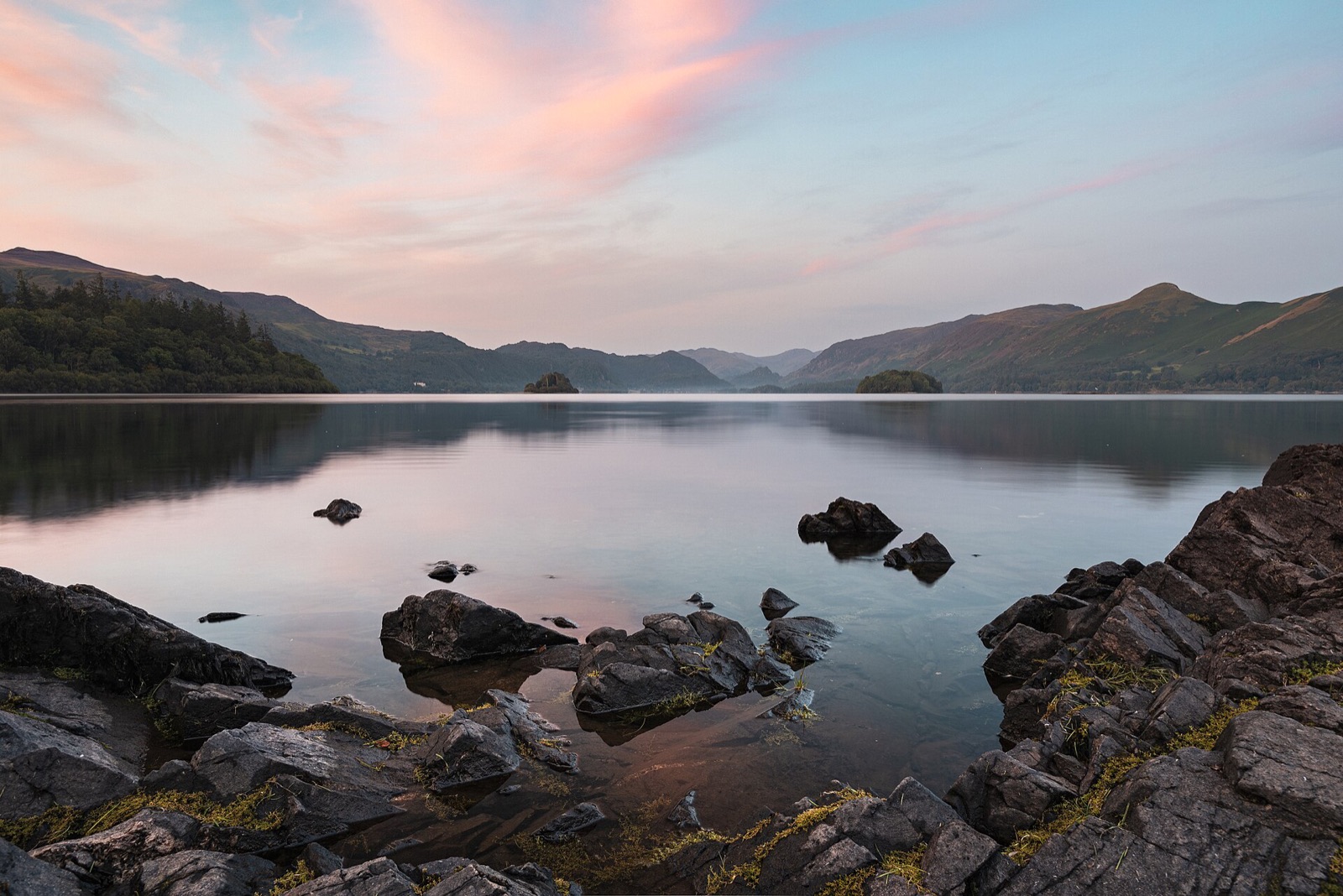
Derwentwater from Friars' Crag, Lake District: June and September are the walking months. Photo: Julian Herzog (Website), Wikimedia Commons, CC BY 4.0.

Autumn: September to November
September is the most underrated month in Britain and the one we would book if the trip has to earn its money. London still averages 68°F (20.2°C) with 150 hours of sun, the sea is at 64°F, warmer than it was in June, and the visitor peak has broken. The argument generalises, and we have made it before in our case for the shoulder season.
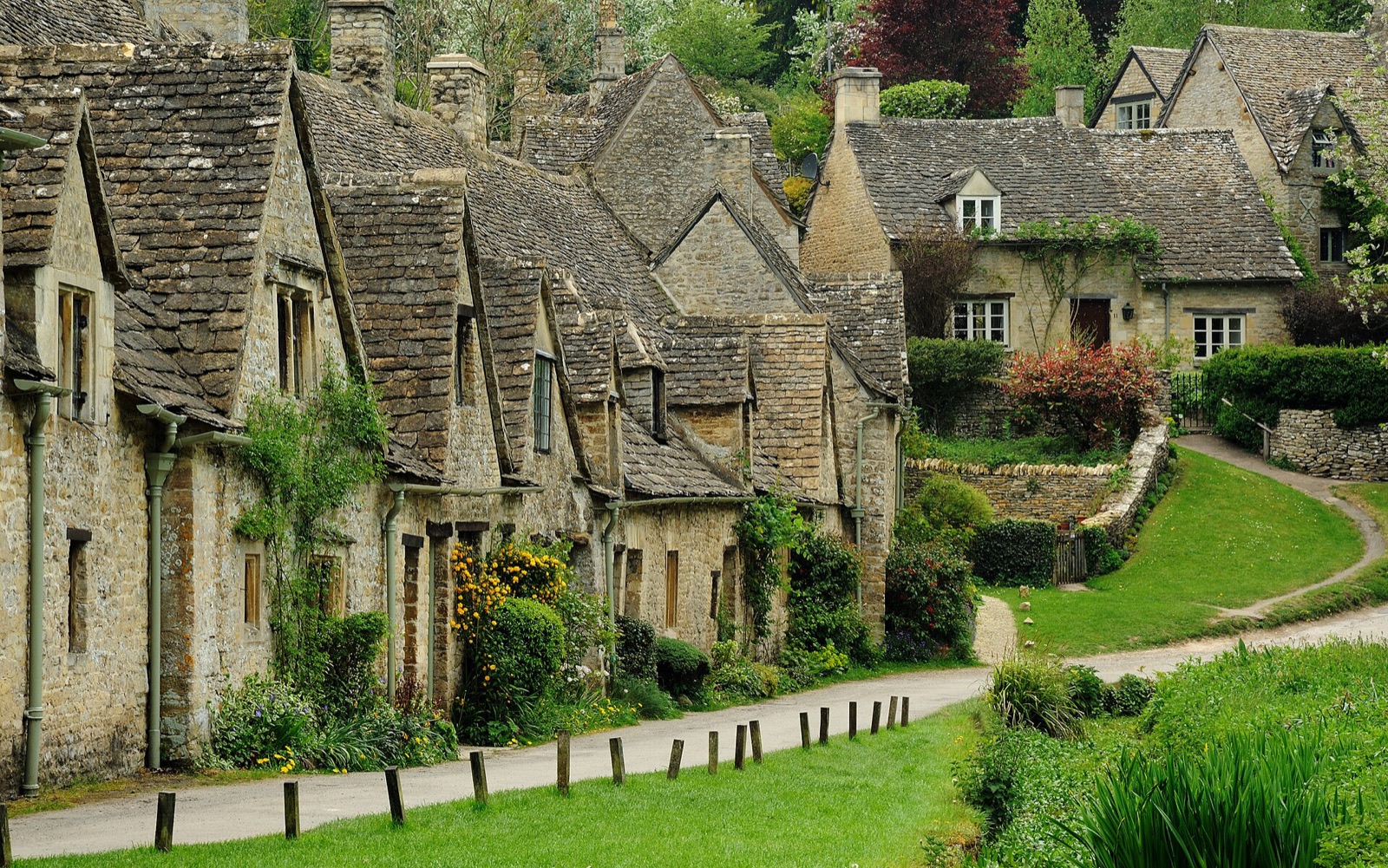
Arlington Row at Bibury, in the Cotswolds, at its best between late April and June. Photo: Saffron Blaze, Wikimedia Commons, CC BY-SA 3.0.

October turns. Daylight in London falls to 10 hours 44 minutes by mid-month, rain rises to 2.6 inches, and the clocks go back on the last Sunday of the month. It is the best month for colour in the Lake District, the New Forest and the Highlands. November is the darkest month with real weather: 68 hours of sunshine in the whole month, under three hours a day. Rates fall from mid-September outside half-term weeks, and unlike late December the country is still running normally.
Winter: December to February
Winter in Britain is mild and dark rather than cold. London averages a high of 48°F (8.8°C) in December and 47°F in January, and snow in the cities is unusual and short-lived. Cornwall is milder still, 49°F at Camborne in January. What you actually lose is light: 53 hours of sunshine in London across the whole of December, and an Edinburgh day of seven hours.
The Royal Mile in winter: mild, wet and dark by 3:40 p.m. Illustration: my-usa-stay.com.
The Christmas period has a trap that catches Americans every year. There are no National Rail trains anywhere in Britain on Christmas Day. On Boxing Day, 26 December, most operators also run nothing, with a very limited service from a handful including ScotRail, Southern, Chiltern and London Overground. Network Rail concentrates its major engineering closures across the same window, which routinely shuts main lines out of London and Glasgow for a week or more. Plan Christmas Day around walking distance, and check the route before booking a 27 December train.
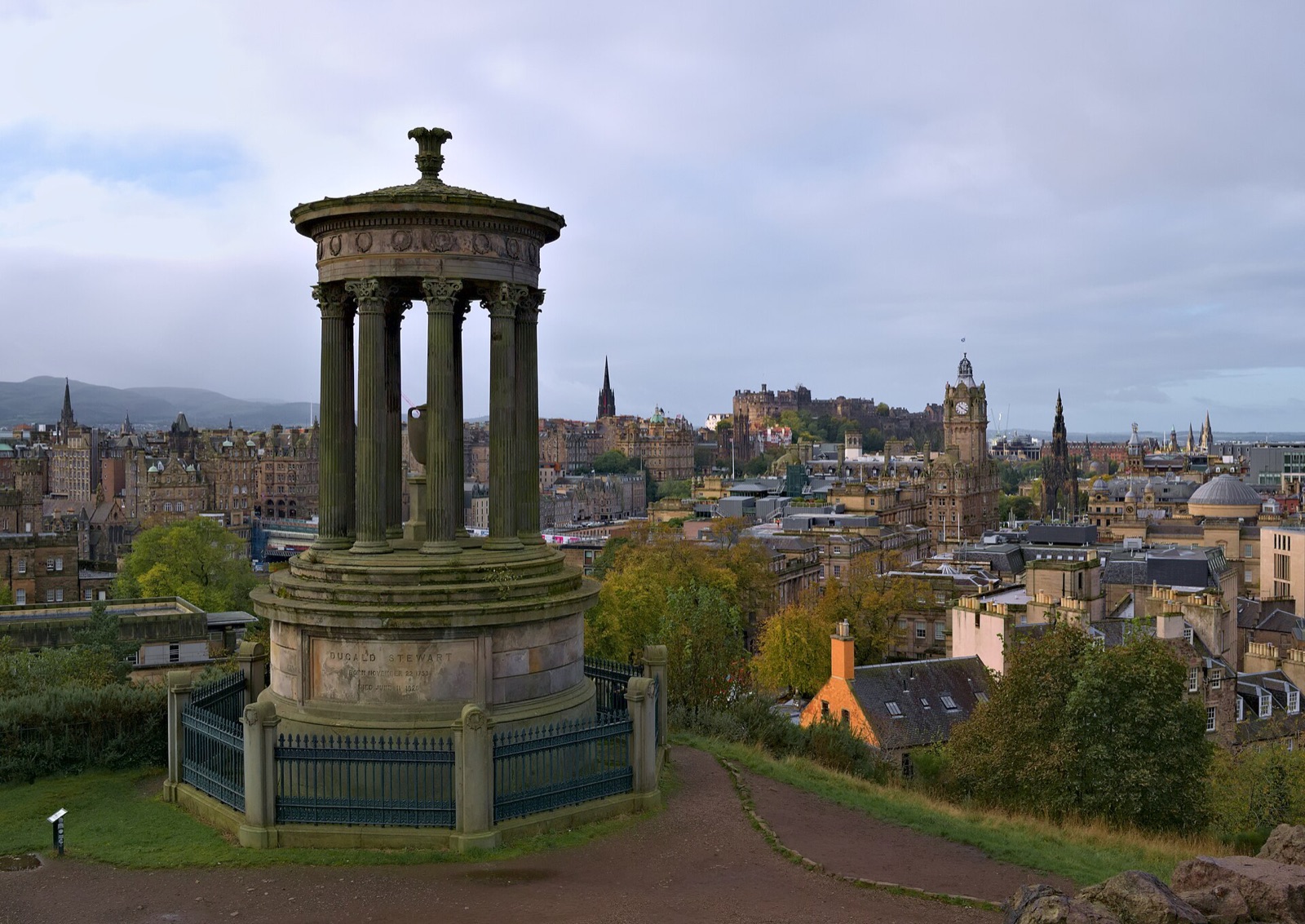
Edinburgh Old Town from Calton Hill, where a December day lasts seven hours. Photo: Daniel Kraft, Wikimedia Commons, CC BY-SA 3.0.

Against that, winter has two genuine arguments. Hotel rates are at their annual low from early January to mid-February, and Hogmanay in Edinburgh, on 30 December to 1 January, is the one night when the darkest week of the year works in your favour. Scotland also takes 2 January as a bank holiday, which England does not.
The United Kingdom month by month
| Month | London high / low | Rain | Sunshine | Daylight, London / Edinburgh | Sea, Channel | Verdict |
|---|---|---|---|---|---|---|
| January | 47 / 37°F (8 / 3°C) | 2.3 in | 59 h | 8h21 / 7h37 | 50°F | Dark, cheap, quiet |
| February | 48 / 37°F (9 / 3°C) | 1.8 in | 76 h | 10h00 / 9h37 | 48°F | Lowest rates, short days |
| March | 53 / 39°F (12 / 4°C) | 1.5 in | 120 h | 11h49 / 11h46 | 48°F | Driest month, cold |
| April | 59 / 43°F (15 / 6°C) | 1.7 in | 169 h | 13h51 / 14h10 | 49°F | Gardens, bluebells, Easter |
| May | 65 / 48°F (18 / 9°C) | 1.8 in | 197 h | 15h36 / 16h18 | 53°F | Best all-round month |
| June | 71 / 54°F (22 / 12°C) | 1.9 in | 197 h | 16h37 / 17h34 | 58°F | Longest days, midges start |
| July | 75 / 58°F (24 / 14°C) | 1.8 in | 206 h | 16h11 / 17h02 | 62°F | Warmest, busiest, priciest |
| August | 74 / 57°F (23 / 14°C) | 2.1 in | 192 h | 14h39 / 15h07 | 65°F | Warmest sea, Edinburgh full |
| September | 68 / 53°F (20 / 12°C) | 2.0 in | 150 h | 12h41 / 12h48 | 64°F | Best value, warm sea |
| October | 60 / 48°F (16 / 9°C) | 2.6 in | 110 h | 10h44 / 10h30 | 62°F | Autumn colour, light fading |
| November | 53 / 42°F (12 / 5°C) | 2.6 in | 68 h | 8h54 / 8h17 | 58°F | Darkest, wettest, cheapest |
| December | 48 / 38°F (9 / 3°C) | 2.2 in | 53 h | 7h52 / 7h01 | 53°F | Markets, then everything closes |
Temperature, rainfall and sunshine: Met Office historic station data for Heathrow, 1991-2020 averages. Daylight: computed from the sunrise equation for the coordinates of London and Edinburgh, on the 15th of each month. Sea temperature: NOAA OISST v2.1, English Channel off Brighton, 2016-2025 monthly means. Monthly visitor numbers are not shown because the Office for National Statistics suspended its monthly overseas travel series and now publishes quarterly estimates only.
The best time for what you want to do
The right month depends on what you came for, and the gap between the answers is several weeks.
- London and the big museums: any month. Interiors do not care about weather, and January and February give you the Tate, the British Museum and the National Gallery at their emptiest. See our Greater London hotels.
- Gardens and countryside: late April to early June. Chelsea is in late May, bluebells in late April, and the ground is dry enough to walk.
- Scottish Highlands and islands: May and September. May gives long days before the midges, September gives heather, stags and no crowds.
- Beaches and the Cornish coast: late July to mid-September, when the sea passes 62°F. It never gets warm by Florida standards.
- Hiking the Lake District or Snowdonia: June and September. Avoid February, when eight hours of daylight makes a long route unsafe.
- Festivals and theatre: August in Edinburgh, or any month in London's West End.
- Traveling with children: late June, before American and British school holidays collide. Our guide to hotels that genuinely understand families is a good starting point.
- Lowest prices: mid-January to mid-March, excluding the February half-term week.
Events that shape the year
A handful of fixed events move prices and availability far more than weather does.
- RHS Chelsea Flower Show, London: 18 to 22 May 2027, with public days from 20 to 22 May. Central London hotels tighten for the week.
- Wimbledon: 28 June to 11 July 2027, the 150th Championships. Southwest London fills, and the public queue is still the only way in without a ballot ticket.
- Edinburgh Festival Fringe: 6 to 30 August 2027, the 80th edition. The 2026 Fringe carried more than 4,200 shows from 74 countries and issued over 2.8 million tickets in a city of half a million people. Rooms go on sale a year ahead and rates rise sharply.
- Royal Edinburgh Military Tattoo: 6 to 28 August 2027, on the Castle Esplanade, overlapping the Fringe.
- Notting Hill Carnival, London: the August bank holiday weekend, 29 and 30 August 2027. The parade is free and West London transport is heavily restricted.
- Hogmanay, Edinburgh: 30 December to 1 January, the only time Scotland's shortest days fill the city.
- Bank holidays 2027: 1 January, 26 and 29 March, 3 May, 31 May, 30 August, 27 and 28 December in England and Wales. Scotland differs: 4 January instead of Easter Monday, its summer holiday on 2 August rather than late August, and St Andrew's Day on 30 November.
One newer cost to budget for: from 24 July 2026, Edinburgh charges a visitor levy of 5 percent of the accommodation price before VAT, capped at five consecutive nights. It is the first city-wide scheme of its kind in the UK, and it applies whether you booked through a hotel or a short-let.
Where to go, and when
The United Kingdom is small enough to cross in a day and varied enough that the best month changes with the region. Our United Kingdom hotel guide is organised the same way.
London and the southeast
The warmest, driest and most weatherproof part of the country, and the one that works in every month. London takes 24.2 inches of rain a year and has enough indoor capacity that a wet week costs you nothing. January and February are the value months; May and September are the pleasant ones. Browse Greater London and the wider England selection.
The West Country and Cornwall
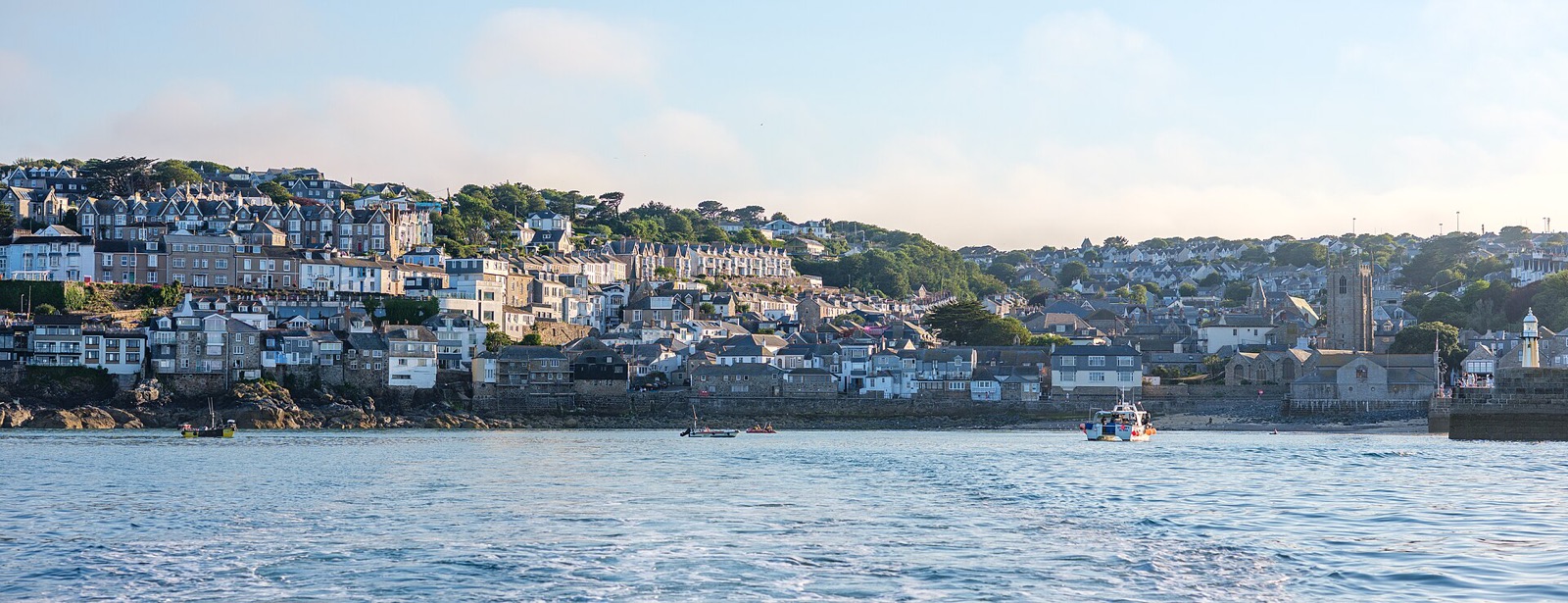
St Ives in Cornwall, where January is milder than March in most of Britain. Photo: ArildV, Wikimedia Commons, CC BY-SA 4.0.

Mildest winter in Britain, best beaches, worst August traffic. Camborne's January high of 49°F is warmer than most of the country manages in March, which is why Cornish gardens open in February. The peninsula has one main road, and it jams from mid-July to the end of August. Come in late May, or in late September when the sea is still 62°F. Our guide to staying on the Cornish coast covers the base most Americans pick.
Bath, the Cotswolds and the heritage towns
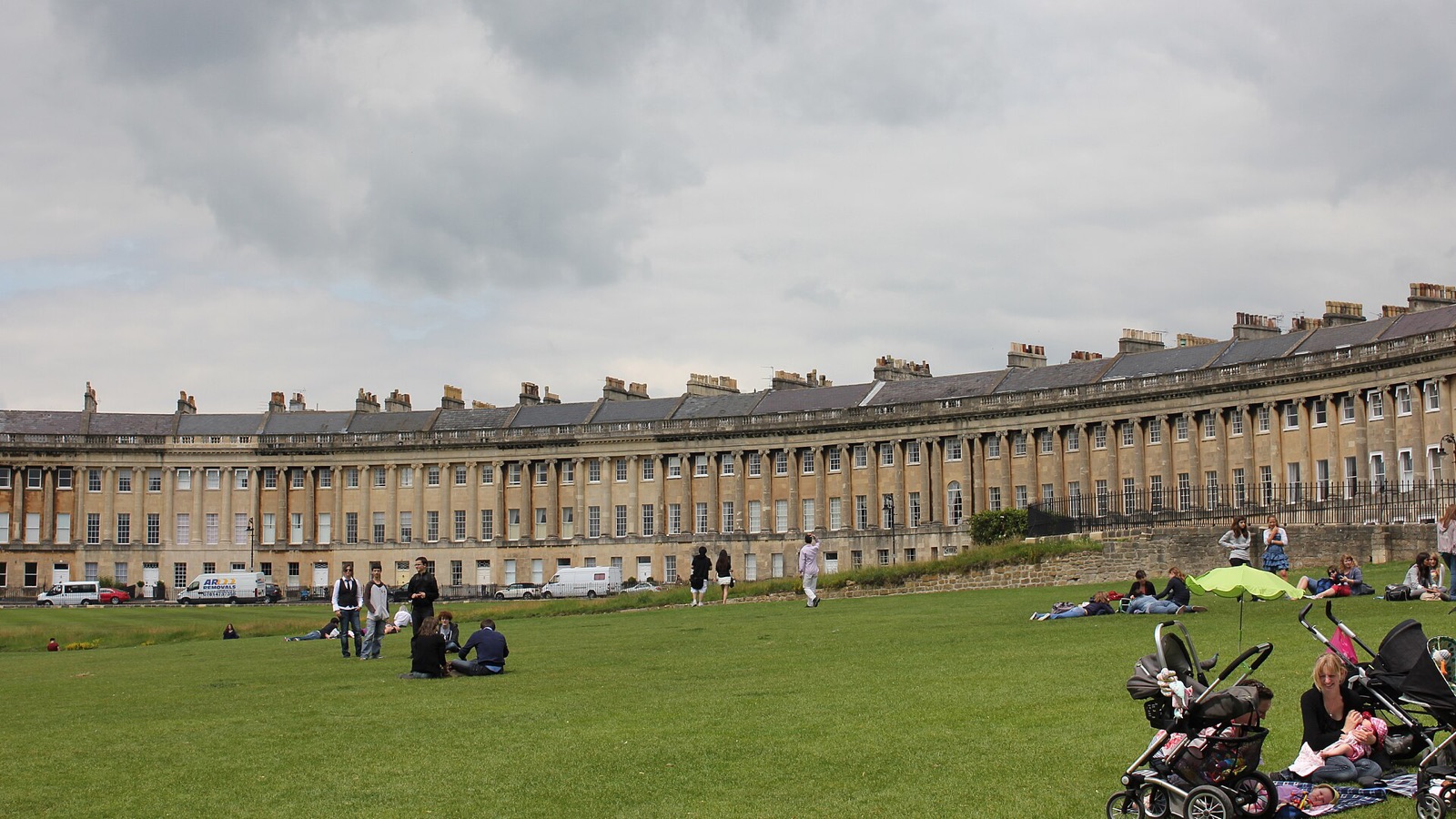
The Royal Crescent in Bath, a walking town that needs the long days of May and June. Photo: Perituss, Wikimedia Commons, CC0.

Georgian Bath, Oxford, York and the Cotswold villages are the classic first trip, and they are at their best between late April and June, when the stone is warm and the coach season has not peaked. These are walking towns, so daylight matters: in December you get four usable sightseeing hours.
The North of England
The Lake District, the Yorkshire Dales and the Northumberland coast. Rainfall at Bradford runs to 35 inches a year, between London and Cardiff, and the fells collect far more. June and September are the walking months. October gives the colour.
Scotland
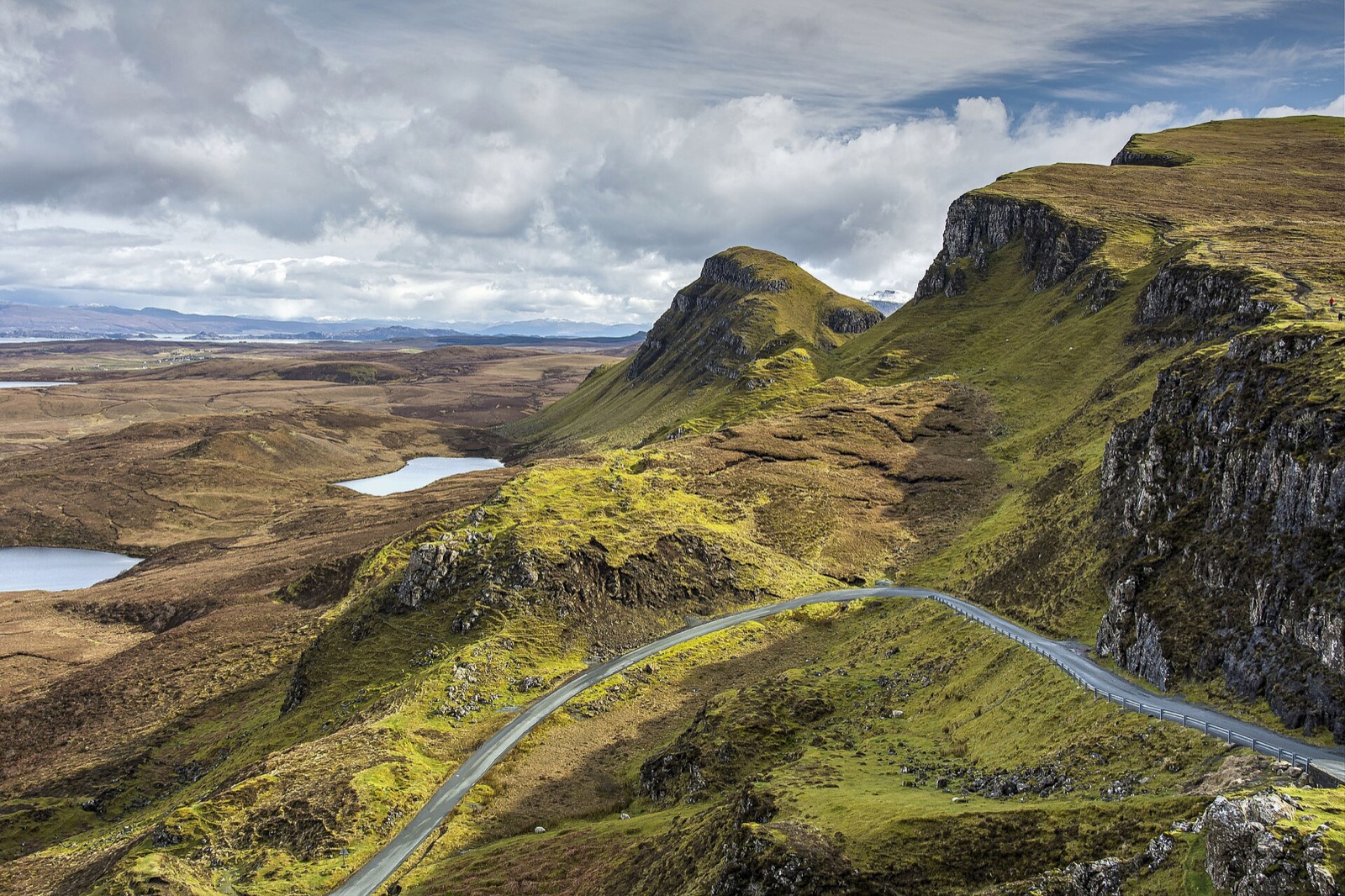
The Quiraing on Skye: almost 17 hours of light in June, barely seven in December. Photo: MPerkowski, Wikimedia Commons, CC BY-SA 4.0.

The strongest seasonal case in Britain, and the strongest argument for reading the daylight table before booking. May and early June deliver almost 17 hours of light, dry ground and no midges. September delivers heather, stags and quiet roads. Edinburgh in August is a different trip entirely, worth doing on purpose and worth avoiding by accident.
Wales and the Irish option
Cardiff records 47.3 inches of rain a year, and Snowdonia considerably more, so Wales rewards May and June more than any other region. Many American itineraries pair Britain with Ireland, which runs on the same seasonal logic: see our Ireland hotels and the Wild Atlantic Way.
Getting there from the United States
Britain is the easiest transatlantic trip an American can make, and the practical details have changed recently enough that old advice is wrong.
Flights. Nonstop service from the East Coast runs about seven hours eastbound and eight westbound, because the jet stream helps you out and fights you home. From the West Coast, expect ten to eleven hours. Beyond Heathrow and Gatwick there is nonstop service from the US to Manchester and Edinburgh, worth checking if Scotland or the north is your real destination.
Time difference. London is normally five hours ahead of New York and eight ahead of Los Angeles. The exception matters for connections: the UK changes its clocks on the last Sunday in March and the last Sunday in October, while the US changes on the second Sunday in March and the first Sunday in November. For about three weeks in March and one week around the end of October, the gap is four hours rather than five.
Entry requirements. US citizens do not need a visa for tourism, but since 25 February 2026 the UK requires an Electronic Travel Authorisation before you board. It costs 16 pounds through the official GOV.UK route, allows multiple journeys, and lasts two years or until your passport expires. Most applications are decided automatically within minutes, but the Home Office advises allowing three working days. An ETA permits stays of up to six months and does not guarantee entry. Apply on gov.uk, never through a third-party site charging a markup. Check the State Department country page before you travel for anything that has changed since.
One thing that surprises people. A British hotel room is smaller than its American equivalent at the same price, lifts are rare in historic buildings and air conditioning is the exception, so budget by room rather than by star rating. If you are pairing Britain with the continent, the Eurostar puts Paris two and a half hours from St Pancras: see our France hotels.
FAQ
What is the best month to visit the United Kingdom?
May is the best single month. London averages a high of 65°F with 197 hours of sunshine and only 1.8 inches of rain, the day already runs over 15 hours, and gardens are at their peak. June is warmer at 71°F with even longer days, but prices climb once schools break up in July.
What is the cheapest time to visit the UK?
Mid-January to mid-March is cheapest, excluding the February school half-term week. Airfares and hotel rates are at their annual low, museums are empty and London still averages 47 to 53°F. The cost is daylight: you get eight to eleven hours, and Scotland gets less.
What is the rainiest month in England?
October and November are the wettest months in London, both around 2.6 inches, and March is the driest at 1.5 inches, on Met Office 1991-2020 averages at Heathrow. Annual rainfall in London is 24.2 inches, roughly half New York's 49.5 inches, so the reputation exceeds the reality.
Is August a good time to visit the UK?
August is good for the coast and difficult for Edinburgh. The English Channel reaches 65°F, its warmest of the year, and London averages 74°F. But the Edinburgh Fringe runs through the month with over 2.8 million tickets issued, filling the city's beds, and English school holidays put the country at peak crowding.
How many days do you need in the United Kingdom?
Ten days covers London plus one region properly. Seven days is enough for London and a two-night trip to Bath, Oxford or the Cotswolds. Adding Scotland realistically needs fourteen days, because Edinburgh is four and a half hours by train from London and the Highlands are another half day beyond it.
Which month has the best weather in the UK?
July has the best raw numbers: a London average high of 75°F and 206 hours of sunshine, the most of any month. May and June are close behind at 197 hours each with less rain and fewer people, which is why they usually make the better trip. Sunshine collapses to 53 hours in December.
What is the worst time to visit the United Kingdom?
Late November to early January, if sightseeing is the point. London gets 53 to 68 hours of sunshine a month and Edinburgh drops to a seven-hour day, sunset at 3:40 p.m. Add the Christmas rail shutdown, when no National Rail trains run at all on 25 December, and the country is hard to move around.
Do Americans need a visa for the UK?
No visa, but yes to an Electronic Travel Authorisation since 25 February 2026. The ETA costs 16 pounds on GOV.UK, covers multiple trips for two years or until your passport expires, and permits stays of up to six months. Most decisions arrive within minutes; the Home Office advises allowing three working days.
Read next
- Hotels in the United Kingdom, organised by nation and city.
- Where to stay in Greater London.
- Hotels across England, beyond the capital.
- The best time to visit the USA, for the trip in the other direction.
- Why the shoulder season delivers the trip you actually wanted.