The best time to visit Germany is late May to mid September, when Berlin averages a high of 72 to 76 °F (22 to 24 °C) and beer gardens, lake swimming and alpine trails are all open at once. The country is fullest in August, which booked 59.4 million hotel nights in 2025 against 25.9 million in January, according to the federal statistics office. September is the sweet spot: Oktoberfest, the Riesling harvest and warm afternoons, with fewer families on the road. Avoid November, the greyest and emptiest month of the year. More trip planning on my-usa-stay.com.
The short answer
- Best overall: late May, June and September, for long daylight, open terraces and moderate crowds.
- Best for Christmas markets: the last week of November through December 23, and not the week after Christmas.
- Busiest: July and August, with 56.7 and 59.4 million nights booked in 2025.
- Quietest and cheapest: January and February, at 25.9 and 26.9 million nights.
- Warmest city: Frankfurt, with an annual mean of 51.8 °F (11.0 °C) and 16.4 days a year above 86 °F.
- Sunniest city: Munich, at 1,842 hours of sunshine a year, against 1,617 in Hamburg.
- Entry: no visa for US passport holders for stays up to 90 days in any 180 day period. Browse where to stay in Germany before you lock the dates.
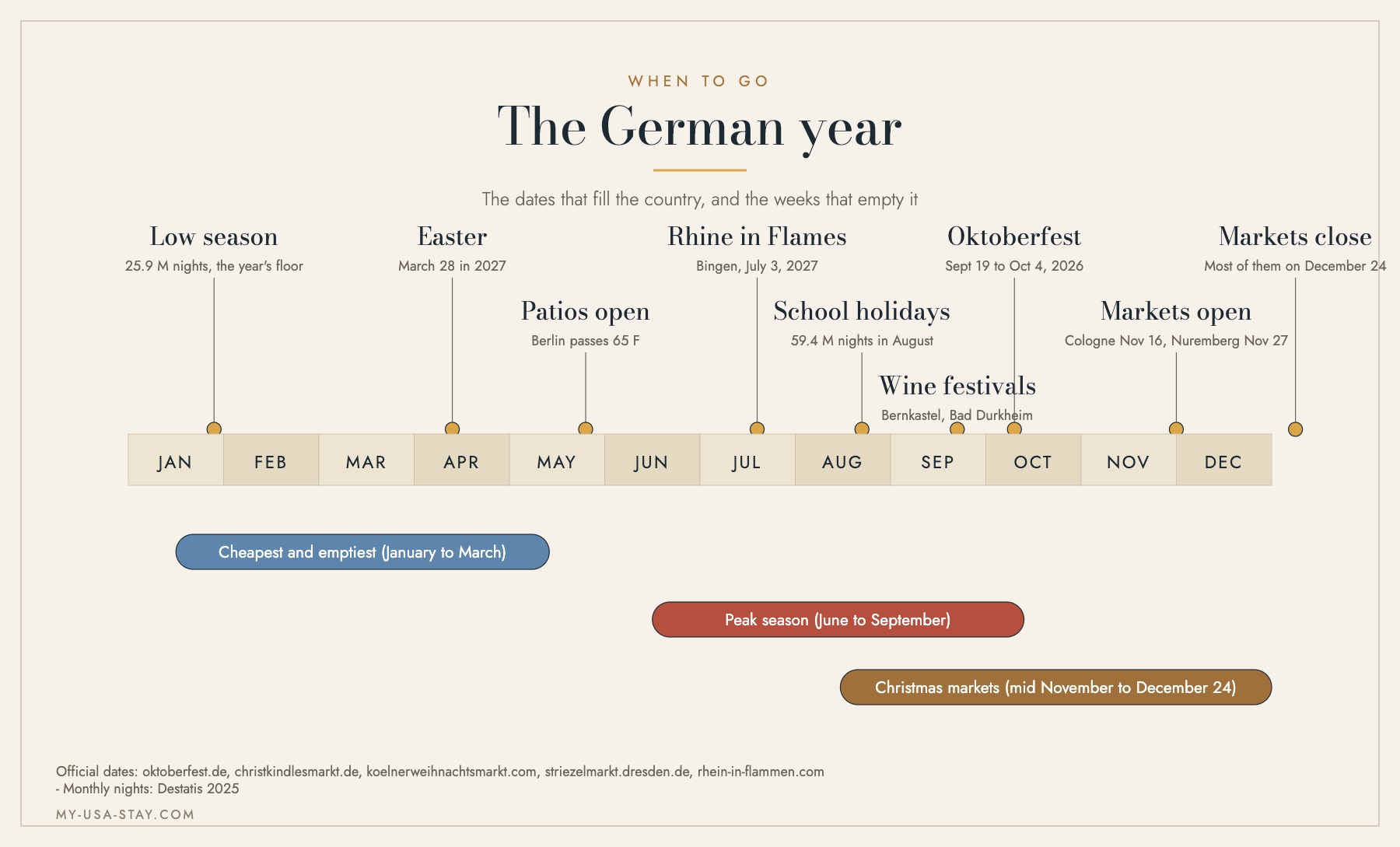
The German year at a glance: the dates that fill the country, and the weeks that empty it.
Understanding the climate in Germany
Germany has no single climate: the north is maritime, the south is continental, and the gap between them decides what you pack. The Deutscher Wetterdienst, the national weather service, publishes station normals for the period 1991 to 2020, and they put the annual mean at 51.8 °F (11.0 °C) in Frankfurt, 50.7 °F in Berlin, 50.2 °F in Munich and 49.3 °F in Hamburg. Two degrees does not sound like much. What it hides is a very different shape of year.
Hamburg, 60 miles from the North Sea, has the flattest year in the country. Its warmest month averages a high of 73 °F (22.6 °C) and its coldest a high of 39 °F, and it records only 5.9 days a year above 86 °F. Frankfurt, in the sheltered Rhine-Main basin, records 16.4 such days, almost three times as many, and 59.6 days a year above 77 °F. If you want heat in Germany you go to the Rhine valley, not to the coast.
Munich sits at 1,703 feet (519 m) on the edge of the Alps, and it breaks the rule that south means dry. The DWD station in the city centre records 939.7 mm of precipitation a year, against 572 mm in Berlin: Munich is the wettest big city in Germany, and its wettest months are June (120.9 mm) and July (118.9 mm), not the winter. Those are afternoon thunderstorms rolling off the Alps, usually short and violent. Munich also gets the most sunshine of any major German city, 1,841.5 hours a year. Wet and sunny are not contradictory here: they happen at different hours of the same day.
Berlin is the dry one, at 572 mm a year, and its sandy Brandenburg hinterland bakes in a hot August. The city still records 67.6 frost days a year, because nothing to the east blocks a cold snap.
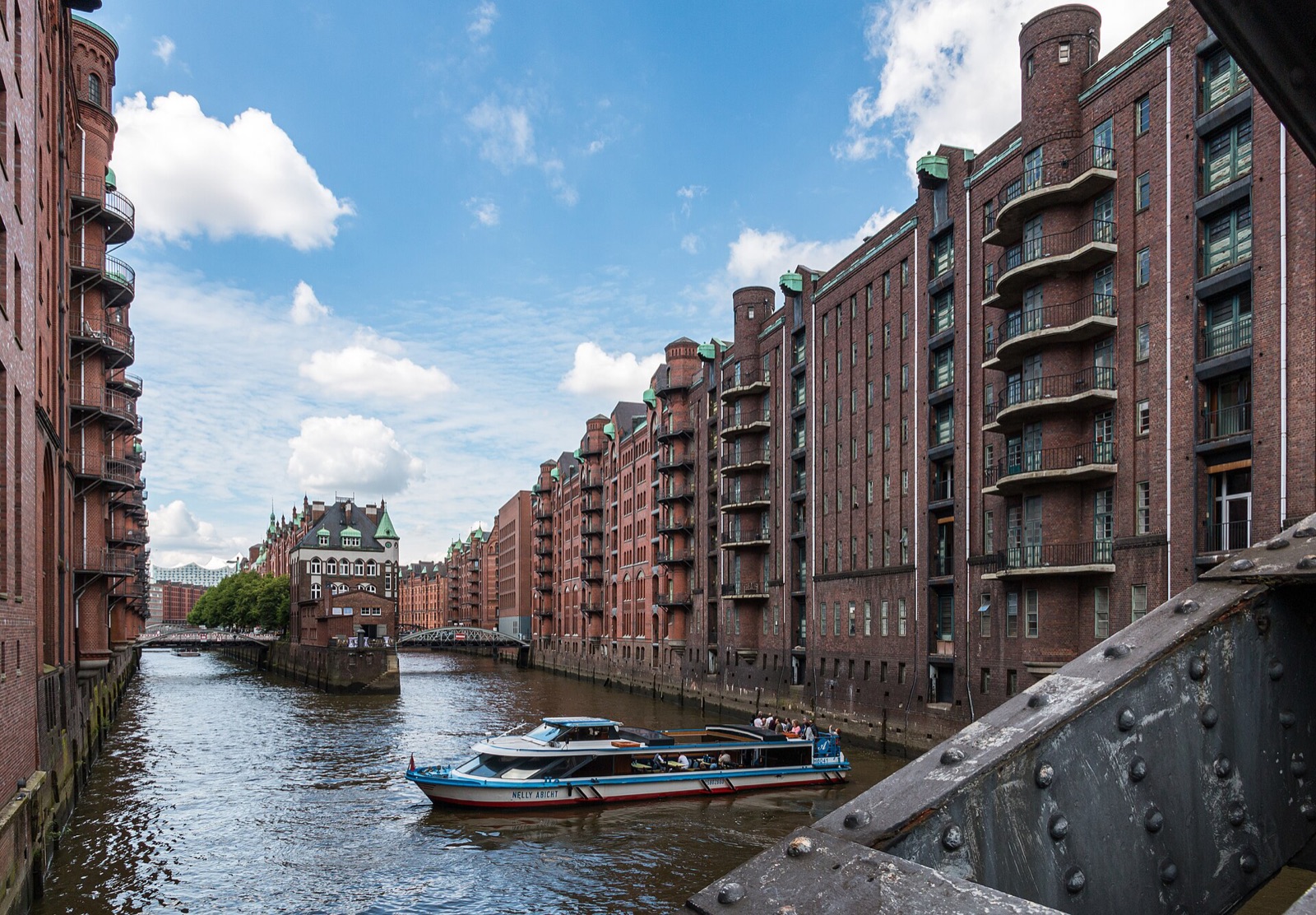
The Speicherstadt in Hamburg. The maritime north has the flattest year in Germany, and the least sunshine: 1,617 hours a year against 1,842 in Munich. Photo: Dietmar Rabich, Wikimedia Commons, CC BY-SA 4.0.

The one number that separates a good German winter trip from a miserable one is sunshine, and the north and south are not remotely equal. In December, Hamburg gets 36 hours of sunshine in the whole month, about an hour and ten minutes a day. Munich gets 66 hours, nearly double. Berlin and Frankfurt sit in between at 41 and 40 hours. If you are flying over in December for the markets and you care about seeing daylight, Bavaria and Saxony are the better bet than the Hanseatic north.
Spring in Germany: March to May
Spring is the fastest-moving season in Germany and the one that rewards flexibility. Berlin goes from an average high of 47 °F in March to 66 °F in May, a swing of nearly 20 degrees in ten weeks. March is still winter in practice: Berlin records 10.6 frost nights that month and Munich 9.4. April is the month of four seasons in one afternoon, with hail, sun and 60 °F in the same walk.
May is when the country turns on. Berlin averages 224 hours of sunshine that month, the second highest of the year, and terraces, lake swimming areas and castle grounds reopen in full. Asparagus season runs through May and June and takes over restaurant menus across Brandenburg, Baden and Lower Saxony.
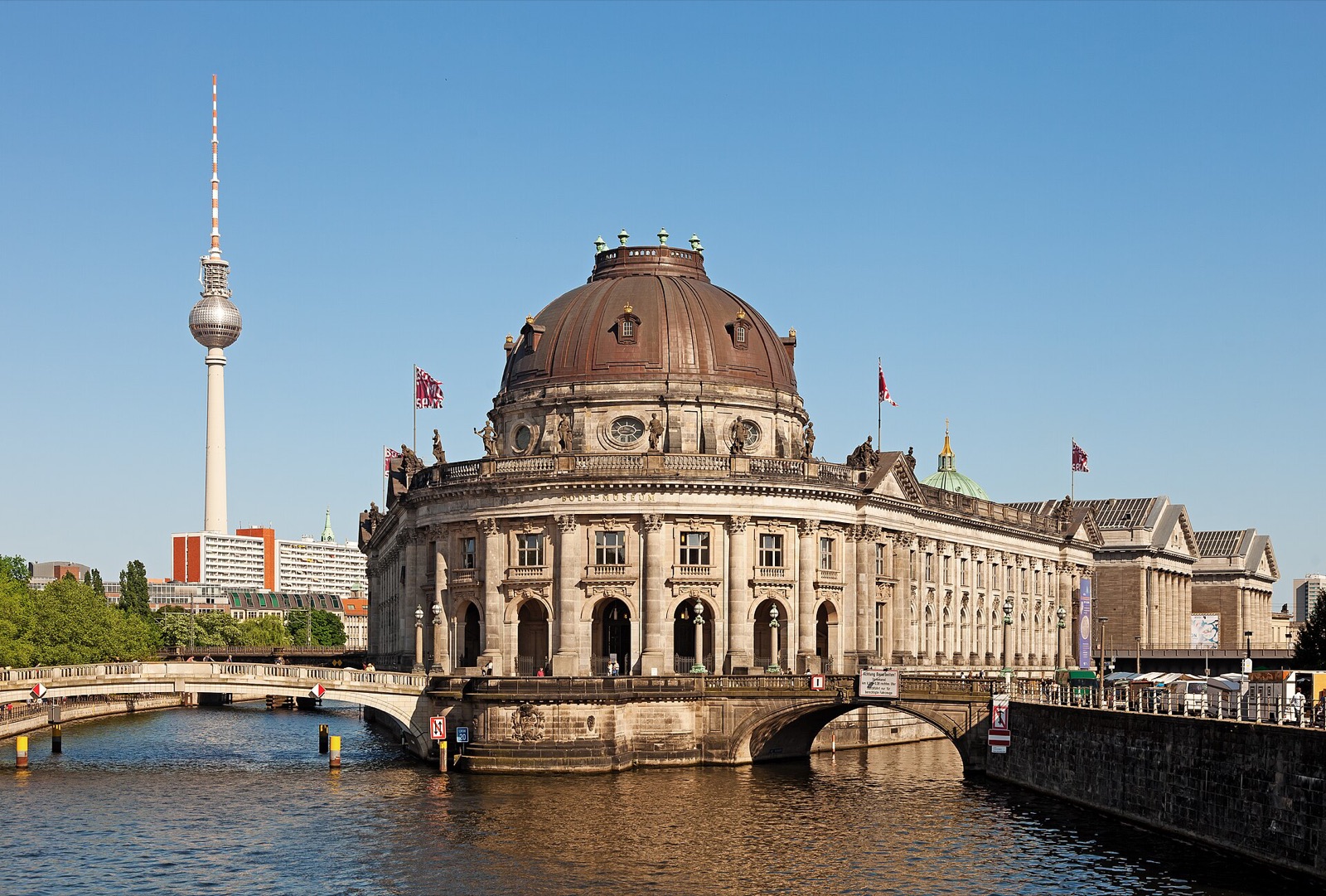
Museum Island and the Fernsehturm in Berlin. May brings the city 224 hours of sunshine, its second sunniest month. Photo: Thomas Wolf, www.foto-tw.de, Wikimedia Commons, CC BY-SA 3.0.

What to watch in spring:
- Easter moves, and the country moves with it. Easter fell in April in 2025 and German hotel nights jumped 11.0 % year on year that month, while March fell 7.7 %. Easter Sunday is March 28 in 2027.
- Good Friday and Easter Monday are public holidays, and almost everything except restaurants closes.
- Shops close on Sundays all year in Germany, which surprises most American visitors. Plan supplies on Saturday.
- Alpine trails are not open yet. Snow sits on the higher Bavarian paths well into June.
- Pack layers and a rain shell. Berlin still logs 8.7 to 10.8 rain days a month in spring.
Summer in Germany: June to August
Summer is short, generous and genuinely hot in the southwest. Berlin averages a high of 76 °F in July and August with lows around 60 °F, and Frankfurt runs two degrees warmer. Daylight is the real luxury: in late June the sun sets after 9:30 pm in Berlin and the sky stays pale until nearly eleven, which is why the whole country eats outside.

A Munich beer garden in summer. The city averages a high of 74 F in July and takes 120.9 mm of rain in June, most of it in afternoon storms. Illustration: my-usa-stay.com.
Two things surprise visitors. The first is that air conditioning is uncommon in German hotels and apartments outside the new-build business chains, because a country that averages twelve hot days a year never built for it. The second is that summer is the wet season in the south: Munich takes 120.9 mm of rain in June, more than twice what Berlin gets.
August is the fullest month of the German year, at 59.4 million nights booked in 2025, because school holidays overlap across all sixteen federal states and Germans overwhelmingly holiday at home. Only 16.8 % of the country's nights are booked by foreign guests, so the crowd you meet in August is largely German, and it heads for the Baltic and North Sea coasts, the Alps and the lakes.
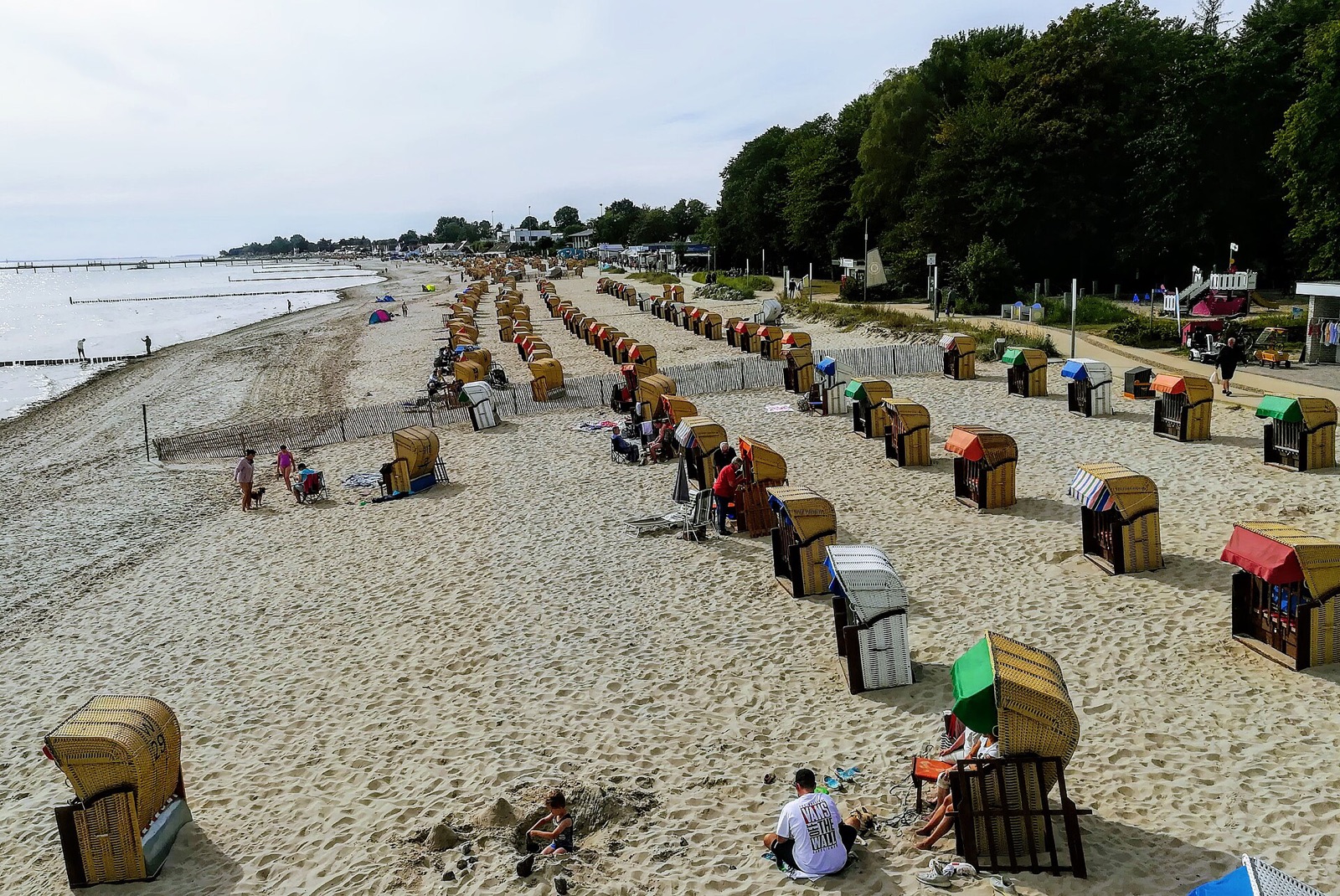
Strandkoerbe on the Baltic beach at Kellenhusen. July and August are the only warm months on the coast, and German families fill them. Photo: Nemracc, Wikimedia Commons, CC BY-SA 4.0.

Summer precautions:
- Book the coast and the Alps months ahead for July and August. Cities are easier than the countryside in high summer.
- Expect thunderstorms in Bavaria between 3 pm and 7 pm. Start alpine hikes early and be off exposed ridges by mid afternoon.
- Check for air conditioning explicitly if you are heat-sensitive and travelling to the Rhine valley.
- Trains fill up. Reserve a seat on long-distance ICE services rather than relying on an open ticket.
Autumn in Germany: September to November
September is the best-kept secret of the German calendar. Berlin still averages a high of 67 °F and only 8.9 rain days, the driest month of the year by that measure, while national hotel nights drop from 59.4 to 48.6 million. You get summer weather with an autumn crowd.

Neuschwanstein in autumn. The castle switches to winter hours, 10 am to 4 pm, on October 16, and is visited on guided tours only. Illustration: my-usa-stay.com.
It is also the month Germany throws its biggest parties, and the naming trips people up: Oktoberfest is mostly in September. The 191st edition runs September 19 to October 4, 2026 on the Theresienwiese in Munich, per the festival's official site. During those sixteen days Munich hotel rates and availability are unlike any other time of year, and it affects Salzburg and Garmisch too.
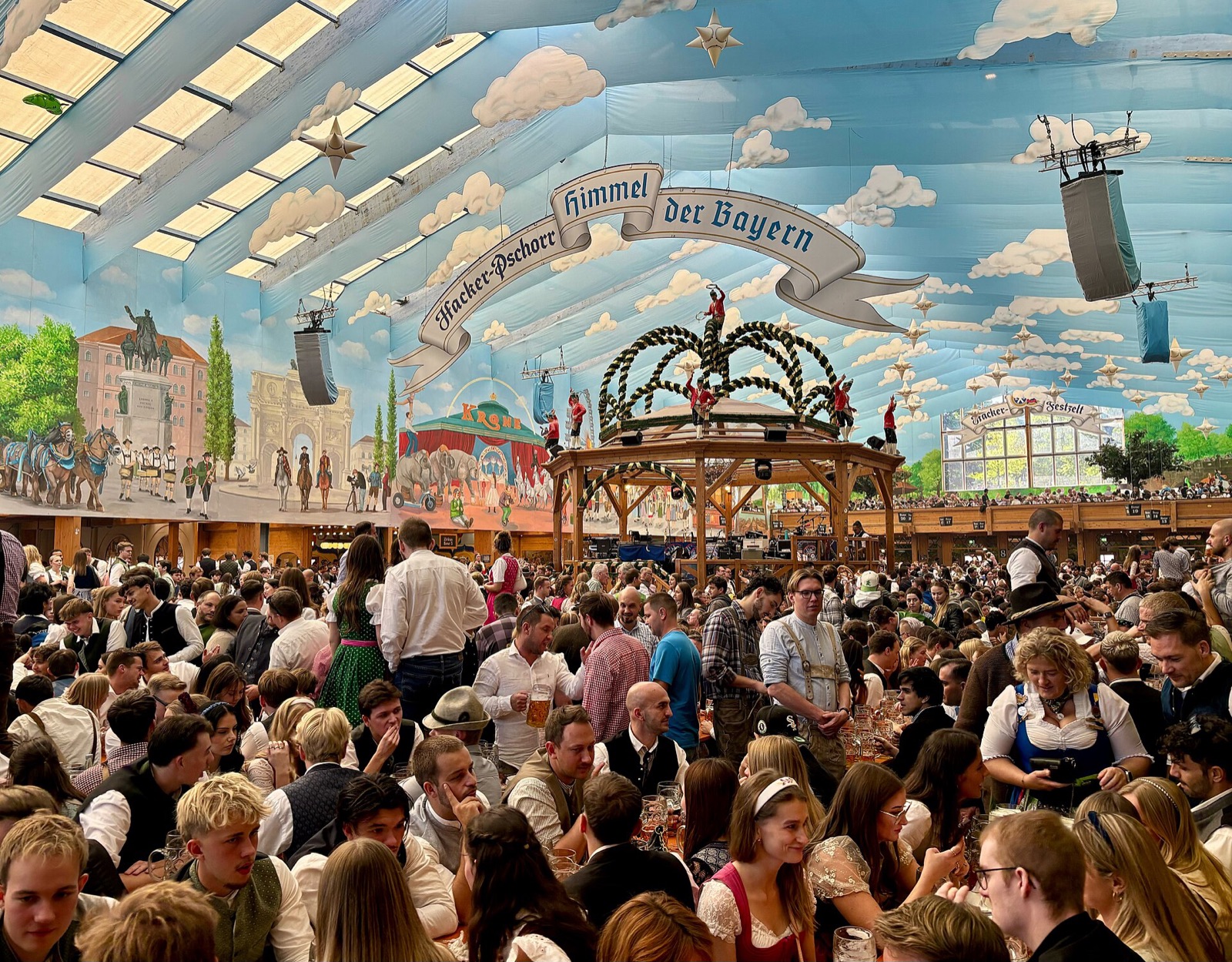
Inside a tent on the Theresienwiese. The 191st Oktoberfest runs September 19 to October 4, 2026. Photo: kallerna, Wikimedia Commons, CC BY-SA 4.0.

The wine calendar runs alongside it. The Weinfest der Mittelmosel at Bernkastel-Kues is set for September 3 to 7, 2026, and the Dürkheimer Wurstmarkt in the Pfalz for September 11 to 15 and 18 to 21, 2026, with fireworks on the 15th and the 21st at 9 pm. The Deutsches Weininstitut puts the Riesling harvest on the Mosel and in the Rheingau in late September and early October, which is when the terraced slopes above the river turn gold and the villages smell of fermenting must.
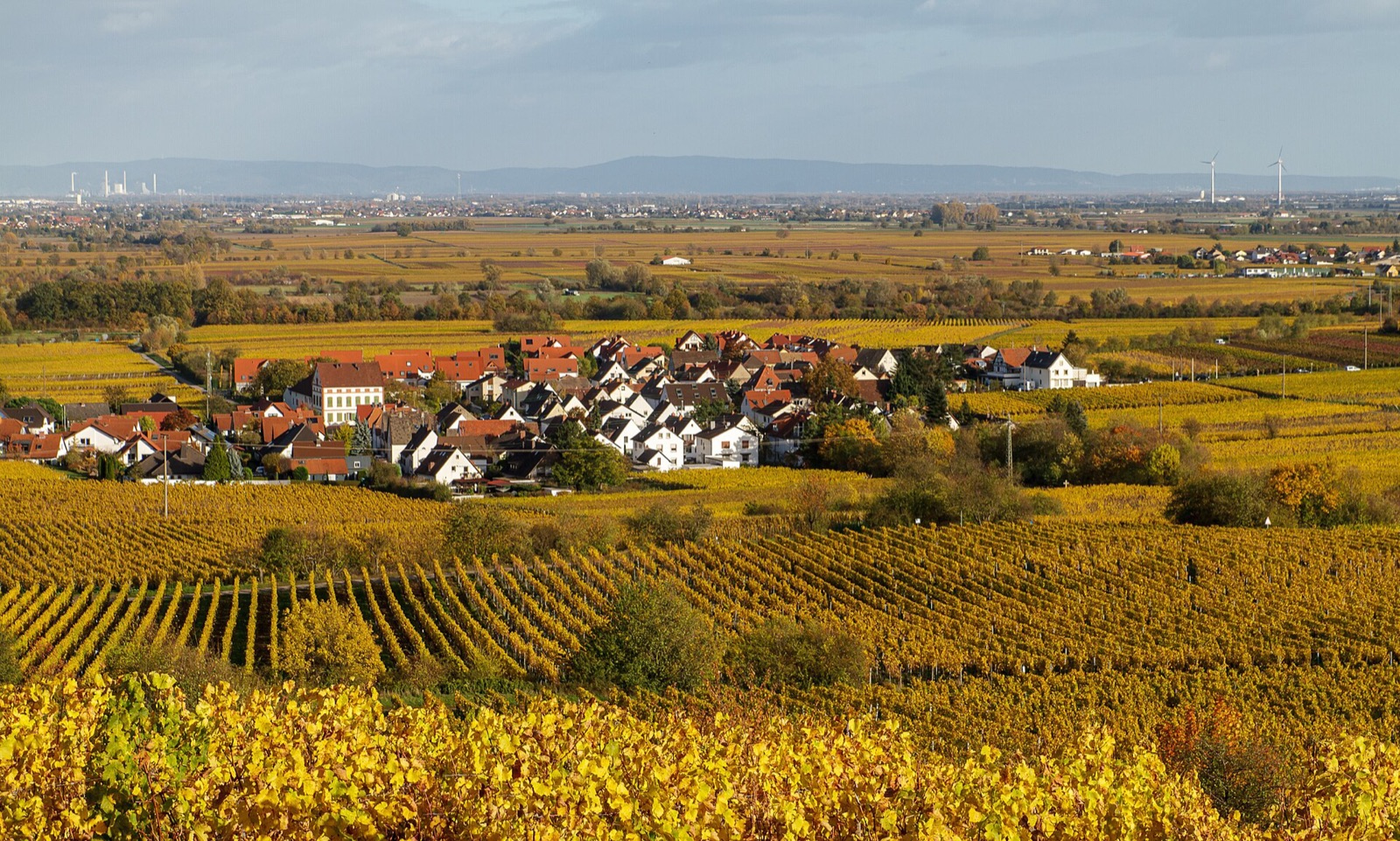
Vineyards at Deidesheim in the Pfalz at the end of October. Riesling is picked on the Mosel and in the Rheingau from late September. Photo: Friedrich Haag, Wikimedia Commons, CC BY-SA 4.0.

October is cooler and calmer, at a Berlin high of 57 °F and 45.9 million nights nationally. It is the last comfortable month for castles and river valleys. Neuschwanstein switches to winter hours on October 16, from 9 am to 6 pm down to 10 am to 4 pm, and it can only be visited on a guided tour of about 30 minutes, booked in advance.
November is the month to skip. Berlin gets 54.5 hours of sunshine in the whole month, Hamburg 51.4, and the country logs only 32.2 million nights. The markets rescue the second half of it, and nothing rescues the first.
Winter in Germany: December to February
Winter in Germany is not about weather, it is about December. The Christmas markets turn the emptiest quarter of the year into a genuine high season for four weeks, then vanish. Berlin averages a high of 40 °F in December and 37 °F in January, with lows around freezing. Snow in the cities is occasional and rarely lasting. Munich records 73.4 frost days a year and Hamburg 64.9, so cold is reliable but deep cold is not.
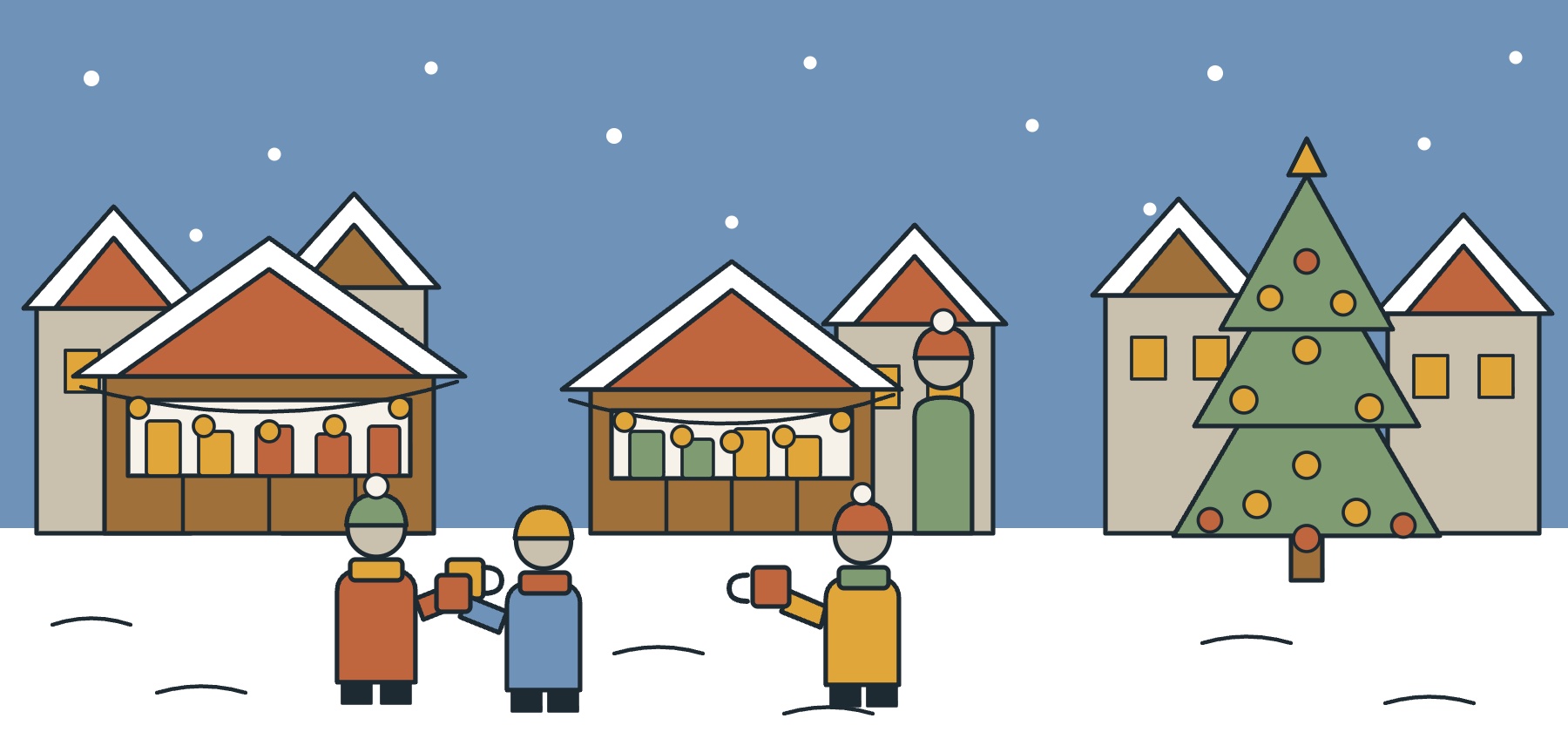
The four biggest Christmas markets open between November 16 and November 27, and all of them close on or before December 24. Illustration: my-usa-stay.com.
The dates are published city by city, and they do not match. This is the single most useful thing to know before booking a December trip, and almost no guide states it plainly. For 2026, using each market's official site:
- Cologne, Cathedral market: November 16 to December 23, closed on November 22 for Totensonntag. Over 140 stalls on Roncalliplatz.
- Munich, Christkindlmarkt: November 20 to December 24, Marienplatz and Rindermarkt, more than 130 stalls.
- Dresden, Striezelmarkt: November 25 to December 24, the 592nd edition. Running since 1434, it is Germany's oldest, with more than 200 traders. Daily 10 am to 9 pm, and 10 am to 2 pm on December 24.
- Nuremberg, Christkindlesmarkt: November 27 to December 24, daily 10 am to 9 pm, opened by the Christkind from the Frauenkirche balcony at 5:30 pm on the first day.
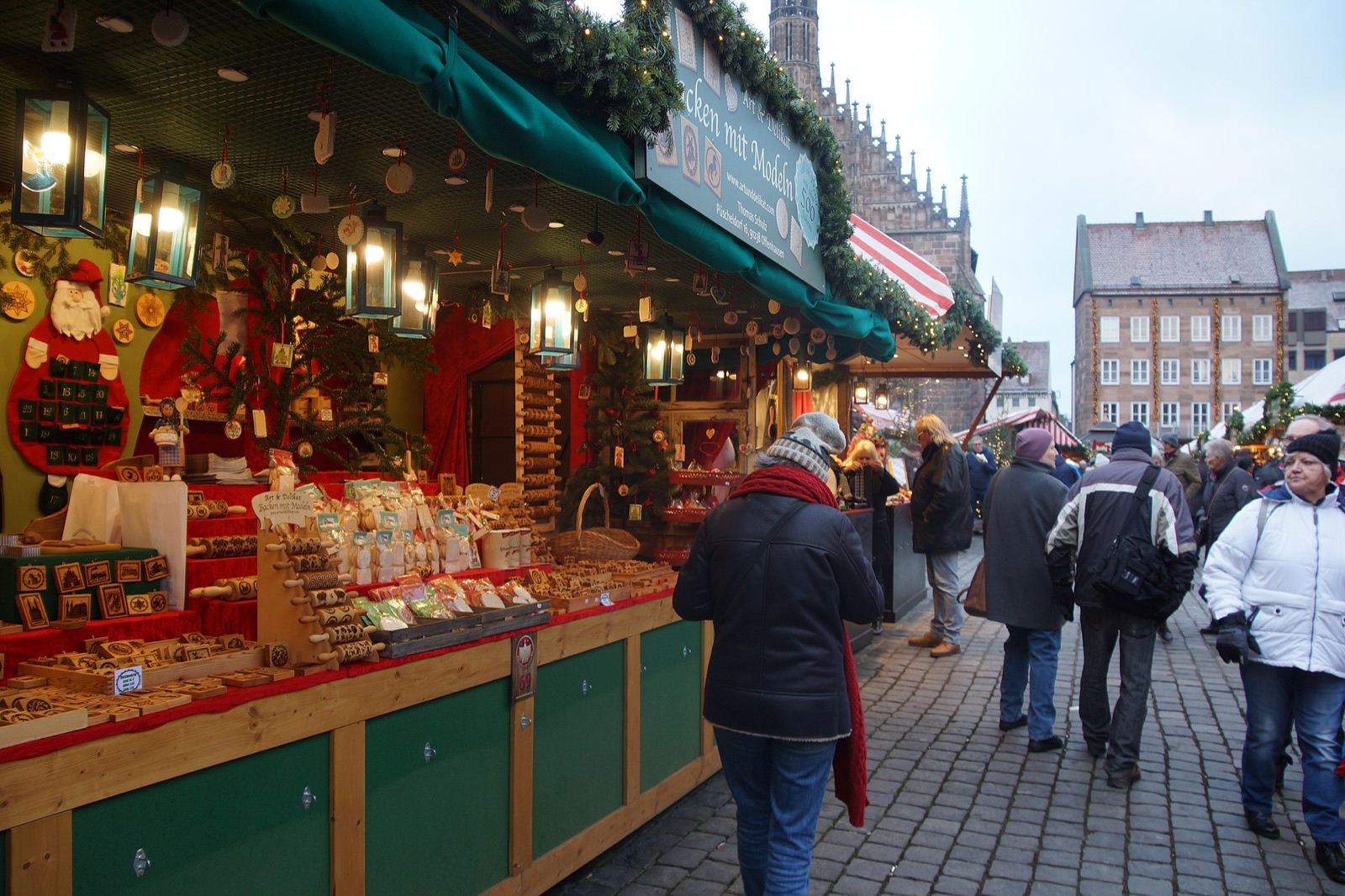
The Christkindlesmarkt on the Hauptmarkt in Nuremberg, open November 27 to December 24, 2026, daily from 10 am to 9 pm. Photo: DALIBRI, Wikimedia Commons, CC BY-SA 4.0.

The trap is the week between Christmas and New Year. Cologne, Munich, Dresden and Nuremberg are all finished by the evening of December 24, so an American family flying over on December 26 to see German Christmas markets will find the squares swept and the huts gone. Berlin is the exception and it is worth reorganising a trip around: the Gendarmenmarkt market runs to December 31, and the Humboldt Forum and Breitscheidplatz markets to January 3, 2027. The Gendarmenmarkt alone draws around 800,000 visitors a year.
January and February are the true low season, at 25.9 and 26.9 million nights. Cities are cheap, museums are empty, and the Bavarian and Black Forest ski areas are the only busy places in the country.
Germany month by month
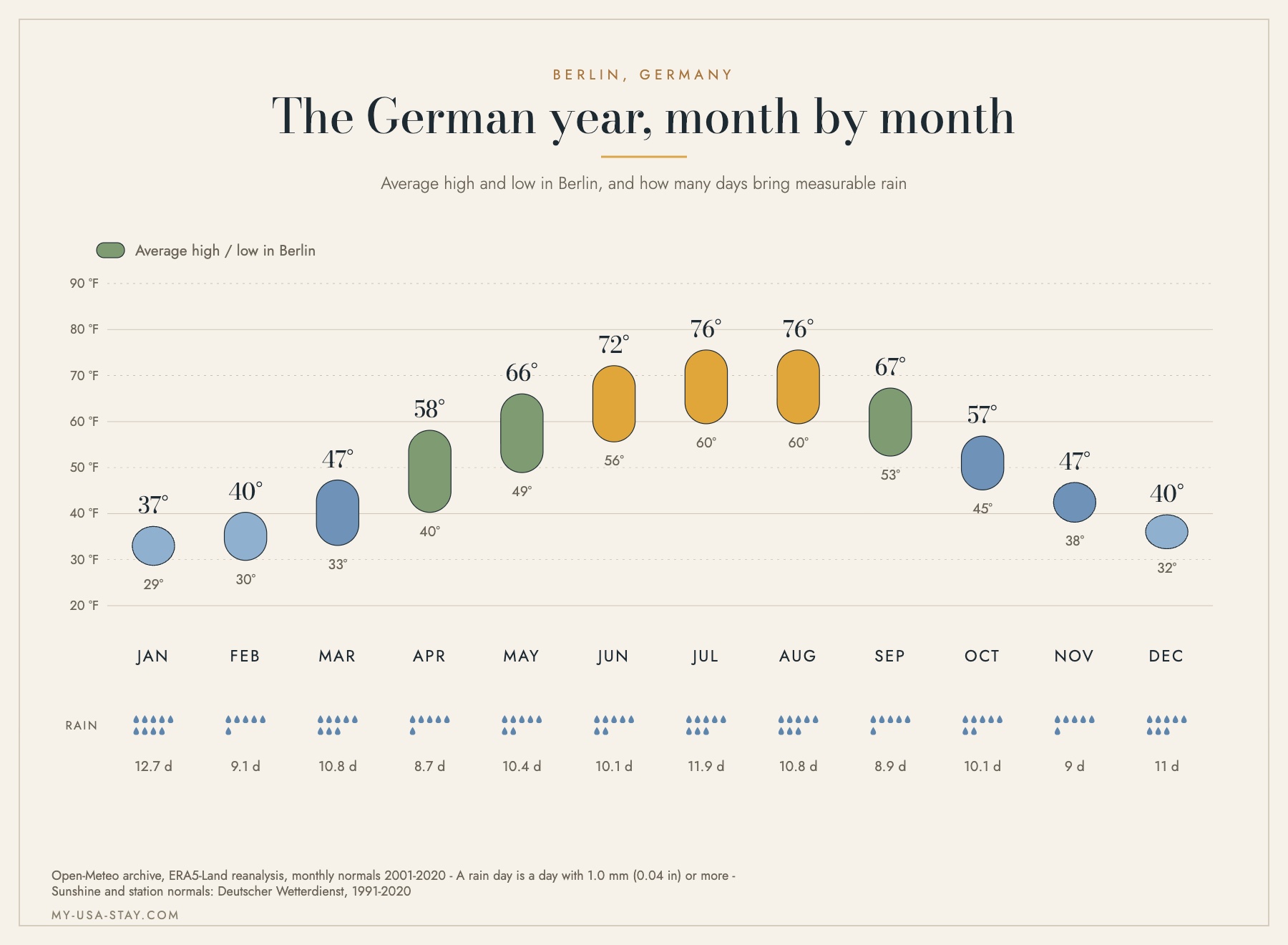
Berlin month by month, in Fahrenheit, with the number of days that bring 1 mm of rain or more.
| Month | Berlin high / low | Rain days | Nights booked | Verdict |
|---|---|---|---|---|
| January | 37 / 29 °F | 12.7 | 25.9 M | Cold, dark, cheap |
| February | 40 / 30 °F | 9.1 | 26.9 M | Cold, still empty |
| March | 47 / 33 °F | 10.8 | 32.7 M | Thawing, unpredictable, quiet |
| April | 58 / 40 °F | 8.7 | 41.0 M | Bright, changeable, pleasant |
| May | 66 / 49 °F | 10.4 | 47.5 M | Green, warm, excellent |
| June | 72 / 56 °F | 10.1 | 50.5 M | Long days, best |
| July | 76 / 60 °F | 11.9 | 56.7 M | Hot, busy, festive |
| August | 76 / 60 °F | 10.8 | 59.4 M | Hottest, fullest, priciest |
| September | 67 / 53 °F | 8.9 | 48.6 M | Warm, golden, superb |
| October | 57 / 45 °F | 10.1 | 45.9 M | Cool, colourful, calm |
| November | 47 / 38 °F | 9.0 | 32.2 M | Grey, dim, skippable |
| December | 40 / 32 °F | 11.0 | 32.0 M | Cold, lit, crowded |
Temperatures and rain days: Open-Meteo archive, ERA5-Land reanalysis, monthly normals 2001 to 2020 for Berlin. A rain day is a day with 1.0 mm (0.04 in) or more. Nights booked: Statistisches Bundesamt (Destatis), monthly accommodation statistics for 2025. Sunshine hours, frost days and hot days quoted elsewhere on this page: Deutscher Wetterdienst station normals, 1991 to 2020.
Crowds and prices through the year
Germany publishes its own attendance figures, so you can plan around the crowd rather than guess at it. The federal statistics office counts every night booked in accommodation with ten beds or more, and released a record 497.5 million nights for 2025. The monthly shape is the useful part.
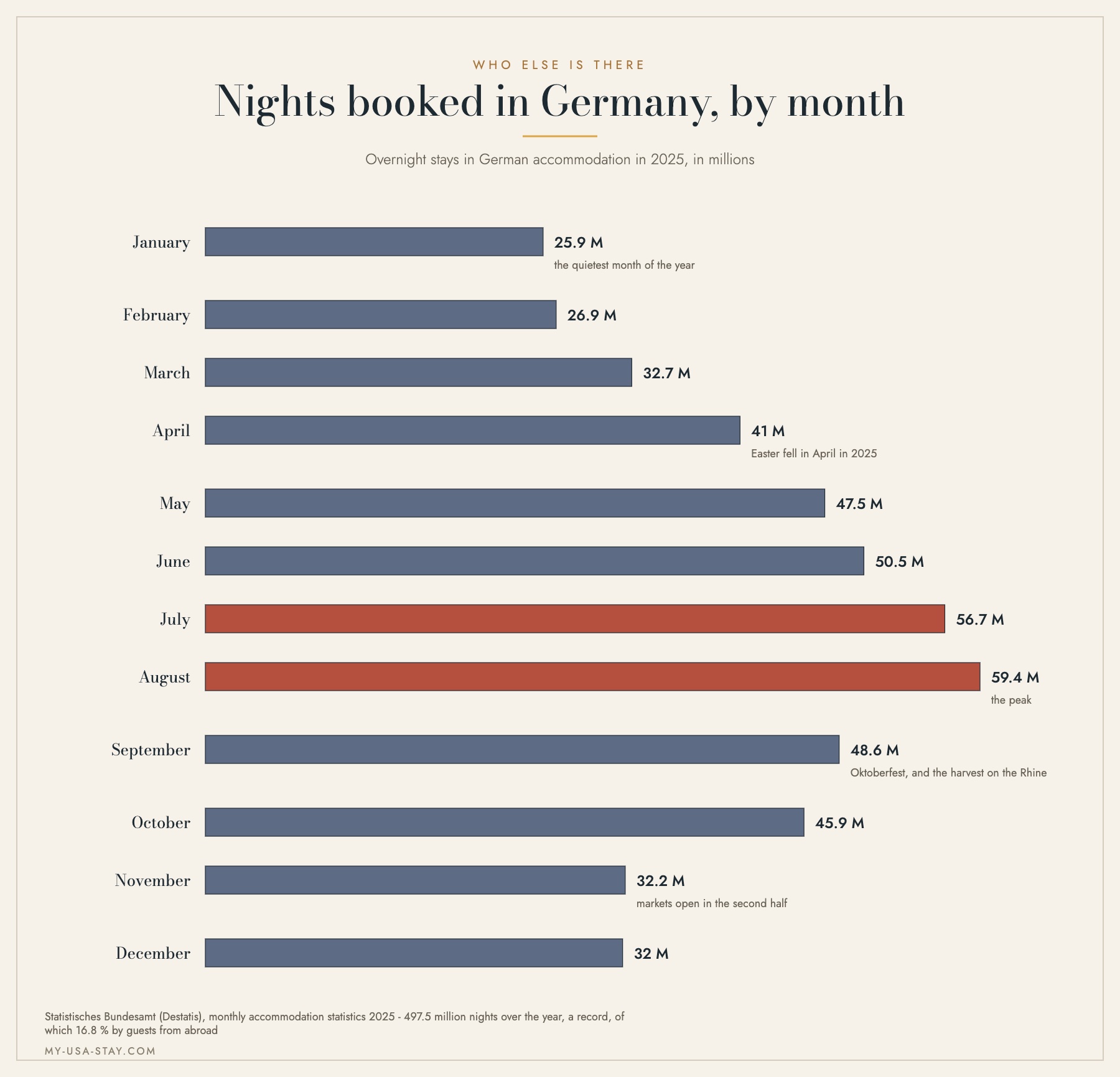
Nights booked in German accommodation by month in 2025. August runs at 2.3 times the volume of January.
August runs at 2.3 times the volume of January. The curve climbs steadily from March, peaks in August, falls off a cliff after October, and stays flat through November and December at around 32 million. That last point matters: even with the Christmas markets, December is a low-volume month nationally, because the markets concentrate demand into a handful of city centres for four weeks while the coasts and the countryside sit empty. City hotel rates in Nuremberg, Dresden and Cologne behave like high season in December. Rural Germany does not.
The shoulders are where the value sits. May at 47.5 million and September at 48.6 million carry roughly 80 % of August's volume with better availability. If budget decides and weather does not, January and February are the cheapest weeks of the German year.
The best time for what you want to do
- Christmas markets: November 27 to December 23, when all four of the big ones overlap. Dresden and Nuremberg for tradition, Cologne for scale, Berlin if your dates run past Christmas.
- Oktoberfest: September 19 to October 4, 2026. Book Munich six to nine months out.
- Castles and the Romantic Road: late September and October, for autumn colour and short queues. Neuschwanstein is on guided tours only and shortens its hours on October 16.
- Rhine and Mosel wine country: early September for the festivals, late September and early October for the harvest itself.
- Hiking the Alps and the Black Forest: late June to mid September, once the high trails clear. Start early to beat the afternoon storms.
- Baltic and North Sea beaches: July and August only, and they are busy. This is where German families go.
- City breaks and museums: January to March. Berlin, Hamburg, Leipzig and Munich are at their cheapest and least crowded.
- Skiing: January and February in the Bavarian Alps and the Black Forest.
- Beer gardens and river swimming: late May to early September, when Munich and Berlin average highs in the seventies.
Events that shape the year
A handful of dates decide whether a German city feels half empty or sold out, and most of them are published a year or more in advance.
Oktoberfest is the biggest single distortion. Sixteen days, one city, and knock-on effects across southern Bavaria and into Austria. Carnival in Cologne, Mainz and Düsseldorf peaks on the Monday before Ash Wednesday and fills those three cities for a week in February or early March. Rhine in Flames, the fireworks series along the Rhine gorge, is set for July 3, 2027 at Bingen and Rüdesheim and August 14, 2027 at Spay and Koblenz, per the organisers' official calendar. The wine festivals of the Mosel and the Pfalz cluster in the first three weeks of September.
On the public holiday side, October 3, the Day of German Unity, is the only holiday set at federal level, and offices and shops close nationwide. Everything else, including Easter Monday, Whit Monday, Corpus Christi and All Saints, is set by the individual states, so a holiday that closes Bavaria may leave Berlin open. Christmas Day, December 26 and January 1 close the country.
Where to go in Germany, region by region
Germany is federal in temperament as well as in law, and the regions run on different calendars. Choosing the region first and the month second usually gives a better trip than the reverse.
The Frankfurt area is the warmest and driest corner of the country and the easiest to reach from the United States. It works from April through October, and it is the natural base for the Rhine gorge, the Rheingau vineyards and Heidelberg. Its annual rainfall, 598.5 mm, is barely above Berlin's.
The Goethe route through Frankfurt, Weimar and the Thuringian towns is a shoulder-season trip: the towns are small, the sights are indoors as often as out, and May, June and September give you daylight without coach traffic.
Brandenburg, the sandy, lake-strewn state wrapped around Berlin, is at its best from June to early September, when the Spree and the lakes at Potsdam are warm enough to swim. It is also the driest part of Germany, which makes it a reasonable summer bet when the forecast looks unsettled elsewhere.
For the full picture of cities, coasts and Alpine valleys, start from the Germany hub and work outward.
Getting there from the United States
Frankfurt is the main door. It is Germany's largest airport, handled about 63.2 million passengers in 2025, and its summer 2026 schedule lists 283 destinations in 92 countries flown by 88 airlines, with more than 1,000 intercontinental connections a week. Munich is the second hub, and Berlin takes a smaller share of transatlantic traffic than its size suggests. Flying into Frankfurt or Munich and out of the other avoids doubling back.
Time difference. Germany is on Central European Time, six hours ahead of New York and nine ahead of Los Angeles. Twice a year that gap narrows to five hours, because the two clocks do not change on the same weekend: the United States springs forward on the second Sunday in March and falls back on the first Sunday in November, while the European Union changes on the last Sundays of March and October. In 2027 the mismatch runs March 14 to March 28 and October 31 to November 7. If you are booking a call home or a connecting flight in those windows, check the arithmetic rather than the habit.
Entry formalities. US passport holders need no visa for tourism in Germany for stays of up to 90 days in any 180 day period, provided no paid work is involved, per the German Federal Foreign Office. Your passport must be valid for at least three months beyond your planned departure date from the Schengen area and have been issued within the last ten years.
The border itself has changed. The EU Entry/Exit System began operating on October 12, 2025 and reached full operation on April 10, 2026, replacing passport stamps. On your first crossing it registers your travel document, a facial image and fingerprints, and it counts your 90 days automatically. Expect the first entry of a trip to take longer than it used to, especially at peak arrival banks in Frankfurt. ETIAS, the separate travel authorisation for visa-exempt visitors, will cost 20 euros; the European Commission has not announced a start date and says it will give several months' notice.
American holidays move prices too. Thanksgiving week and the Christmas to New Year stretch push transatlantic fares up independently of German demand, and both land in what is otherwise Germany's low season. Flying out in the first half of December rather than the second is the cheapest way to see the markets.
FAQ
What is the best month to visit Germany?
September is the strongest single month. Berlin still averages a high of 67 °F with only 8.9 rain days, the fewest of any month, while national hotel nights fall from 59.4 million in August to 48.6 million. You get summer conditions, Oktoberfest and the Rhine harvest, without August's crowds. June is the close second, for the longest daylight of the year.
What is the cheapest time to go to Germany?
January and February. German accommodation booked 25.9 million and 26.9 million nights in those two months of 2025, against 59.4 million in August, so supply far outstrips demand and city hotels price accordingly. The trade-off is cold and darkness: Hamburg gets only 36 hours of sunshine in December and little more in January.
Which month is rainiest in Germany?
It depends where you are, which is the point. In Berlin, July is wettest at 71.7 mm and 11.9 rain days. In Munich, June is wettest at 120.9 mm, part of a summer thunderstorm maximum that makes Munich the rainiest big German city at 939.7 mm a year. Hamburg spreads its 770.5 mm more evenly, with a mild winter peak.
When are the German Christmas markets in 2026?
They open on different days and almost all close on December 24. Cologne runs November 16 to December 23, Munich November 20 to December 24, Dresden November 25 to December 24, and Nuremberg November 27 to December 24. Berlin is the exception: Gendarmenmarkt runs to December 31, and the Humboldt Forum and Breitscheidplatz markets to January 3, 2027.
Can I see German Christmas markets after Christmas?
Only in Berlin. Cologne, Munich, Dresden and Nuremberg all finish on or before December 24, so a trip arriving on December 26 will find those squares empty. If your dates fall between Christmas and New Year, build the trip around Berlin, where several markets run into early January.
When is Oktoberfest, and is it actually in October?
Mostly no. The 191st Oktoberfest runs September 19 to October 4, 2026, on the Theresienwiese in Munich, according to the festival's official site. Only the final days fall in October. Munich accommodation is at its tightest of the year across those sixteen days, and the pressure reaches nearby Bavarian and Austrian towns too.
Do Americans need a visa for Germany?
No. US passport holders may enter Germany without a visa for up to 90 days in any 180 day period for tourism, provided they do no paid work, per the German Federal Foreign Office. The passport must be valid for at least three months beyond your departure from the Schengen area and issued within the last ten years.
Is August a good time to visit Germany?
It is the warmest month and the most crowded. Berlin averages a high of 76 °F, and Germany booked 59.4 million nights in August 2025, its highest of the year, because school holidays overlap in all sixteen states. Cities cope; the Baltic coast, the Alps and the lake districts do not. Air conditioning is also uncommon in German hotels.
Read next
- Where to stay in Germany, city by city and region by region.
- The best time to visit the USA, the same method applied at home.
- Why shoulder season delivers the trip you actually wanted.
- Where to stay in France, an easy add-on by train from the Rhine.
- Hotels in the greater Frankfurt area, the warmest corner of the country.