
The best time to visit Ireland is late May to mid September, when Dublin Airport averages daily highs of 59 to 67 °F (15 to 19.5 °C) and the day stretches to 17 hours at the June solstice. The month to avoid is February: highs of 47 °F (8.5 °C), 7 hours 30 minutes of daylight at midwinter, and the fewest American visitors of the year. Rain matters far less than it looks from abroad, because Irish rain arrives often rather than heavily. Once your dates are set, our Ireland travel hub covers where to stay.
The short answer
- Best overall: late May to mid September. Dublin Airport highs run 59 to 67 °F and every attraction, ferry and mountain road is open.
- Best value with good light: late September and October. US visitor numbers fall from 178,600 in August to 127,500 in October, on Central Statistics Office figures for 2025.
- Avoid if you want space: 13 to 17 March 2027, the St Patrick's Festival in Dublin. American arrivals in March run 166 percent above February.
- Wettest month: November at Dublin Airport (3.3 in, 82.7 mm) and December on the west coast.
- Rain is frequent, not heavy: Dublin gets 30.4 in of rain a year over 200 days. Miami gets 67.4 in over 141 days.
- Sea temperature: the Atlantic off Galway peaks at 61 °F (16.1 °C) in August and never drops below 48 °F.
- No ETIAS, no Schengen: Ireland keeps its own border rules, and US citizens visit without a visa.
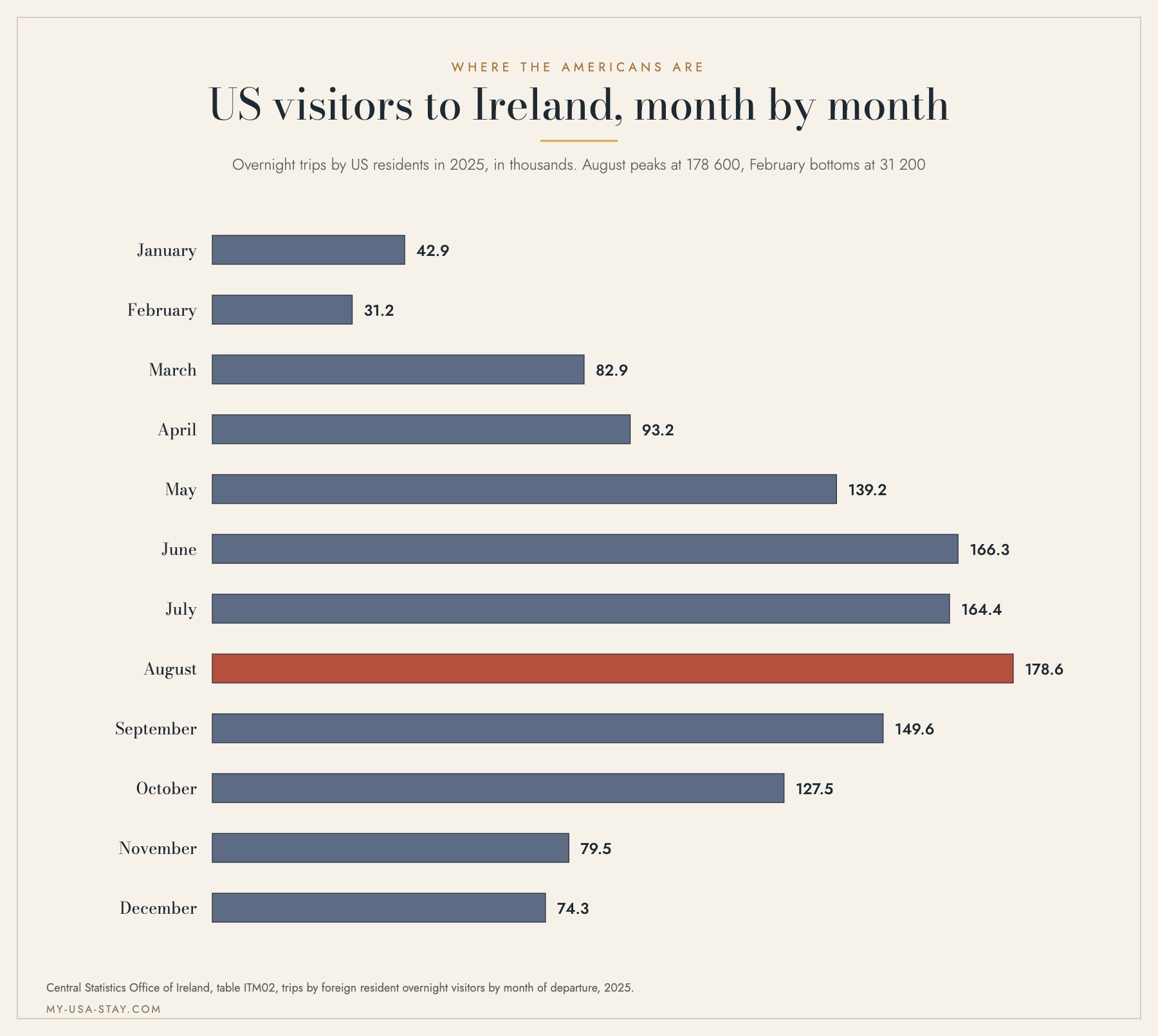
US visitors to Ireland by month, 2025. Source: Central Statistics Office of Ireland, table ITM02.
Understanding the climate in Ireland
Ireland has one of the narrowest temperature ranges in Europe, and the difference between its coasts is a difference in rain, not in heat. Every figure on this page comes from Met Éireann station records for 1991 to 2020 rather than from a gridded model, because a model cell over an island this narrow is mostly sea and flattens the daily highs.
Four stations tell the whole story. Dublin Airport, on the dry east coast, records a July high of 67 °F (19.5 °C) and 30.4 in (772.5 mm) of rain a year. Shannon Airport in County Clare, the reference station for the Cliffs of Moher, matches Dublin in July at 67 °F but takes far more rain, 40.1 in (1,019.7 mm) a year. Valentia Observatory in County Kerry, which speaks for the Ring of Kerry, takes 64.8 in (1,646.5 mm) a year, more than twice Dublin. Belmullet in County Mayo is the windiest of the four.
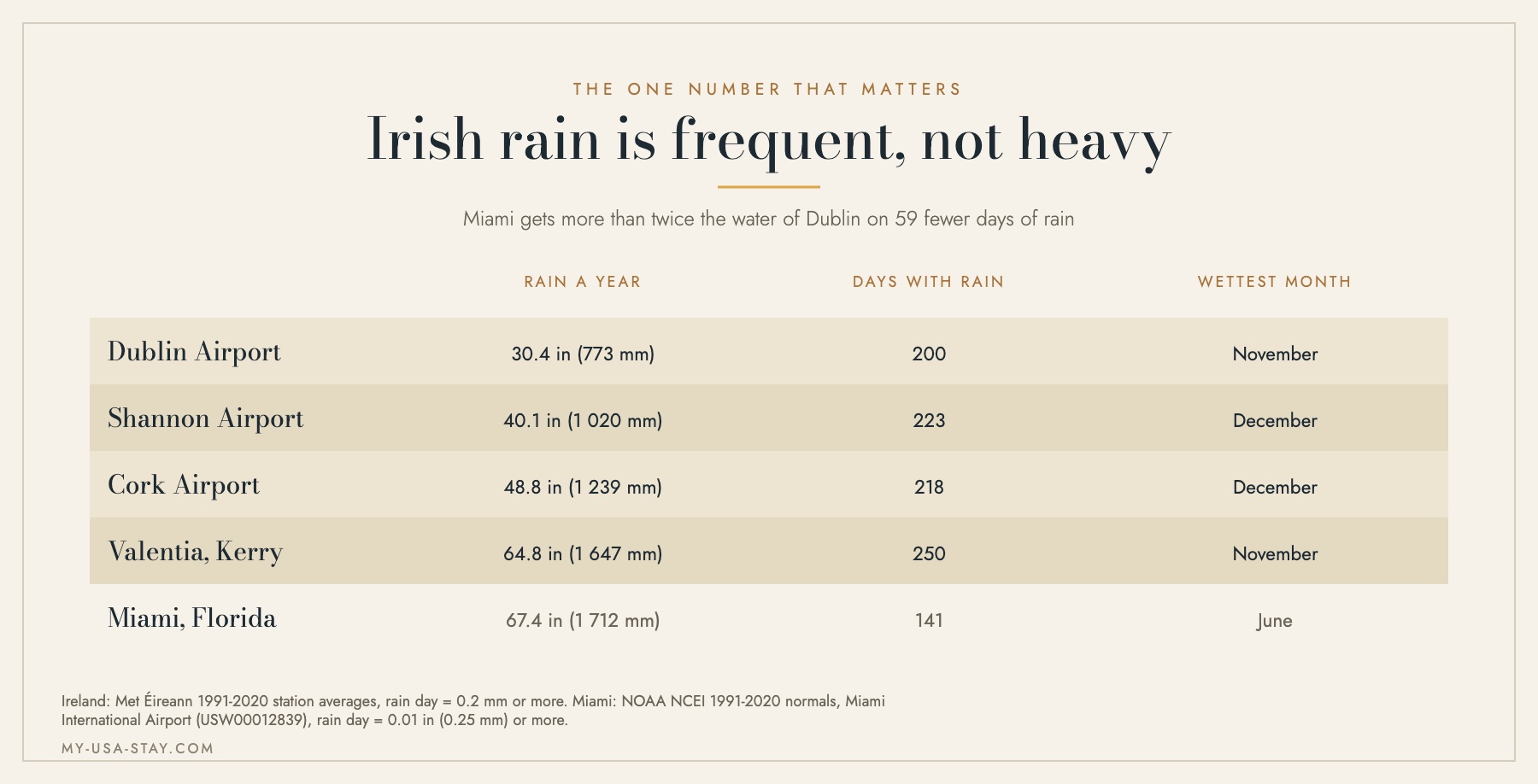
Annual rainfall and rain days at Dublin, Shannon, Cork and Valentia, set against Miami. Sources: Met Eireann 1991-2020 station averages and NOAA NCEI 1991-2020 normals.
Why rain days matter more than inches
The single number that prepares an American traveler for Ireland is the count of rain days, not the depth. Dublin Airport records rain on 199.6 days a year, of which 137.1 carry 1 mm (0.04 in) or more. Miami International Airport, on NOAA normals for the same 1991 to 2020 period, records 67.4 in of rain over only 141 days. Miami gets more than twice the water of Dublin on fifty nine fewer days of rain.
That changes what you pack. A Florida downpour is an event you sit out; Irish rain is a texture you walk through, which is why the local kit is a waterproof shell rather than an umbrella. It also means no month is dry: the driest month at Dublin Airport, June, still carries 9.8 wet days, and the wettest, December, 13.3. Three and a half days separate the best month from the worst.
Daylight is the real seasonal swing
Temperature barely moves across the Irish year, but light moves enormously. Dublin sits at 53 degrees north, further north than Calgary. On the June solstice the US Naval Observatory gives sunrise at 4.57 am and sunset at 9.57 pm local time, a day of 17 hours. On the December solstice the same city gets sunrise at 8.38 am and sunset at 4.08 pm, a day of 7 hours 30 minutes. Met Éireann measures the consequence in sunshine hours: 6.4 hours a day at Dublin Airport in May against 1.7 hours in December.
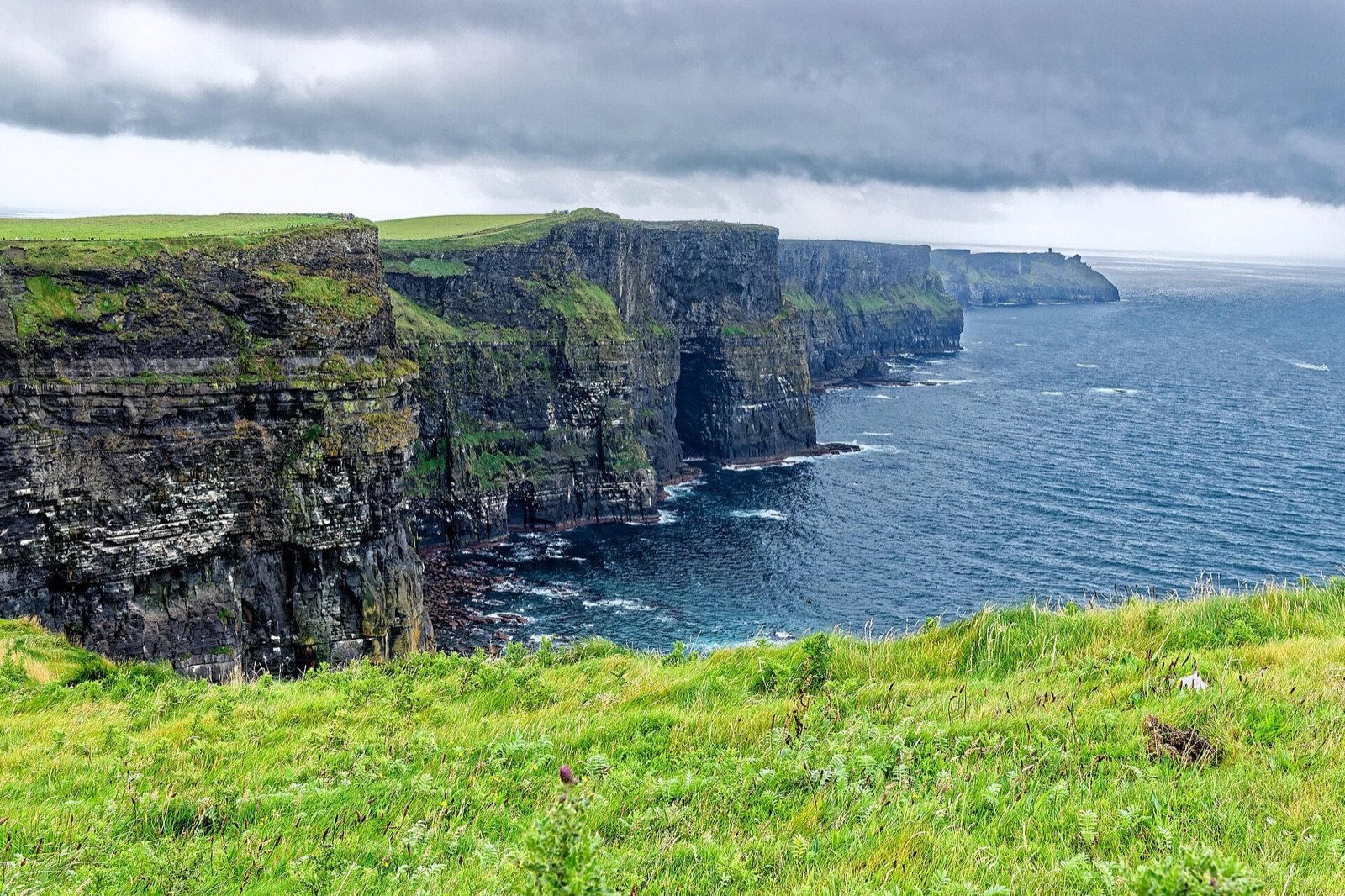
The Cliffs of Moher, County Clare, on the Wild Atlantic Way. Photo: Holger Uwe Schmitt, Wikimedia Commons, CC BY-SA 4.0.

Wind, and why it decides the west coast
Wind is the variable that closes boats and makes coastal driving unpleasant. Belmullet in County Mayo records 26.5 days of gale a year, 6.3 of them in January and 4.7 in December, against 7.8 gale days a year at Dublin Airport. On the Atlantic seaboard, July and August average well under one gale day a month. If your trip is built around the Wild Atlantic Way and its island crossings, that seasonal wind curve matters more than the thermometer.
Spring in Ireland: March to May
Spring is the fastest improving season in Ireland and the best value month of the three is May. Dublin Airport climbs from a 50 °F high in March to 59 °F in May, sunshine rises from 3.7 to 6.4 hours a day, and May is one of the driest months of the year at 2.2 in (55 to 57 mm). Air frost, which Dublin records on 5.5 days in March, is effectively gone by May.
March is the exception, and the reason is one date. St Patrick's Day falls on 17 March, and the St Patrick's Festival in Dublin runs 13 to 17 March 2027. The Central Statistics Office measures the effect precisely: US residents made 82,900 trips to Ireland in March 2025 against 31,200 in February, and 101,600 in March 2026 against 44,400 in February. Dublin hotel rooms and the Dublin to Galway train fill first, and they fill early.
- Book Dublin accommodation for mid March many months ahead, or base yourself outside the city and travel in.
- Skellig Michael landings are not yet running; the season opens in May.
- April and early May are the quietest weeks with usable light: 93,200 American visitors in April 2025 against 166,300 in June.
- Pack for 37 to 39 °F nights in March and April, which is colder than most visitors expect from a maritime climate.
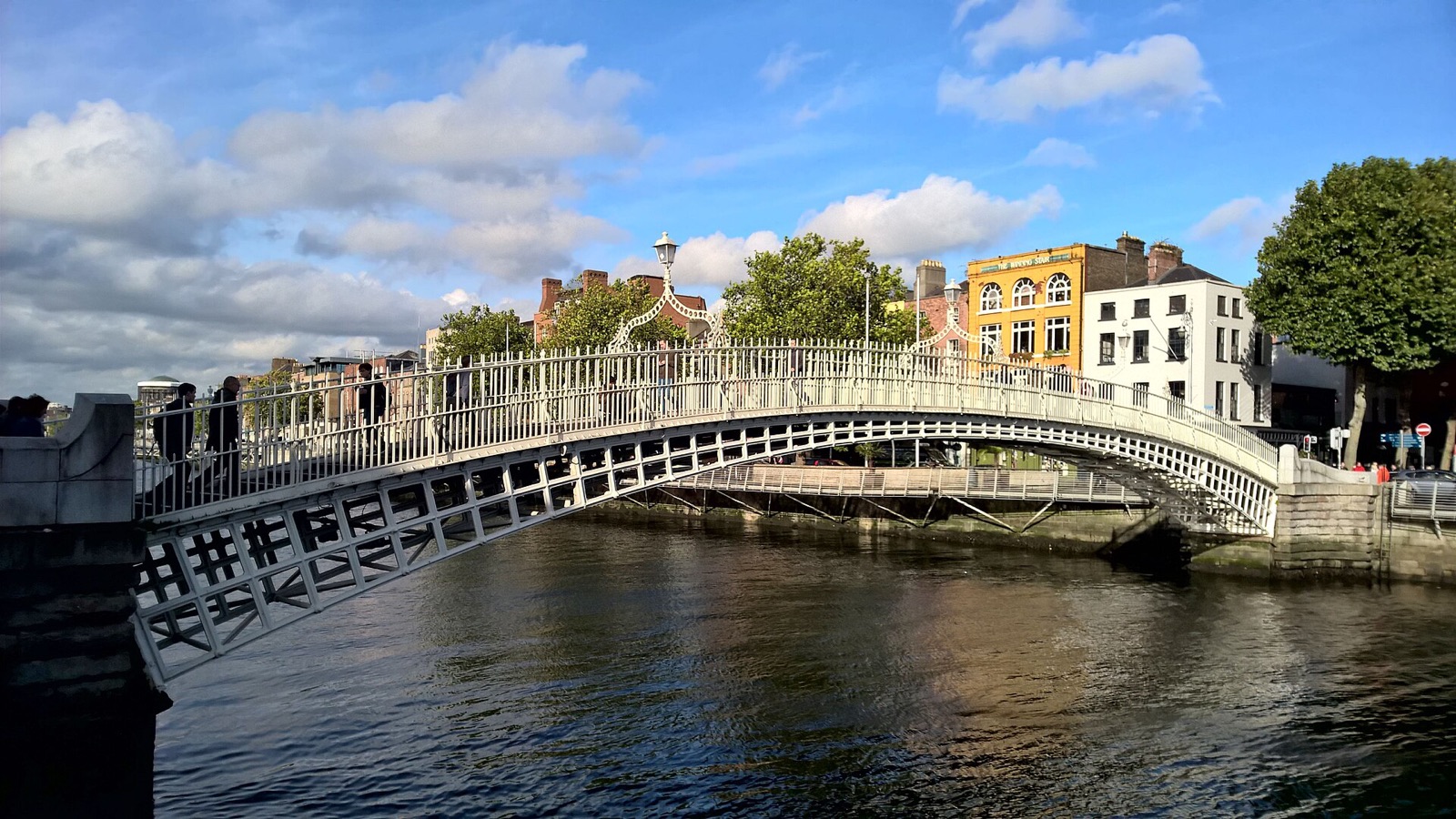
The Ha'penny Bridge and the River Liffey, Dublin. Photo: Chris Morgan, Wikimedia Commons, CC BY-SA 2.0.

Summer in Ireland: June to August
Summer is Ireland at its warmest, its longest and its busiest, and warmest still means mild. Dublin Airport peaks at 67 °F (19.5 °C) in July, Shannon at 67 °F, and Valentia in Kerry at only 64 °F. Nights sit at 52 °F. Air conditioning is rare in Irish hotels because it is almost never needed, and the absolute record at Dublin Airport across the whole thirty year period is 27.2 °C (81 °F).
June is the single driest month at Dublin Airport by rain frequency, with 9.8 wet days. August is the wettest of the three and the most crowded: 178,600 American visitors in August 2025, the peak of the year and 5.7 times the February figure. June and July sit just behind at 166,300 and 164,400.

The Cliffs of Moher, County Clare, reachable in every season but at their calmest between late May and September. Illustration: my-usa-stay.com.
Summer is also when the island opens fully. Skellig Michael, the monastic island off the Kerry coast, accepts landings only through permitted boat operators and only in season: the Office of Public Works gives 12 May to September, with the note that arrangements vary with weather. Aran Islands crossings, Wild Atlantic Way headland roads and the long evenings that make a 9 pm walk possible all belong to these three months.
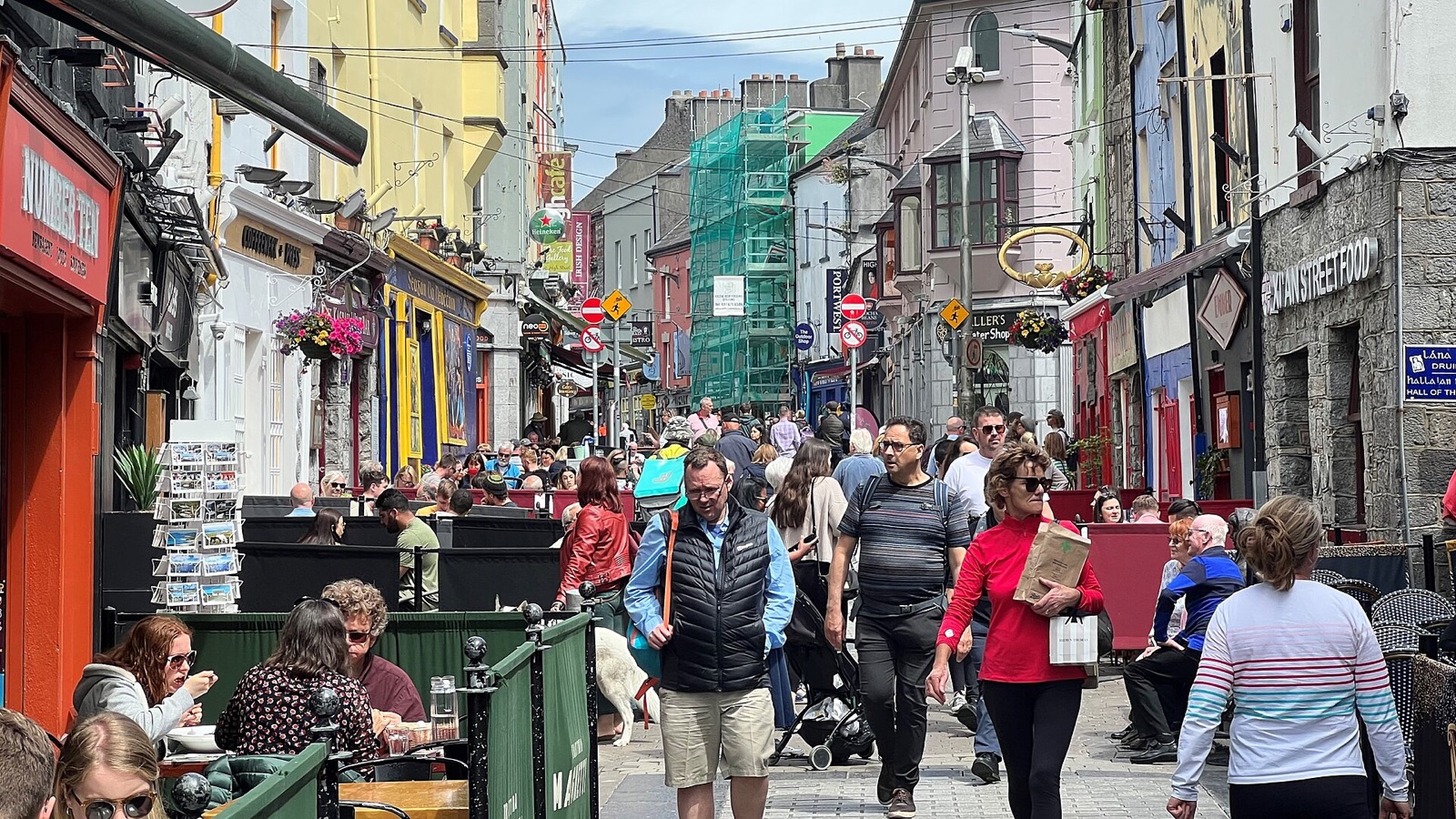
Quay Street, Galway, at the height of the summer season. Photo: Ian Hawfinch, Wikimedia Commons, CC BY-SA 2.0.

Autumn in Ireland: September and October
September is the best trade in the Irish calendar. Dublin Airport still records a 62 °F high, within four degrees of August, and the sea off Galway is at 60 °F, warmer than in June, because the Atlantic warms and cools a month behind the air. Sunshine holds at 4.4 hours a day. Yet American visitor numbers drop to 149,600, sixteen percent below August, and September carries fewer wet days than July or August at Shannon Airport, 12.9 against 13.5 and 13.7.

The Ring of Kerry in October, when the bracken turns and the coastal roads empty. Illustration: my-usa-stay.com.
October trades further. Highs fall to 56 °F in Dublin and 58 °F in Kerry, rain frequency climbs, and US arrivals fall to 127,500. In exchange you get bracken turning rust across the Kerry uplands, near empty coastal roads, and rates that no longer reflect August demand. Two cautions apply: the last Monday in October is an Irish public holiday and domestic travel spikes around it, and Skellig Michael landings have finished for the year.
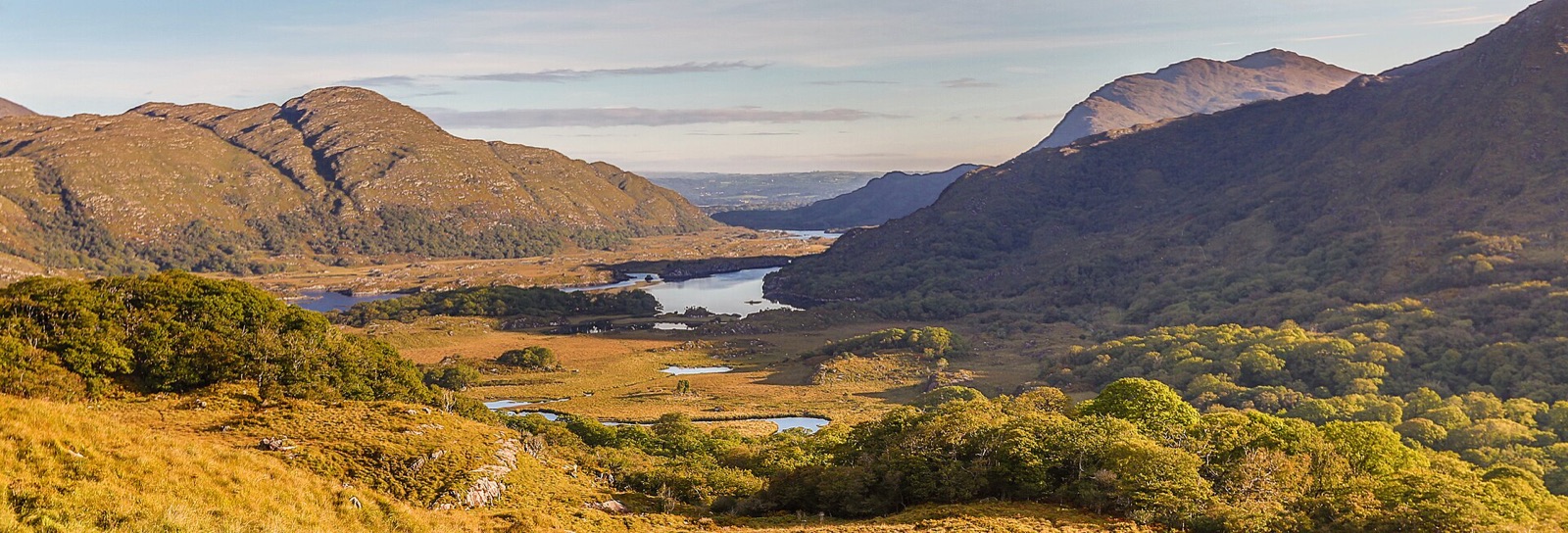
Ladies View on the Ring of Kerry, County Kerry, looking over the Killarney lakes. Photo: Tony Webster from Portland, Oregon, United States, Wikimedia Commons, CC BY 2.0.

Winter in Ireland: November to February
Winter in Ireland is dark rather than cold. Dublin Airport highs sit at 51 °F in November, 47 °F in December and February and 46 °F in January, which is milder than New York or Chicago at the same date. Valentia in Kerry records air frost on just 8.5 days a year against 35 at Dublin Airport, a consequence of the Atlantic sitting at 48 to 51 °F all winter.
What winter takes away is light and boat access. December gives 1.7 hours of sunshine a day at Dublin Airport and a 7 hour 30 minute day at the solstice, which means a Ring of Kerry drive has to be finished by mid afternoon. November is the wettest month in Dublin (3.3 in) and at Valentia (7.4 in), and the Atlantic gale season is at its height: Belmullet averages 6.3 gale days in January alone.
- February is the quietest month for American visitors: 31,200 trips in 2025, one fifth of the August figure.
- Build the trip around cities, indoor collections and short daylight drives rather than headlands and islands.
- Check opening seasons before you plan a day around any island, boat trip or remote site.
- The first Monday in February is a public holiday in Ireland, as is Easter Monday; Good Friday is not.

Trinity College Dublin, one of the indoor anchors of a winter city trip. Photo: Yair Haklai, Wikimedia Commons, CC BY-SA 4.0.

Ireland month by month
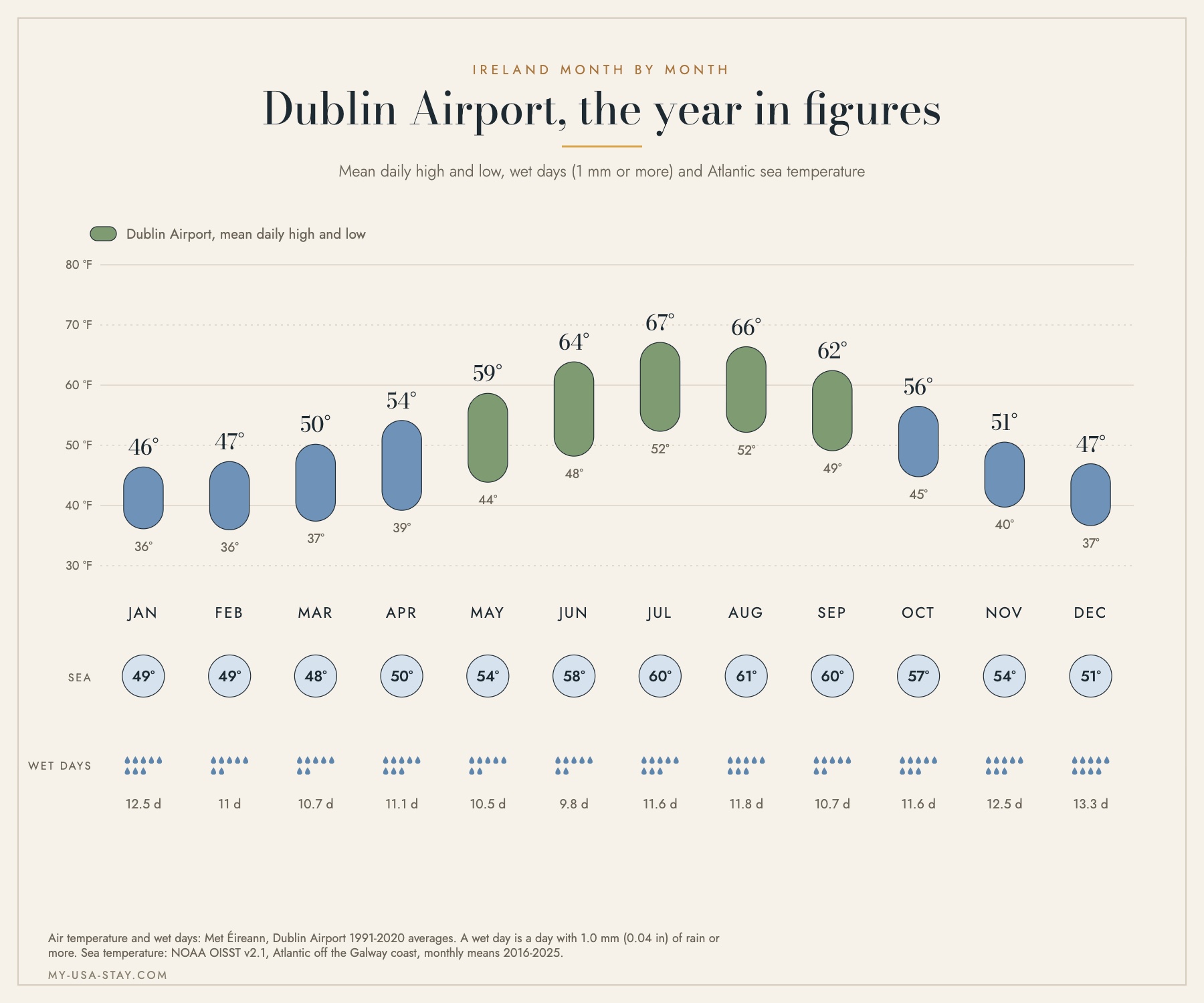
Dublin Airport month by month, with the Atlantic sea temperature off Galway. Sources: Met Eireann 1991-2020 averages and NOAA OISST v2.1.
The table below pairs Dublin Airport normals with the Atlantic sea temperature off Galway and the number of American visitors recorded in that month of 2025, so that weather and crowding can be read together.
| Month | High / low | Sea | Wet days | US visitors (2025) | Verdict |
|---|---|---|---|---|---|
| January | 46 / 36 °F | 49 °F | 12.5 | 42,900 | Dark, mild, empty |
| February | 47 / 36 °F | 49 °F | 11.0 | 31,200 | Quietest of all |
| March | 50 / 37 °F | 48 °F | 10.7 | 82,900 | St Patrick's surge |
| April | 54 / 39 °F | 50 °F | 11.1 | 93,200 | Light returns fast |
| May | 59 / 44 °F | 54 °F | 10.5 | 139,200 | Dry, bright, good |
| June | 64 / 48 °F | 58 °F | 9.8 | 166,300 | Longest days, driest |
| July | 67 / 52 °F | 60 °F | 11.6 | 164,400 | Warmest, festival heavy |
| August | 66 / 52 °F | 61 °F | 11.8 | 178,600 | Warmest sea, busiest |
| September | 62 / 49 °F | 60 °F | 10.7 | 149,600 | The best trade |
| October | 56 / 45 °F | 57 °F | 11.6 | 127,500 | Color, space, value |
| November | 51 / 40 °F | 54 °F | 12.5 | 79,500 | Wettest in Dublin |
| December | 47 / 37 °F | 51 °F | 13.3 | 74,300 | Cities only |
Air temperature and wet days: Met Éireann, Dublin Airport 1991 to 2020 averages; a wet day carries 1.0 mm (0.04 in) of rain or more. Sea temperature: NOAA OISST v2.1, Atlantic off the Galway coast, monthly means 2016 to 2025. Visitors: Central Statistics Office of Ireland, table ITM02, overnight trips by US residents, 2025.
The best time for what you want to do
The right month in Ireland depends far more on the activity than on the destination, because the island is small and the temperature gradient across it is slight.
- Islands and boat trips: June to early September. Skellig Michael runs from 12 May to September only, and even then sailings depend on the sea.
- Long coastal driving: May to September, when Atlantic gale days fall below one a month and daylight runs past 9 pm.
- Hiking in Kerry and Connemara: May, June and September. Valentia records its driest months in May and June, at 3.7 and 4.0 in.
- Traditional music: late July and August, when the Connacht festival calendar is at full stretch.
- Cities, museums and food: any month. January and February give you Dublin, Cork and Galway with the fewest visitors of the year.
- Swimming: August only, and briefly. The Atlantic off Galway reaches 61 °F, which is cold water by American standards.
- Value: November to February outside the Christmas fortnight, when American arrivals are at their annual floor.
Events that shape the year
A handful of fixed dates move prices and availability across whole regions, and all of them fall between March and August.

Galway in festival season, when the July arts festival fills the city centre. Illustration: my-usa-stay.com.
- St Patrick's Festival, Dublin, 13 to 17 March 2027. The single largest demand spike of the Irish year for American travelers.
- Galway International Arts Festival, 12 to 25 July 2027. Two weeks that fill Galway city and the roads into Connacht.
- Fleadh Cheoil na hÉireann, Belfast, 1 to 8 August 2027. The largest gathering of Irish traditional music, held in Northern Ireland.
- Dublin Horse Show, 4 to 8 August 2027. A fixture of the Dublin social and equestrian calendar at the busiest moment of the year.
- Puck Fair, Killorglin, 10 to 12 August. A charter fair held on the same three dates every year, in the heart of the Ring of Kerry.
Irish public holidays also move domestic demand. The Workplace Relations Commission lists them as New Year's Day, the first Monday in February, 17 March, Easter Monday, the first Monday in May, June and August, the last Monday in October, and 25 and 26 December. Good Friday is a normal working day. The August and October Monday holidays are the two that most often catch visitors out, because Irish families travel then.
When to visit each part of Ireland
Ireland divides into a dry, bright east and a wet, wind exposed west, and the best month shifts with it.
Leinster and Dublin work year round. Dublin Airport is the driest of the four Met Éireann reference stations at 30.4 in a year, and the city's museums and Georgian streets do not depend on weather. A winter city break here is a reasonable plan in a way that a winter Kerry road trip is not.
Ireland's Ancient East shares that eastern rain shadow and suits April, May and September, when monastic sites and gardens are open and the ground has dried.
The Wild Atlantic Way is a summer proposition first. Shannon Airport takes 40.1 in of rain a year and Belmullet averages 26.5 gale days, so the window from late May to mid September is where the coast is reliably drivable and its boats reliably sail.
The Ring of Kerry is the wettest corner of the country, at 64.8 in a year at Valentia over 250 days of rain, and also the mildest: 8.5 air frost days a year. May, June and April are its driest months, and October gives it its strongest color.
Connacht peaks in July and August with the Galway festival calendar, and Lough Derg, inland on the Shannon, is at its best from May to September, when the inland light is long and the shoreline paths are dry.
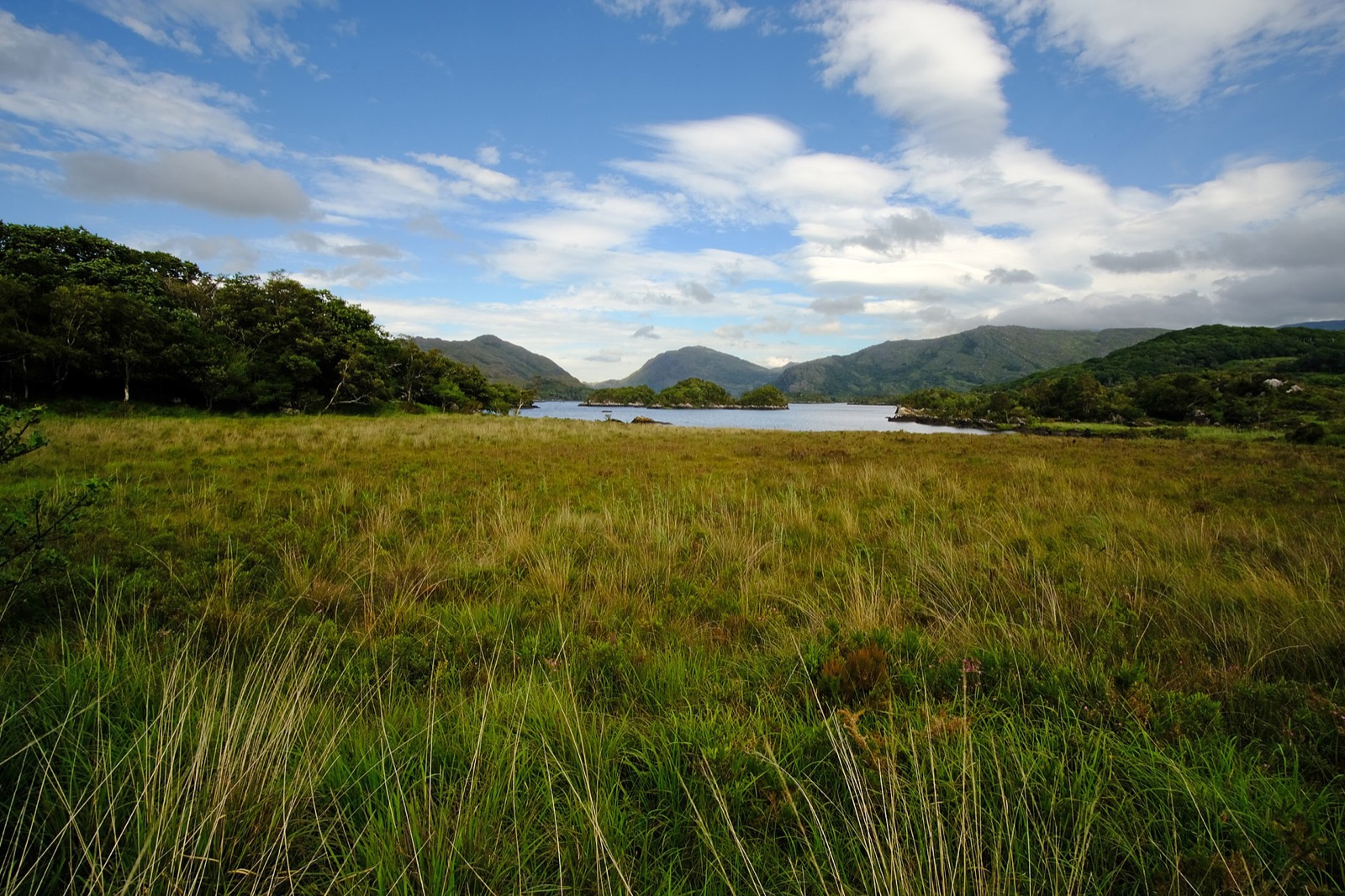
Killarney National Park, County Kerry, the gateway to the Ring of Kerry. Photo: Karie Kuiper, Wikimedia Commons, CC BY-SA 4.0.

Getting there from the United States
Ireland is the easiest European country for an American to enter, and the reason is structural rather than seasonal.
Entry rules: no Schengen, no ETIAS, no EES
Ireland is a European Union member that is not in the Schengen area. The European Commission states that Ireland is "exceptionally allowed by the Schengen Protocol not to apply the Schengen rules" and continues to enforce its own visa and border policies. Three consequences follow for US travelers. The new European Entry/Exit System does not apply at Irish borders. The ETIAS travel authorisation, due to start in the last quarter of 2026 for thirty European countries, does not cover Ireland either. And Irish Immigration Service Delivery states that visitors may come "for less than 90 days", with permission granted at the border by an immigration officer rather than in advance.
Days spent in Ireland also do not count against the Schengen ninety day allowance, which matters if Ireland is one leg of a longer European trip. Carry a passport valid for your whole stay.
Preclearance at Dublin and Shannon
Dublin and Shannon are two of only sixteen airports worldwide with US Customs and Border Protection Preclearance, and the only two in the European Union. You clear US immigration and customs in Ireland before boarding, and on arrival in the United States you "skip CBP and TSA inspection lines" and go straight to a connecting flight. For a traveler with a tight domestic connection, that alone is an argument for routing a European trip through Ireland. Allow extra time on departure.
Time difference and daylight saving
Ireland keeps Greenwich Mean Time in winter and moves one hour ahead to Irish Standard Time from the last Sunday in March to the last Sunday in October. For most of the year Dublin is five hours ahead of New York and eight hours ahead of Los Angeles. Because the United States changes its clocks on different dates, the gap is briefly four hours in mid March and six hours between late October and early November. An overnight eastbound flight from the East Coast lands in Dublin in the early morning, which is why a light first day and an early dinner work better than a full itinerary.
Planning a European trip alongside a domestic one? Our guide to the best time to visit the USA uses the same method on the other side of the Atlantic.
FAQ
What month is the best to go to Ireland?
September is the best single month. Dublin Airport still averages a 62 °F high, within four degrees of August, the Atlantic off Galway is at 60 °F, and Shannon Airport records fewer wet days in September than in July or August. American visitor numbers fall to 149,600 from 178,600 in August, so you get near summer conditions with noticeably more space.
What is the cheapest time to visit Ireland?
November to February, excluding the Christmas fortnight, is when demand is lowest. Central Statistics Office figures show 31,200 US residents visiting in February 2025 against 178,600 in August, a difference of 5.7 times. Rates follow that curve. The trade is daylight: December gives 7 hours 30 minutes at the solstice and 1.7 hours of sunshine a day.
What is the rainiest month in Ireland?
It depends on the coast. At Dublin Airport, November is wettest at 3.3 in (82.7 mm). At Shannon Airport and Cork Airport, December is wettest. At Valentia Observatory in Kerry, November takes 7.4 in (189.2 mm). By frequency rather than volume, December is the most persistent month at three of the four reference stations: 13.3 wet days in Dublin, 17.2 at Shannon and 16.8 at Cork.
What month has the worst weather in Ireland?
January combines the worst of everything. Dublin Airport records a 46 °F high, the lowest of the year, and Belmullet on the Mayo coast averages 6.3 gale days that month against 26.5 for the whole year. Daylight is barely above the December solstice low at the start of the month, and Atlantic boat services are not running.
Will August be hot in Ireland?
No. August averages a daily high of 66 °F (19.1 °C) at Dublin Airport and 64 °F at Valentia in Kerry, with nights around 52 °F. The absolute maximum recorded at Dublin Airport across the 1991 to 2020 period is 81 °F (27.2 °C). Pack layers and a waterproof shell rather than summer clothing, and do not count on air conditioning.
Is October a good time to visit Ireland?
Yes, with two conditions. Dublin highs hold at 56 °F, Kerry at 58 °F, and US arrivals fall to 127,500 from the August peak, so roads and sites are quiet. But Skellig Michael landings have ended for the year, and the last Monday in October is an Irish public holiday when domestic travel spikes. Plan daylight carefully.
How many days are enough for Ireland?
Plan around daylight rather than distance. In June a 17 hour day supports two regions in a week; in December a 7 hour 30 minute day supports one. A week covers Dublin plus one western region comfortably. Ten days lets you add the Ring of Kerry without driving the Wild Atlantic Way in the dark, which is the most common planning mistake.
Do US citizens need a visa or an ETIAS for Ireland?
No. Ireland is outside the Schengen area and enforces its own border policy, so neither the ETIAS travel authorisation nor the European Entry/Exit System applies there. Irish Immigration Service Delivery states that visitors may come for less than 90 days, with permission granted at the border. Carry a passport valid for the length of your stay.
Read next
- Where to stay in Ireland, our country hub for American travelers
- The Wild Atlantic Way, the coast that decides your travel window
- The Ring of Kerry, the wettest and mildest corner of the country
- Ireland's Ancient East, the dry side of the island
- The best time to visit the USA, the same method applied at home