The best time to visit Jamaica is December through April, the island's dry season, when Montego Bay's daytime high sits between 86 and 89 °F (30 to 31 °C), the sea holds 81 to 82 °F (27 to 28 °C) and the north coast collects under 3.5 inches of rain a month. The months to avoid are September and October, which carry the heaviest rainfall of the year and the peak of the Atlantic hurricane season. What almost no guide says: Jamaica has two rainy seasons, not one, with a drier spell in July. Pick your dates first, then your coast, then your hotel.
The short answer
- Best overall: mid-January to mid-April. Dry, hot, and clear of the hurricane window.
- Best value: late April to early June, after spring break and before the summer diaspora traffic.
- Avoid: September and October. The Meteorological Service of Jamaica measures 224 mm (8.8 in) in September and 248 mm (9.8 in) in October across the island, the two wettest months of the year.
- Two rainy seasons: the first peaks in May (244 mm, 9.6 in), the second in September and October. June and July fall back to roughly half that.
- Hurricane season: June 1 to November 30, with the climatological peak on September 10 according to the NOAA National Hurricane Center.
- Sea temperature: never below 81 °F (27 °C), reaching 86 °F (30 °C) from August to October.
- Crowds: December is the busiest month, with 302,594 stopover arrivals in 2024. September is the quietest, with 167,801.
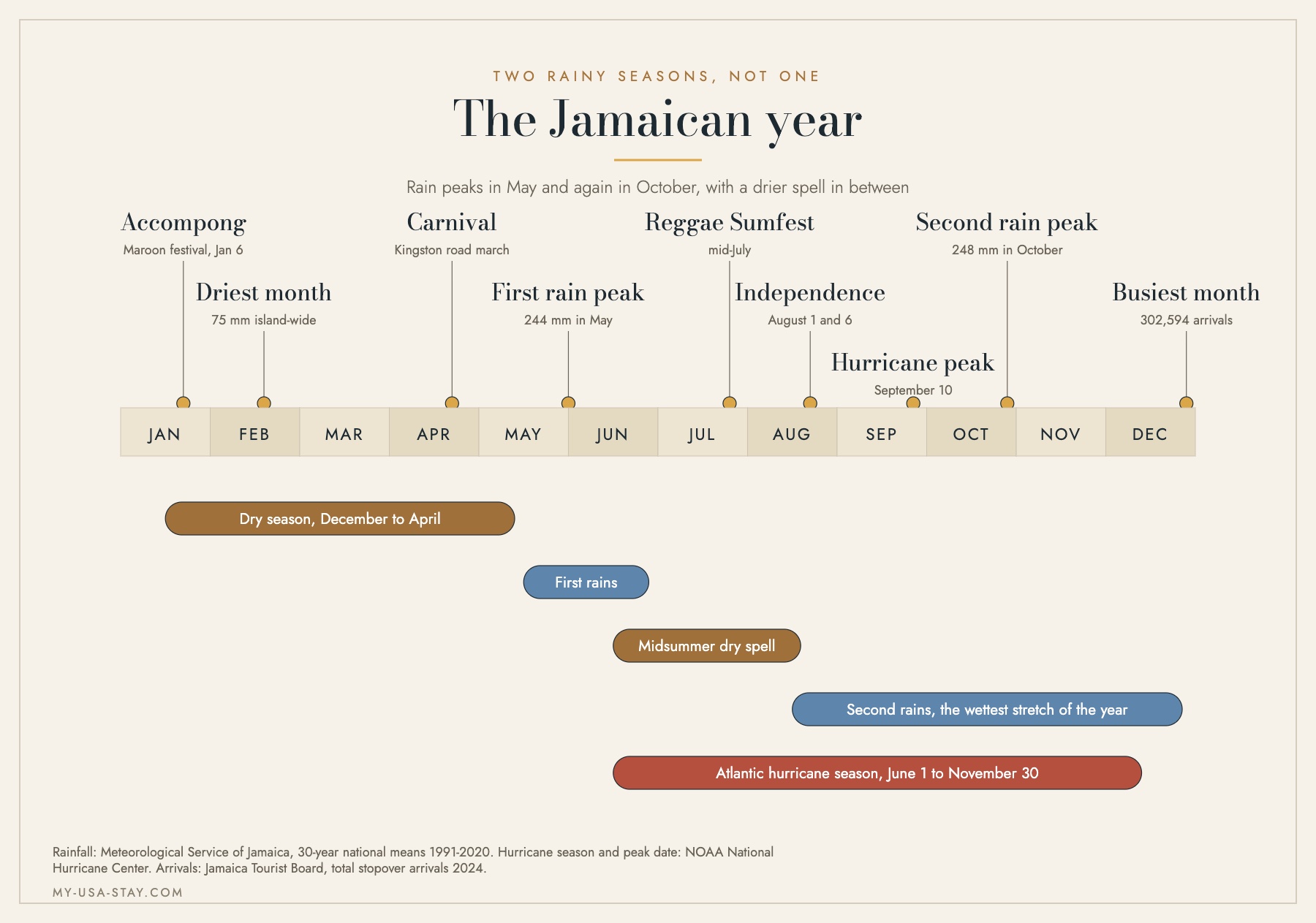
Jamaica has two rain peaks, in May and in October, with a drier spell in between. Rainfall from the Meteorological Service of Jamaica, hurricane season from NOAA, arrivals from the Jamaica Tourist Board.
Understanding the climate in Jamaica
Jamaica is not one climate but four, and the difference between them is rain, not heat. A mountain range runs down the spine of the island, so the northeast trade wind dumps its moisture on the eastern slopes and arrives dry on the south coast. The Meteorological Service of Jamaica publishes 30-year rainfall means for 1991 to 2020 by parish, and the spread is the single most useful number on this page: Portland, the parish around Port Antonio, collects 3,614 mm (142 in) a year. Kingston collects 1,377 mm (54 in). That is a factor of 2.6 across an island 146 miles long.
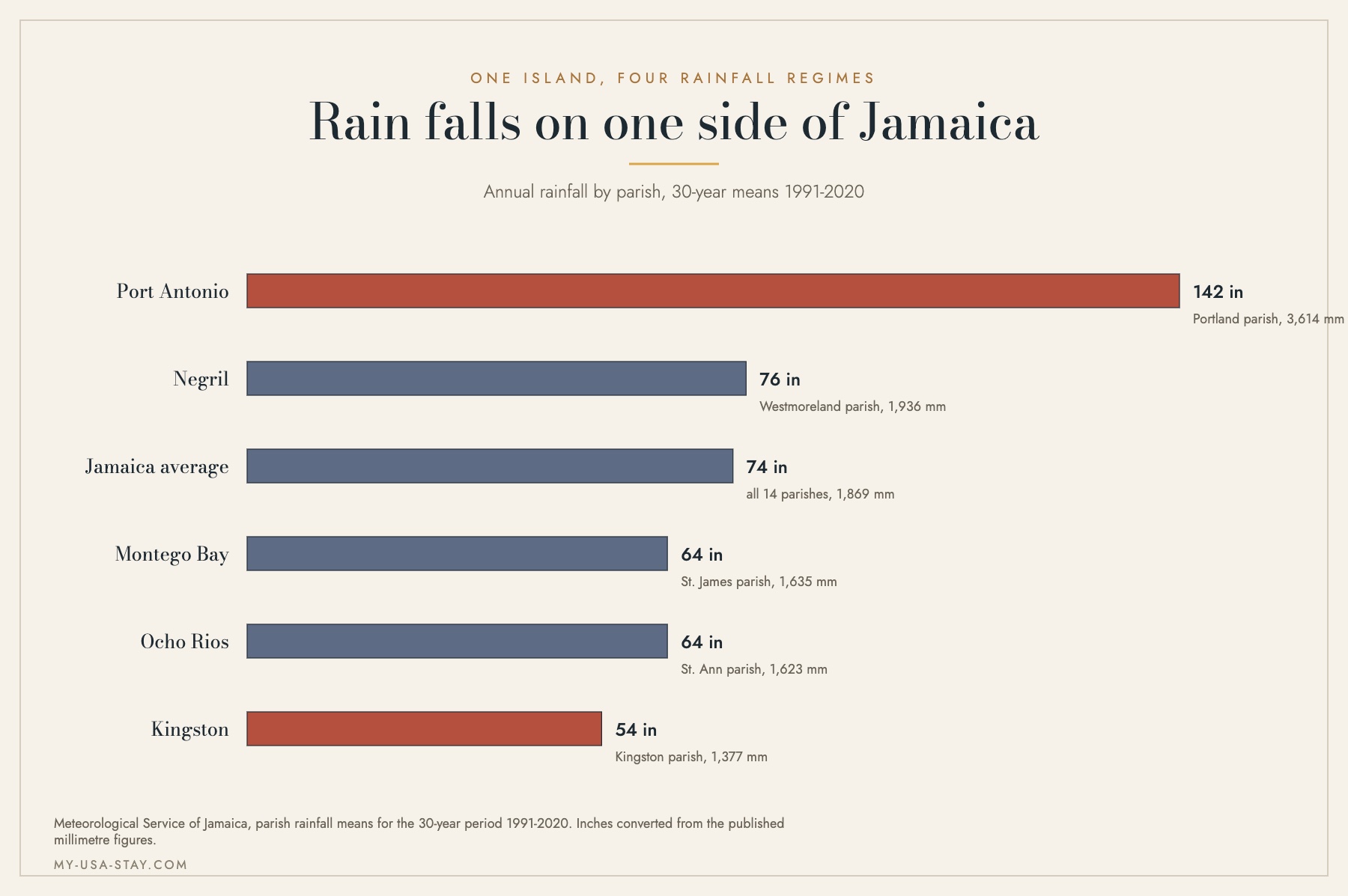
Port Antonio's parish collects almost twice the island average and 2.6 times what Kingston gets. Meteorological Service of Jamaica, 30-year parish means 1991 to 2020.
Temperatures barely move by comparison. The Meteorological Service's own station series, 20-year means for 1996 to 2015, puts Sangster International at Montego Bay at 33.4 °C (92 °F) in August and 29.8 °C (86 °F) in January, a swing of under seven degrees Fahrenheit across the whole year. Norman Manley at Kingston runs a shade warmer in winter, 30.9 °C (88 °F) in January, and a shade cooler in the peak of summer. We quote those station figures rather than a global reanalysis grid, because a grid cell over a narrow Caribbean shoreline is mostly seawater and flattens the daytime highs: for Montego Bay in August the reanalysis returns 31.4 °C where the airport station records 33.4 °C, a full two degrees Celsius short.
Altitude is the one thing that does move the thermometer. The Meteorological Service's inland station at Worthy Park, in the hills of St. Catherine, peaks at 31.4 °C (89 °F) in August, more than three degrees Fahrenheit below the Montego Bay coast, and drops to 27.8 °C (82 °F) in January. Go higher and it keeps falling. Blue Mountain Peak stands at 2,256 m (7,402 ft), the highest point in the Caribbean outside Hispaniola, and hikers there need a fleece at dawn in a country where nobody owns one.
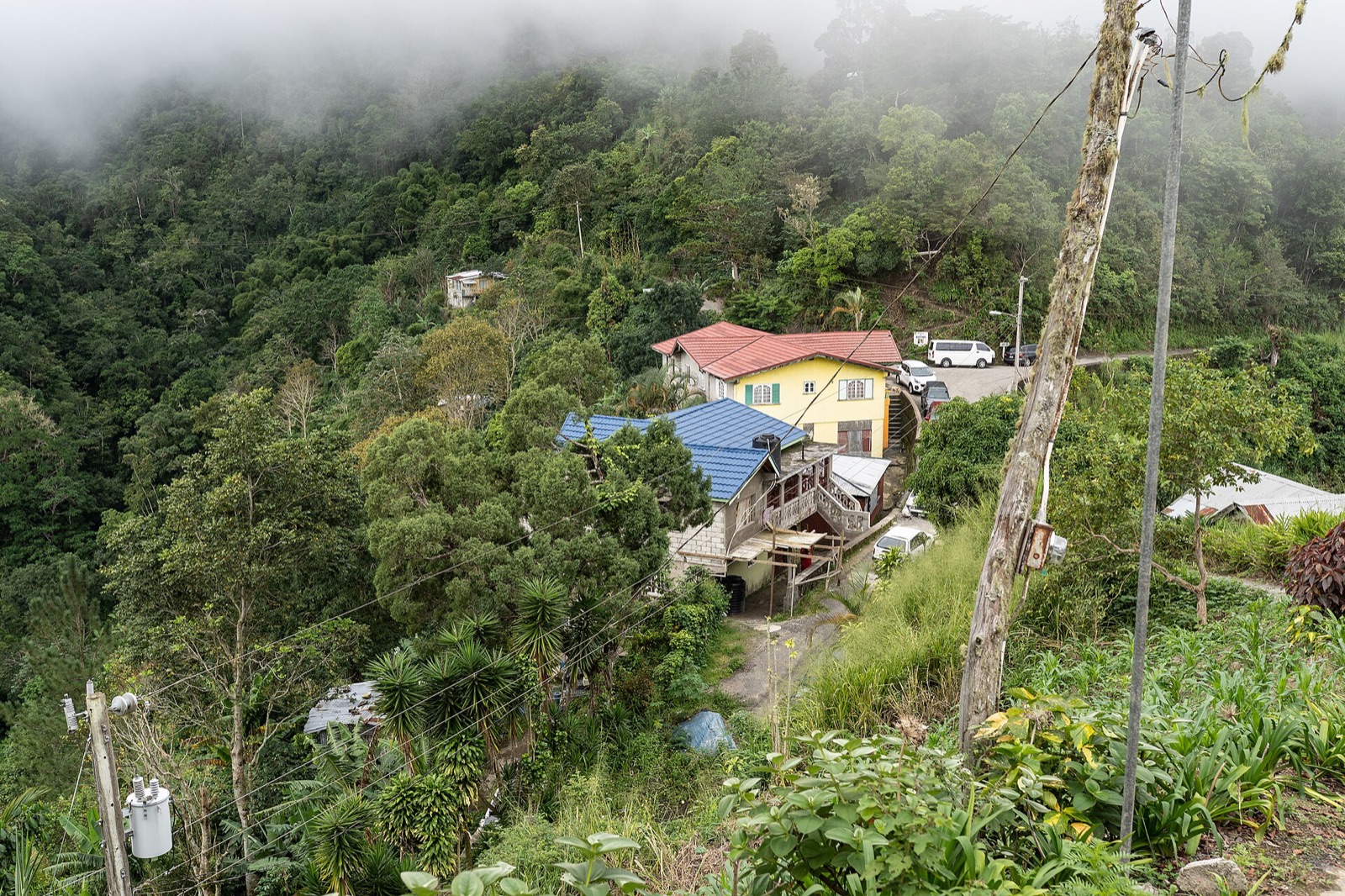
Fog over the village of Section, in the Blue Mountains of Portland parish. Photo: Matthew.kowal, Wikimedia Commons, CC BY-SA 4.0.

The dry season, December to April
This is the stretch to book if you want a beach holiday with the odds on your side. At Sangster station, Montego Bay records 43 mm (1.7 in) in February, the driest month of the Jamaican year, and never more than 84 mm (3.3 in) in any dry-season month. Daytime highs run 86 to 89 °F (30 to 31 °C). Humidity is at its lowest, the trade wind is steady, and the sea sits at 81 to 82 °F (27 to 28 °C), which reads cool on paper and is perfectly swimmable in practice.
What you trade for the weather is company and price. The Jamaica Tourist Board recorded 302,594 stopover arrivals in December 2024 and 291,443 in March, the two busiest months of the year, against an annual total of 2,900,358. December is Christmas and New Year. March is American spring break, and it lands hardest on Negril and Montego Bay. If you want the dry-season weather without the dry-season crush, aim for the second half of January or the first three weeks of February.
- Book flights and rooms for Christmas week and for mid-March several months out. Both sell through.
- Bring a light layer for evenings in the hills. Worthy Park's January high is 82 °F (28 °C) and nights are cooler still.
- The east coast is the exception to everything above. Portland parish records 413 mm (16 in) in January, more than Kingston gets in its wettest month.
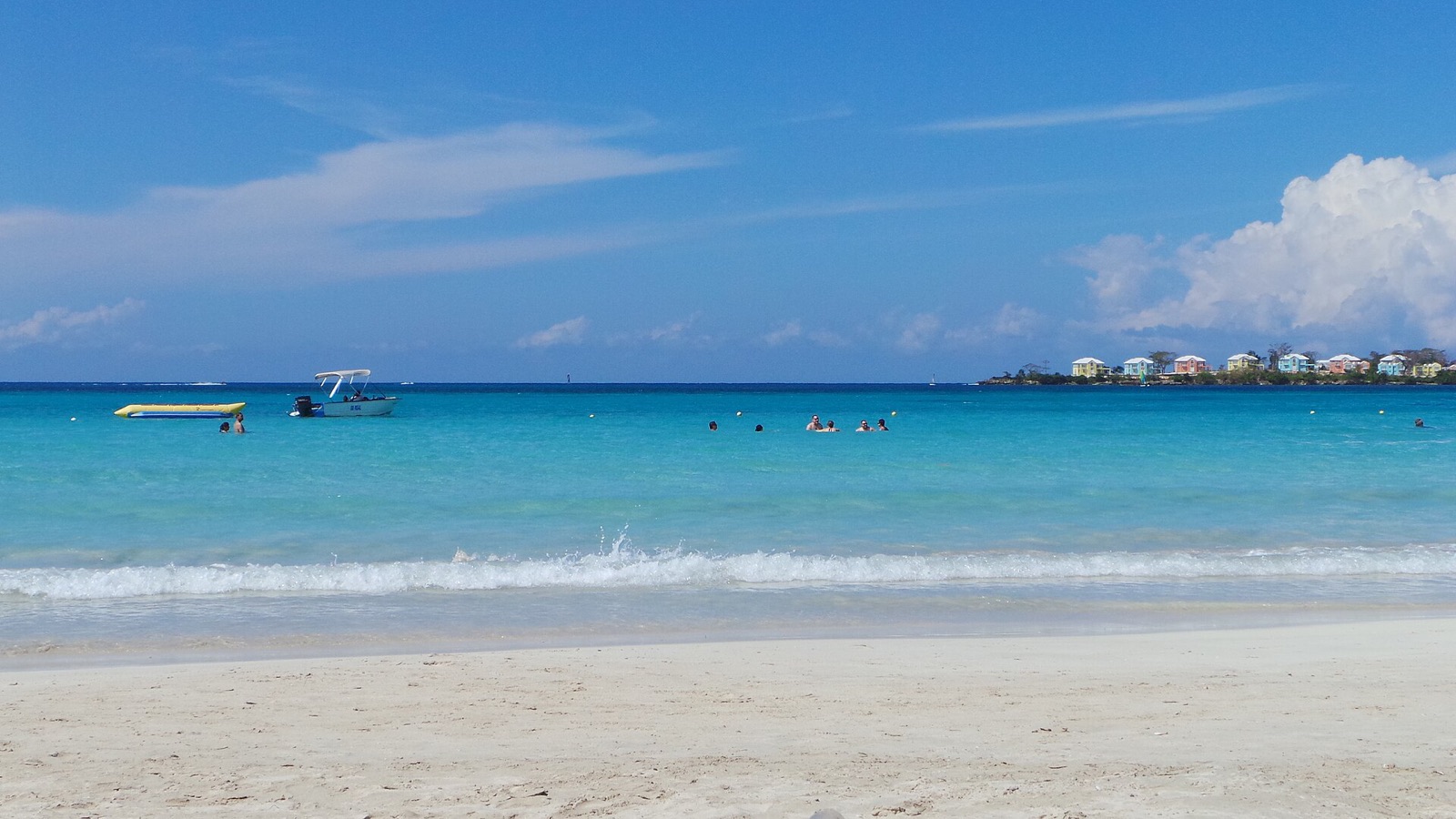
Bloody Bay at Negril, on the west coast, in the dry season. Photo: wardyboy400, Wikimedia Commons, CC BY 2.0.

The first rains and the midsummer dry spell, May to August
May is the first rainy season, and it is short. The national mean jumps to 244 mm (9.6 in), the highest monthly figure on the island after October, then falls back to 121 mm (4.8 in) in June and 127 mm (5.0 in) in July. This midsummer dry spell is a real feature of the Caribbean calendar and it is the piece most guides leave out. On the Montego Bay coast it is more striking still: the Sangster station records 66 mm (2.6 in) in July against 77 mm (3.0 in) in January. On the north coast, July is drier than January.
The catch is heat and the opening of the hurricane window. July and August are the hottest months, with Montego Bay highs of 92 °F (33 °C) and night lows that stay near 78 °F (26 °C). The sea reaches 85 to 86 °F (30 °C), warm enough that it stops cooling you. Hurricane season opens on June 1, though NOAA's climatology puts almost nothing in June and July: the curve only climbs sharply through August.
Visitor numbers tell you Jamaicans and the diaspora already know this. July 2024 drew 258,324 stopover arrivals, more than May, more than August and more than any month except December, March and June. Reggae Sumfest and the August 1 and August 6 holidays fill the island with people who are not on a package.
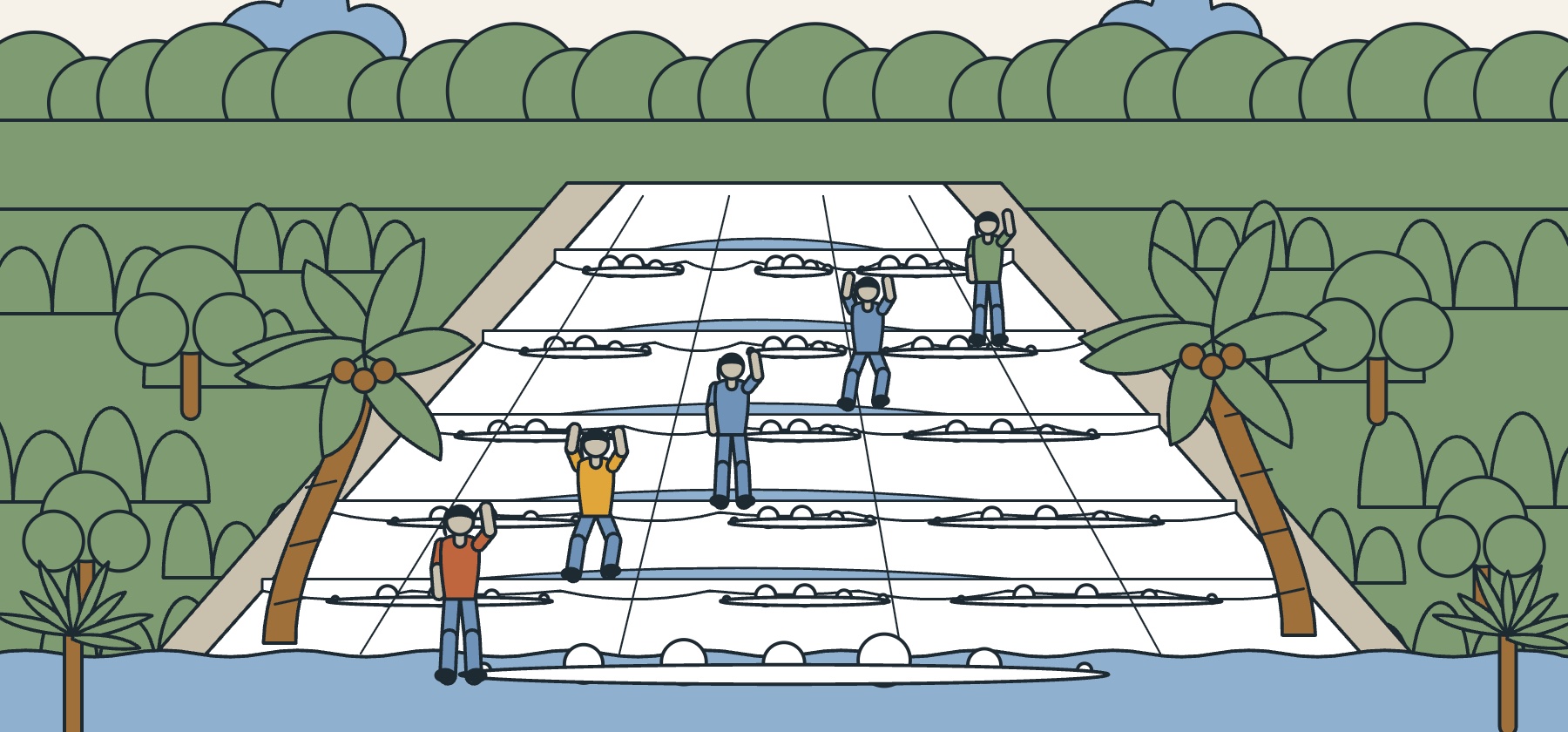
Dunn's River Falls at Ocho Rios, where the climb runs up terraced limestone in a human chain. Illustration: my-usa-stay.com.
The second rains and the hurricane season, September to November
September and October are the two months to skip if you have a choice. The Meteorological Service measures 224 mm (8.8 in) island-wide in September and 248 mm (9.8 in) in October, and the rain arrives in heavy afternoon systems rather than the brief showers of July. The NOAA National Hurricane Center puts the climatological peak of the Atlantic season on September 10, and an average season on the 1991 to 2020 record produces 14 named storms, 7 hurricanes and 3 major hurricanes across the whole basin.
Jamaica knows exactly what that means. On October 28, 2025, Hurricane Melissa came ashore in Westmoreland parish, between Belmont and New Hope, as a category 5 storm with sustained winds near 185 mph. It was the first category 5 hurricane on record to make landfall in Jamaica. Stopover arrivals for November 2025 fell to 70,081, against 218,878 in November 2024, a drop of 68 percent in the Jamaica Tourist Board's own figures.
The island reopened for visitors in December 2025. As of May 2026 the Ministry of Tourism reported 89 percent of attractions reopened, 75 percent of hotel rooms back online and electricity and water restored to between 83 and 90 percent of the network. Negril and Montego Bay recovered fastest. The south coast has been slower. If you are booking for this stretch, confirm directly with the property that it is trading, and buy travel insurance that covers named storms.
- September is the cheapest and emptiest month, with 167,801 arrivals in 2024 against a monthly average of about 242,000.
- November flips the map. Portland parish records its wettest month of the year, 538 mm (21 in), while Montego Bay is already back down to 107 mm (4.2 in).
- Book refundable rates. A storm watch changes plans faster than any other weather on this list.
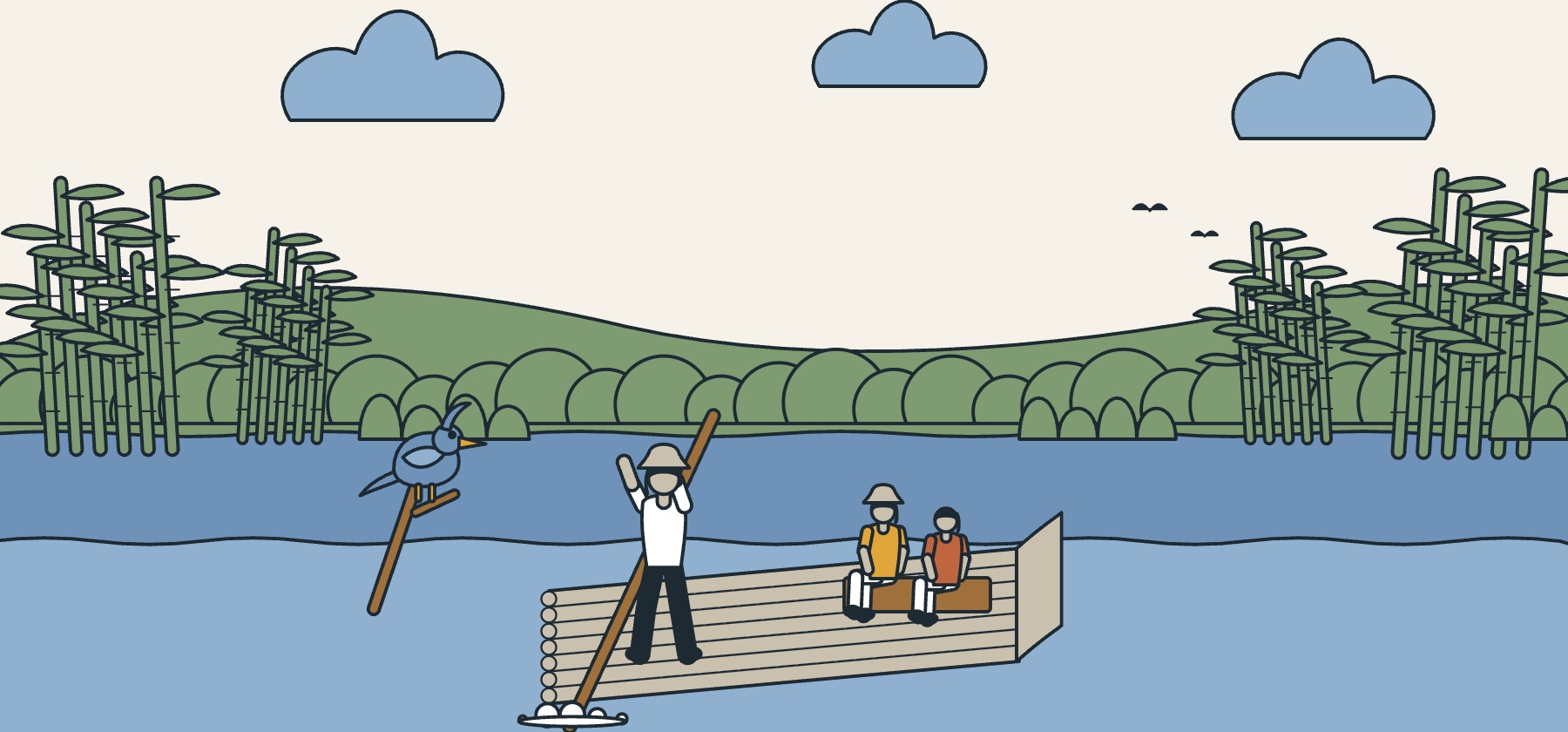
A bamboo raft on the Rio Grande near Port Antonio, on the wettest coast of the island. Illustration: my-usa-stay.com.
Jamaica month by month
The table below is built for the north coast, where most visitors stay, with Port Antonio's rainfall beside it so you can see the two Jamaicas in one row. Highs come from the Meteorological Service of Jamaica's station at Sangster International, rainfall from its 30-year parish and station means, arrivals from the Jamaica Tourist Board.
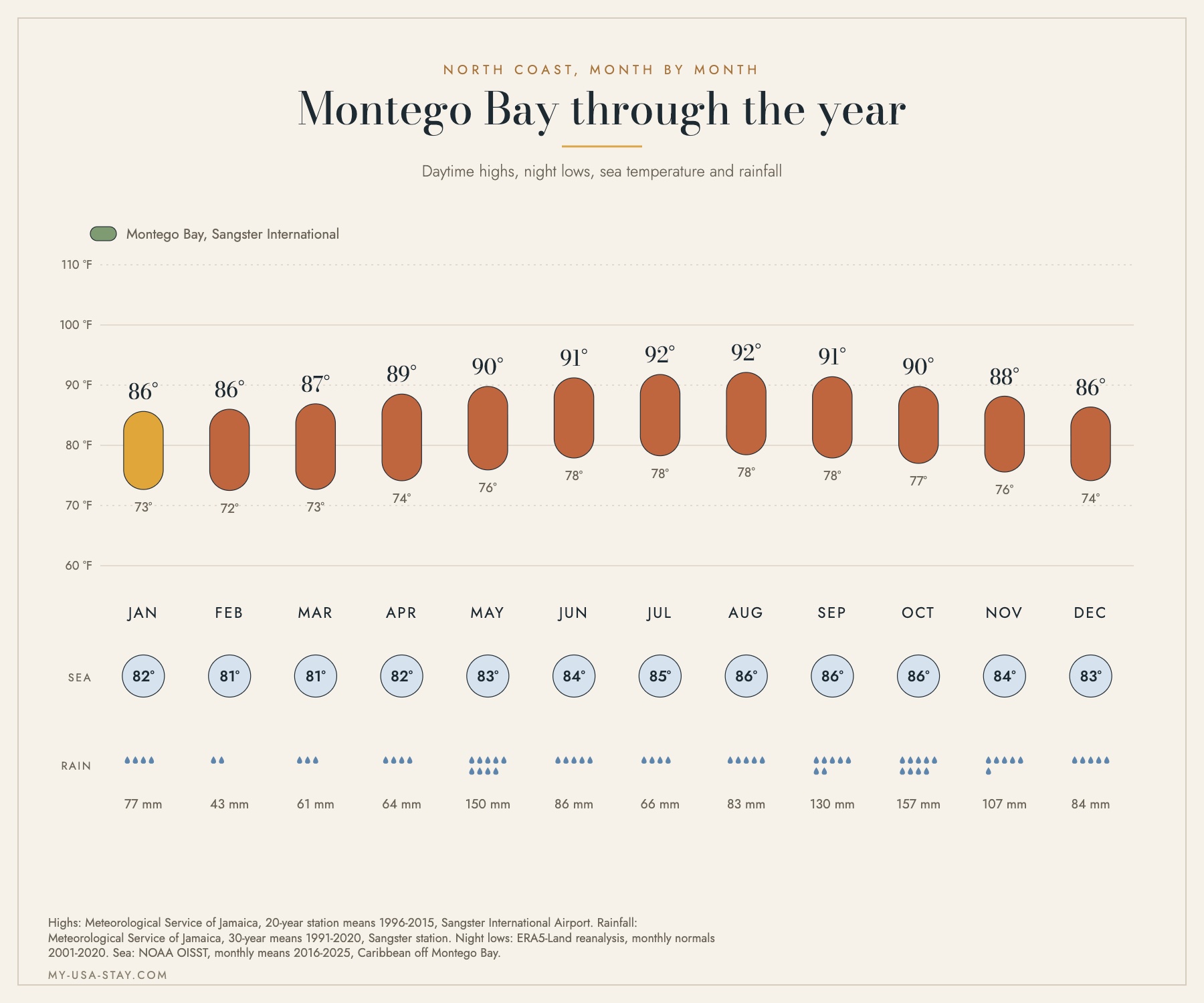
Montego Bay through the year. Highs and rainfall from the Meteorological Service of Jamaica at Sangster International, night lows from ERA5-Land, sea temperature from NOAA OISST.
| Month | High | Low | Sea | Rain, Montego Bay | Rain, Port Antonio | Arrivals (2024) | Verdict |
|---|---|---|---|---|---|---|---|
| January | 86 °F (30 °C) | 73 °F (23 °C) | 82 °F (28 °C) | 3.0 in | 16.3 in | 246,791 | Dry, peak season |
| February | 86 °F (30 °C) | 72 °F (23 °C) | 81 °F (27 °C) | 1.7 in | 9.6 in | 242,847 | Driest month islandwide |
| March | 87 °F (31 °C) | 73 °F (23 °C) | 81 °F (27 °C) | 2.4 in | 10.3 in | 291,443 | Spring break crowds |
| April | 89 °F (31 °C) | 74 °F (23 °C) | 82 °F (28 °C) | 2.5 in | 9.8 in | 239,229 | Warm, still dry |
| May | 90 °F (32 °C) | 76 °F (24 °C) | 83 °F (29 °C) | 5.9 in | 13.7 in | 229,387 | First rain peak |
| June | 91 °F (33 °C) | 78 °F (26 °C) | 84 °F (29 °C) | 3.4 in | 5.6 in | 263,053 | Rain eases, hot |
| July | 92 °F (33 °C) | 78 °F (26 °C) | 85 °F (30 °C) | 2.6 in | 6.9 in | 258,324 | Surprisingly dry month |
| August | 92 °F (33 °C) | 78 °F (26 °C) | 86 °F (30 °C) | 3.3 in | 8.1 in | 242,139 | Hottest, storms building |
| September | 91 °F (33 °C) | 78 °F (26 °C) | 86 °F (30 °C) | 5.1 in | 7.6 in | 167,801 | Quietest, riskiest month |
| October | 90 °F (32 °C) | 77 °F (25 °C) | 86 °F (30 °C) | 6.2 in | 15.1 in | 197,872 | Wettest month nationally |
| November | 88 °F (31 °C) | 76 °F (24 °C) | 84 °F (29 °C) | 4.2 in | 21.2 in | 218,878 | Drying west, soaked east |
| December | 86 °F (30 °C) | 74 °F (23 °C) | 83 °F (28 °C) | 3.3 in | 18.0 in | 302,594 | Dry and busiest |
Sources. Highs: Meteorological Service of Jamaica, 20-year station means 1996 to 2015, Sangster International Airport. Rain, Montego Bay: Meteorological Service of Jamaica, 30-year means 1991 to 2020, Sangster station. Rain, Port Antonio: same source, Portland parish mean. Night lows: ERA5-Land reanalysis, monthly normals 2001 to 2020. Sea: NOAA OISST, monthly means 2016 to 2025, Caribbean off Montego Bay. Arrivals: Jamaica Tourist Board, total stopover arrivals by month, 2024. Inches converted from published millimetre figures.
The best time for what you want to do
The right month depends far more on the activity than on the destination. Here is how the year splits.
Beach and swimming: January to April. Driest air, steadiest trade wind, sea at 81 to 82 °F (27 to 28 °C). Seven Mile Beach at Negril and Doctor's Cave at Montego Bay are at their calmest. If you want the warmest water rather than the driest sky, August to October reaches 86 °F (30 °C).
Waterfalls: any month, but they run hardest after the rains. Dunn's River Falls in St. Ann, operated by the Urban Development Corporation, and YS Falls in St. Elizabeth carry the most water from late May and again from late September. In February the flow is thinner and the climb is easier for children.
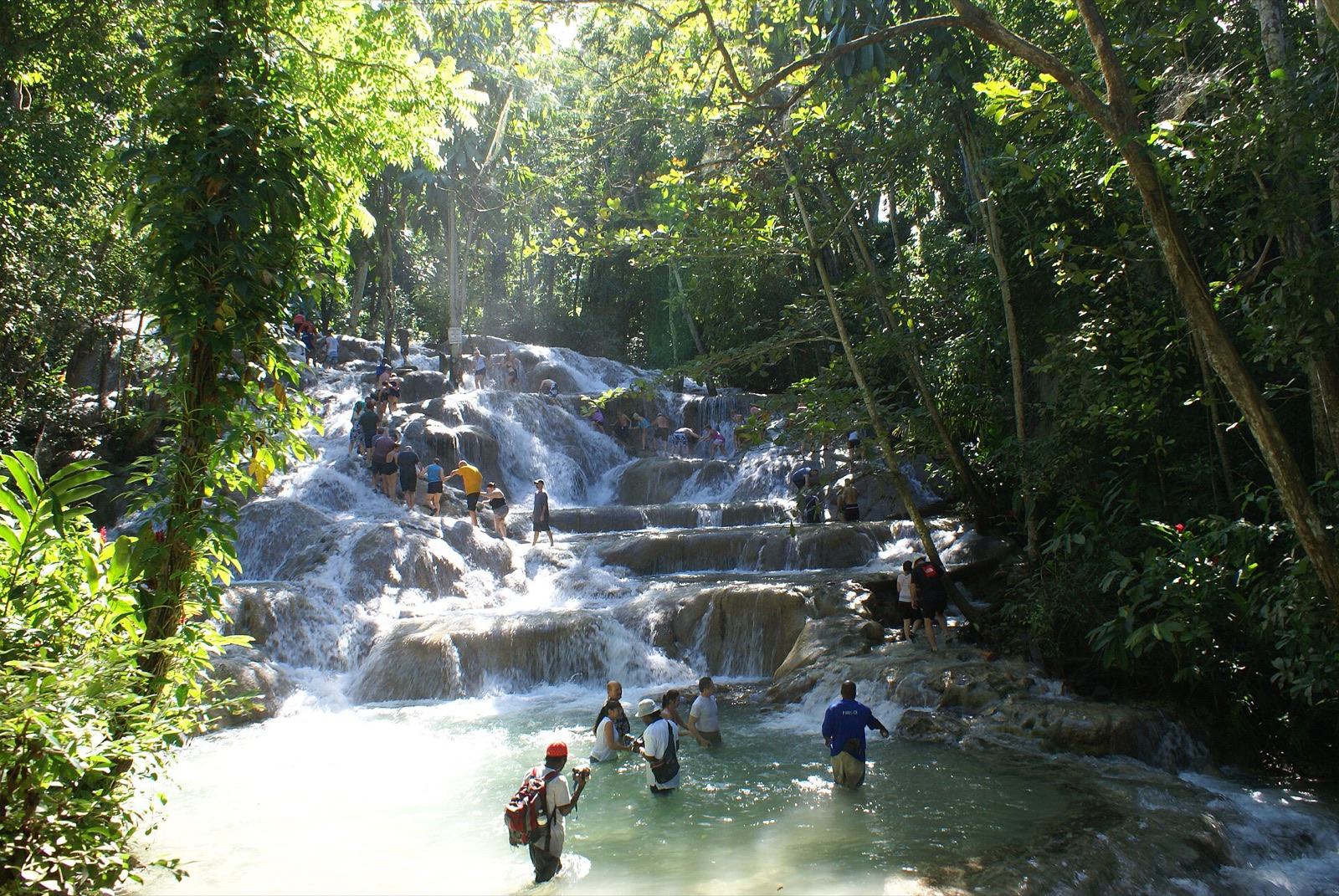
The climb at Dunn's River Falls, near Ocho Rios in St. Ann. Photo: Breakyunit at English Wikipedia, Wikimedia Commons, CC BY-SA 3.0.

Hiking the Blue Mountains: December to April. The Blue and John Crow Mountains National Park, a UNESCO World Heritage site managed by the Jamaica Conservation and Development Trust, charges visitors US$20 for the Blue Mountain Peak trail. The route is 9.3 km (5.8 miles) one way with roughly four hours of climbing and seven hours round trip. The park's own guidance is to start just after midnight to reach the summit for dawn, before cloud closes in. Do this in the dry months: the eastern slopes are the wettest ground in Jamaica and the trail turns to mud.
Coffee: November to February. Blue Mountain coffee is picked from late autumn into the new year, and the estates above Kingston around Mavis Bank are working through the crop then rather than showing an empty mill.
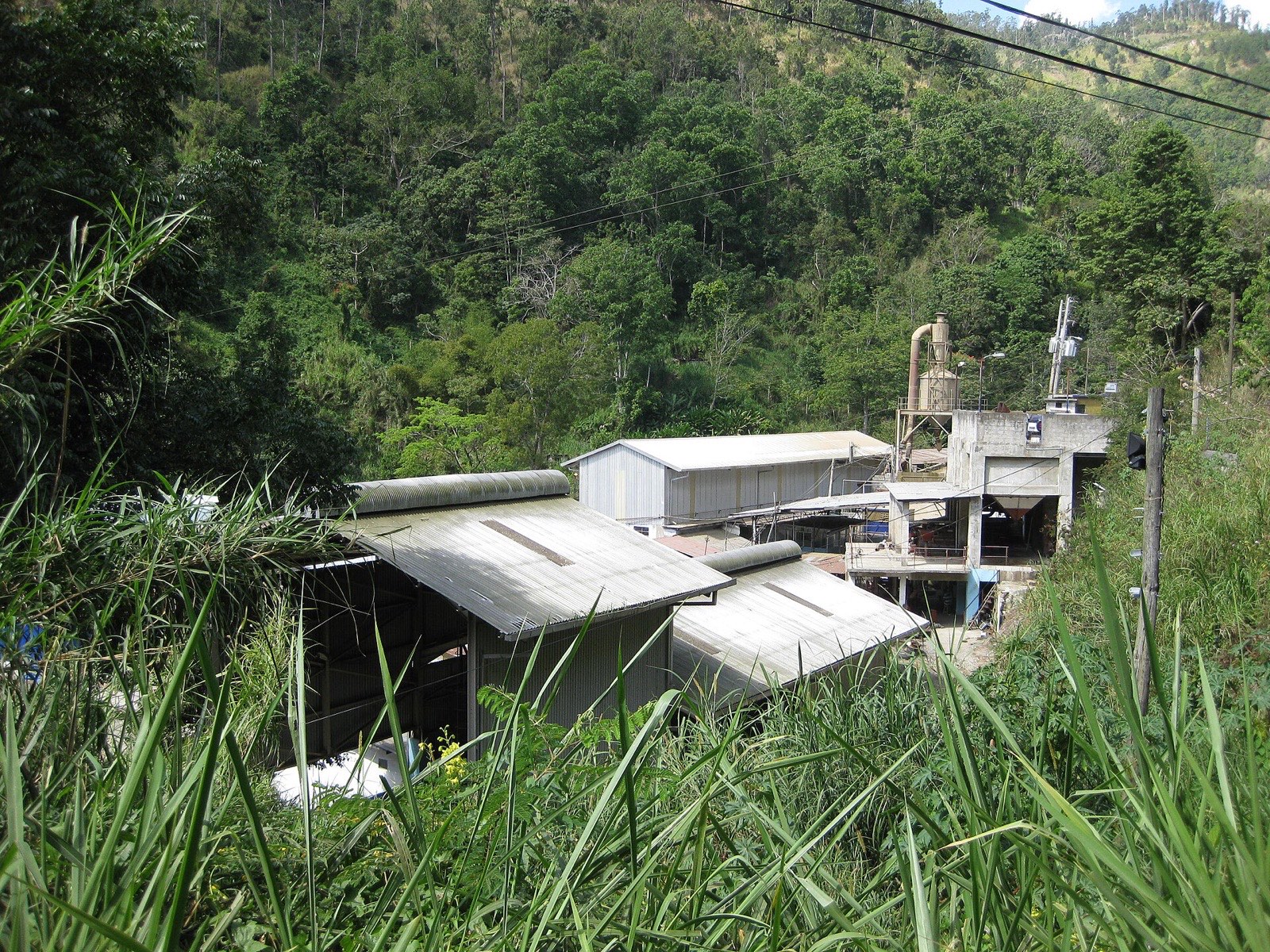
The coffee factory at Mavis Bank, in the Blue Mountain foothills above Kingston. Photo: Elizabeth B. Thomsen, Wikimedia Commons, CC BY-SA 4.0.

Snorkeling and diving: December to April. Least rain means least runoff, and runoff is what clouds the water off the north coast. The rivers of Portland and St. Mary push sediment out after every heavy month.
Music and carnival: January, April, July. The calendar clusters, and it is the subject of the next section.
Events that shape the year
Jamaica's cultural calendar has three poles, and two of them sit outside the dry season. Book rooms early for all of them.
January opens with the Accompong Maroon Festival on January 6 in St. Elizabeth, which marks the 1739 peace treaty with the British and the birthday of the Maroon leader Cudjoe. Rebel Salute, the roots reggae festival, runs in the same month. Both land inside the driest stretch of the year.
Carnival is tied to the Easter calendar, so it moves. The season of fetes runs through the weeks after Easter and ends with the road march through Kingston, normally in April. Check the organisers' dates before you book, because Easter can fall five weeks apart from one year to the next.
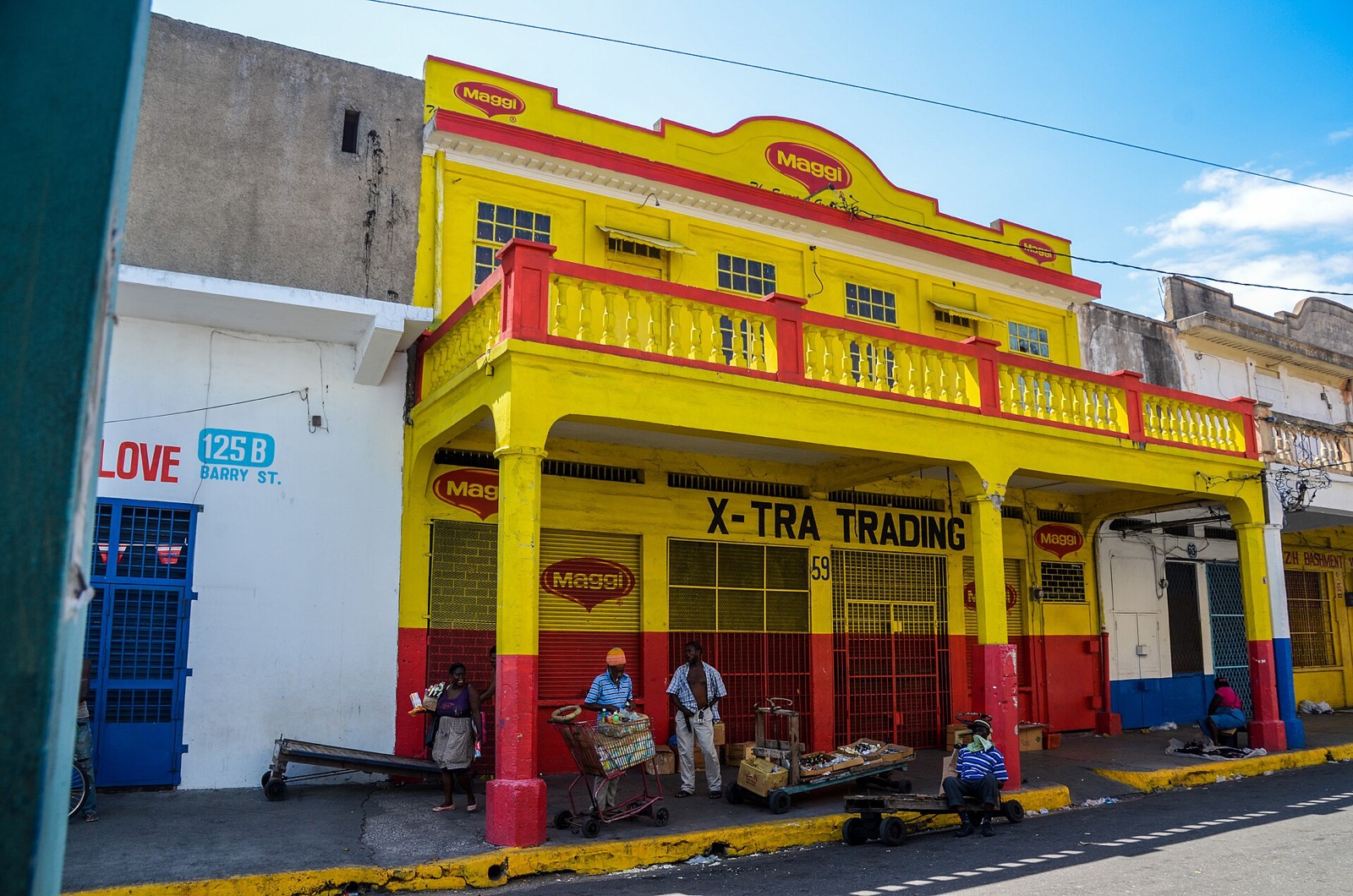
Downtown Kingston, where the carnival road march and most of the winter music festivals happen. Photo: Ralf Steinberger from Northern Italy and Berlin, Wikimedia Commons, CC BY 2.0.

Reggae Sumfest is the largest music event on the island and falls in mid-July. The 2026 edition was held on July 18 at Plantation Cove in St. Ann rather than at its usual Montego Bay home. Confirm the venue as well as the date for the coming year: it has moved.
Two national holidays fall together in the first week of August. Emancipation Day is August 1 and Independence Day is August 6. Domestic travel peaks, roads are busy and the whole island is out. It is the most Jamaican week of the year and the worst one for a quiet beach.
Where to go, coast by coast
Because rainfall varies so much more than temperature, the question of when to go and where to go is the same question. Four choices, four different years.
The north coast, Montego Bay to Ocho Rios. The mainstream, and the driest coastline with good air access. St. James parish averages 1,635 mm (64 in) a year and St. Ann 1,623 mm (64 in), both slightly under the national mean. Works from December to April, and again in July. Our hotel listings cover the Montego Bay coast and the Ocho Rios coast in detail.
The west, Negril. Westmoreland parish averages 1,936 mm (76 in), a little above the island mean, but the Negril Point Lighthouse station on the headland itself records only 1,259 mm (50 in): the rain falls inland, not on the beach. Negril takes the sunset and the flattest water. It is also where spring break concentrates in March.
The south, Kingston and the plains. The driest part of Jamaica by a wide margin, with 1,377 mm (54 in) a year in Kingston and just 32 mm (1.3 in) in February. It is also the hottest in high summer. Come for the music, the Bob Marley Museum and the mountains behind the city, not for a beach.
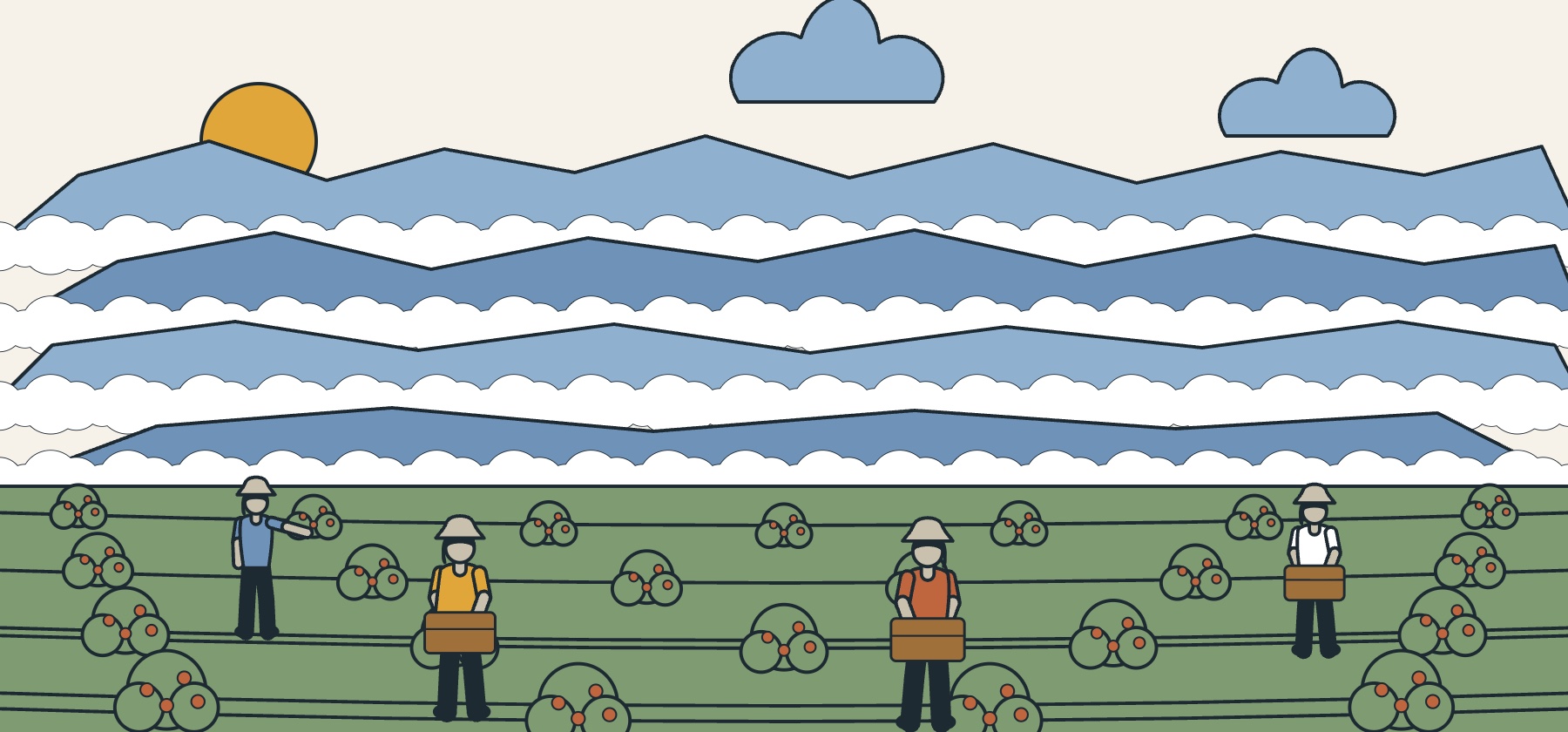
The Blue Mountains at first light, with the coffee terraces that are picked from late autumn into the new year. Illustration: my-usa-stay.com.
The east, Port Antonio and Portland. The green one. 3,614 mm (142 in) a year, and a rainfall calendar that runs backwards from the rest of the island: Portland's wettest months are November (538 mm, 21 in), December (456 mm, 18 in) and January (413 mm, 16 in), while its driest is June (143 mm, 5.6 in). If you are going east for the Rio Grande rafting, the Blue Lagoon and Frenchman's Cove, go in June or July, not in the winter dry season that works everywhere else.
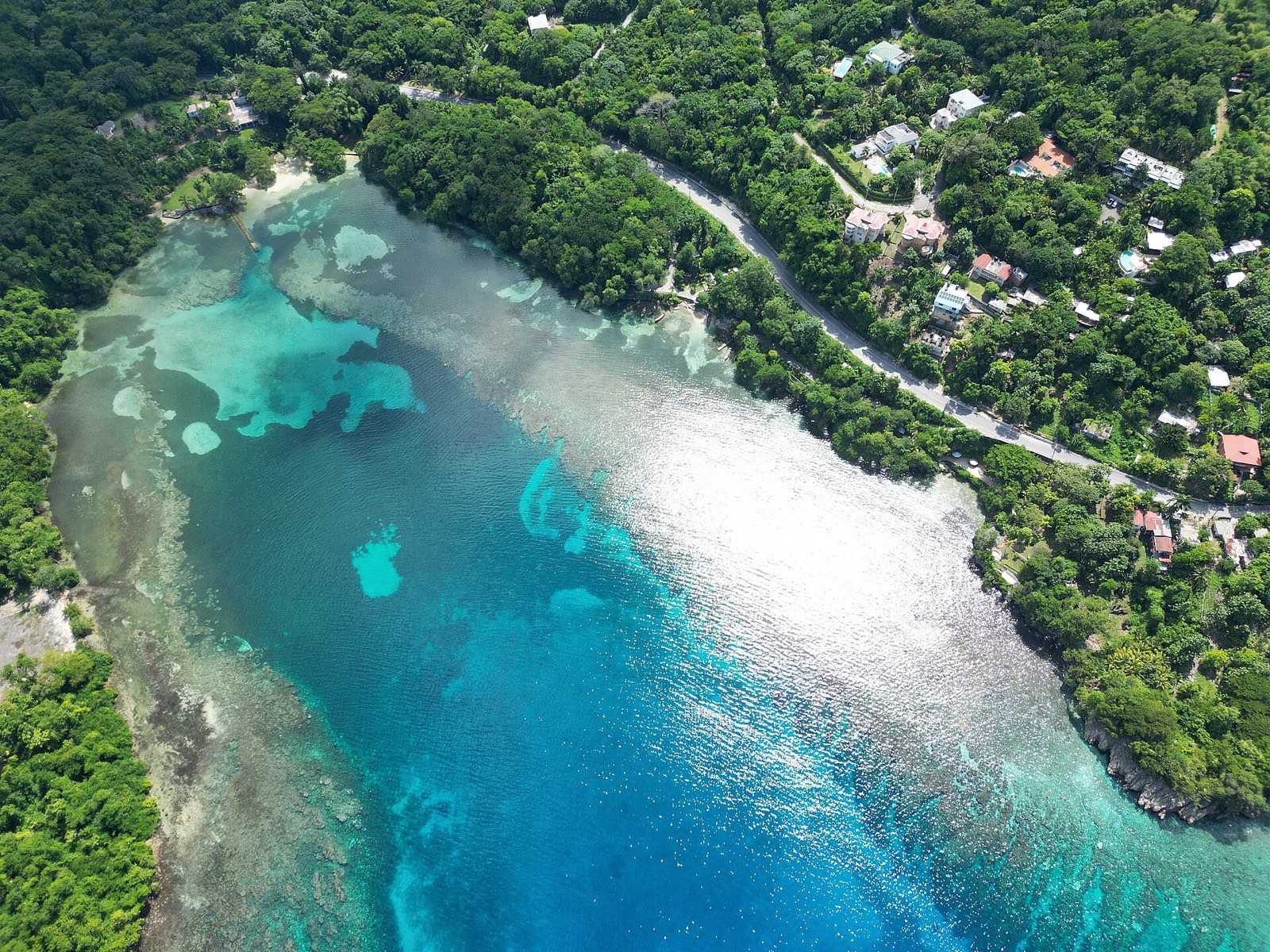
San San Bay, near Port Antonio, on the green east coast. Photo: Layneartz19, Wikimedia Commons, CC BY-SA 4.0.

Getting there from the United States
Jamaica is one of the shortest international flights an American can take, and the entry rules are among the simplest in the Caribbean.
Airports. Sangster International (MBJ) at Montego Bay is the gateway for the north and west coasts and handled 5 million passengers in 2025. It carries nonstop service from US hubs including New York JFK, Miami and Baltimore. Norman Manley (KIN) at Kingston serves the capital, the south coast and the Blue Mountains, and is the right arrival airport if the Peak is on your list. Ian Fleming International at Boscobel handles regional traffic for Ocho Rios.
Entry. United States citizens need no visa. Jamaica's Passport, Immigration and Citizenship Agency states plainly that US passport holders may enter for up to six months without one. You will need a valid passport, and the immigration and customs declaration, the C5, is filed online in advance at enterjamaica.gov.jm, PICA's own site. Check the US State Department country page for the current travel advisory level before you book.
Time difference. This is the detail that catches people out. Jamaica keeps Eastern Standard Time all year and does not move its clocks. From November to March it is the same time as New York, one hour ahead of Chicago and three ahead of Los Angeles. From March to November, when the mainland springs forward and Jamaica does not, it is one hour behind New York, the same time as Chicago and two hours ahead of Los Angeles. A 3 p.m. flight home in July departs an hour later than your body expects.
School holidays and prices. American demand, not Jamaican weather, sets the price of a room. The Jamaica Tourist Board's monthly arrivals map onto the US calendar almost exactly: December (302,594), March (291,443) and July (258,324) are the three heaviest months of 2024, which is Christmas, spring break and summer vacation. The cheap windows are the ones between them: late April to early June, and September, if you accept the weather that comes with September. The same logic drives prices in the United States itself.
FAQ
What month is best to go to Jamaica?
Mid-January to mid-April is the best month range. February is the driest month on the island, with just 43 mm (1.7 in) at Montego Bay's Sangster station, highs of 86 °F (30 °C) and a sea at 81 °F (27 °C). It also falls outside the June to November hurricane season. March is equally dry but carries American spring break crowds.
What is Jamaica's rainy season?
Jamaica has two rainy seasons rather than one. The first peaks in May, when the Meteorological Service of Jamaica records a national mean of 244 mm (9.6 in). The second runs from September to November and peaks in October at 248 mm (9.8 in). June and July fall back to around 125 mm (5 in), a genuine midsummer dry spell.
What is Jamaica's rainiest month?
October is the rainiest month island-wide, at 248 mm (9.8 in) in the Meteorological Service of Jamaica's 30-year means for 1991 to 2020. The answer changes by coast. In Portland parish, around Port Antonio, the wettest month is November at 538 mm (21 in), and January is wetter than any month Kingston sees.
What months to avoid in Jamaica?
September and October are the months to avoid. They are the two wettest of the year, they straddle the September 10 climatological peak of the Atlantic hurricane season, and September is the emptiest month for visitors, with 167,801 stopover arrivals in 2024 against a monthly average near 242,000. Resorts run reduced service.
What month do most hurricanes hit Jamaica?
September carries the highest risk. The NOAA National Hurricane Center puts the climatological peak of the Atlantic season on September 10, with most activity between mid-August and mid-October. The season officially runs June 1 to November 30. Hurricane Melissa, the first category 5 storm on record to make landfall in Jamaica, came ashore on October 28, 2025.
What month is the cheapest to go to Jamaica?
September is the cheapest month, because it is the emptiest. The Jamaica Tourist Board counted 167,801 stopover arrivals in September 2024, roughly 45 percent fewer than in December. The best compromise between price and weather is late April to early June, after spring break ends and before the July diaspora and summer traffic arrives.
Which month is the hottest in Jamaica?
July and August are the hottest months. The Meteorological Service of Jamaica's station means put Sangster International at Montego Bay at 33.2 °C (92 °F) in July and 33.4 °C (92 °F) in August, with night lows near 78 °F (26 °C). The sea reaches 86 °F (30 °C), warm enough to stop being refreshing.
Is Jamaica open after Hurricane Melissa?
Yes. Jamaica reopened to visitors in December 2025, and all three international airports were operating by January 1, 2026. As of May 2026 the Ministry of Tourism reported 89 percent of attractions reopened and 75 percent of hotel rooms back online. Negril and Montego Bay recovered fastest, the south coast more slowly. Confirm your property directly.
Read next
- Where to stay in Jamaica, coast by coast.
- Hotels on the Montego Bay coast, the driest and best connected stretch.
- Hotels on the Ocho Rios coast, closest to Dunn's River Falls.
- The best time to visit the USA, if you are weighing a domestic trip against the Caribbean.
- Hotels in the Dominican Republic, the nearest comparison on the same hurricane calendar.