The best time to visit Greece is late May to mid June and September to early October: warm days, a sea that has had time to heat up, and hotels that are all open. August is the month to avoid if you have any choice, because it takes 21.6 percent of the country's foreign hotel nights on its own and Athens averages a high of 89 F (32 C). The real trap for American travelers is winter on the islands. Foreign overnight stays fall 88 percent between October and November, and most Cycladic hotels, tavernas and ferry routes simply stop. Start planning on our travel guides for American travelers.
The short answer
- Best overall: September. The Aegean is still 76 F (24.6 C), Athens has come down to a high of 83 F, and the islands are fully open.
- Best value with good weather: late May and early October. National hotel occupancy is 50.2 percent in May and 38.4 percent in October, against 81.0 percent in August (ELSTAT, 2024).
- Avoid if you can: the first three weeks of August. Peak crowds, prices and heat, with the meltemi wind at its strongest.
- Do not plan an island trip between November and March. Those five months together account for 3.4 percent of Greece's foreign hotel nights.
- Swimming season: June through October. The sea off Crete reaches 79 F (26.1 C) in August and is still 74 F in October, the same as it was in June.
- Wettest months: November and December in Athens (13.7 rain days in December), December and January on Crete (16 rain days in January in Heraklion).
- Athens works all year. Even in January the average high is 56 F (13.6 C), and the Acropolis is open daily on winter hours.
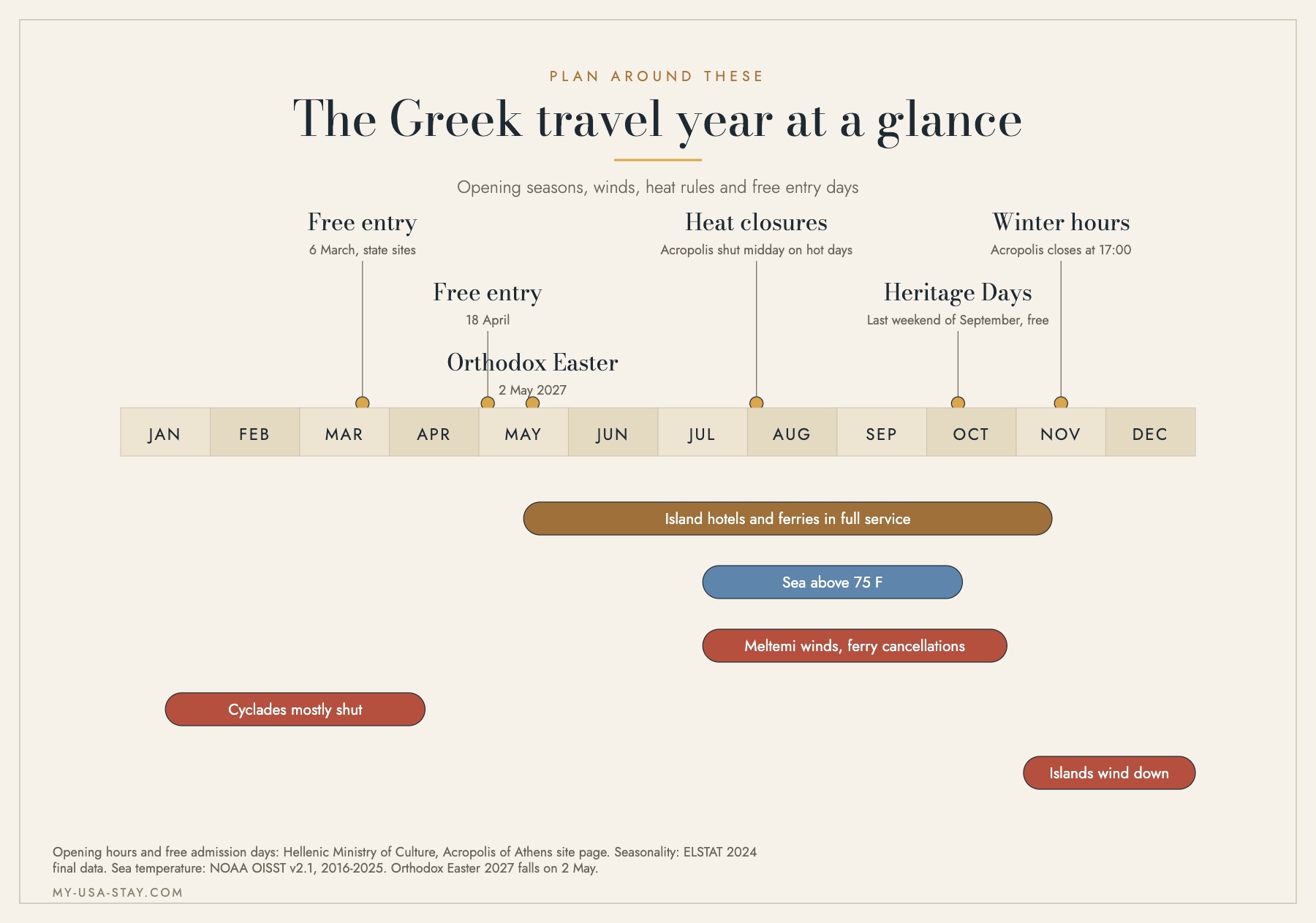
The Greek travel year at a glance: opening seasons, winds, heat rules and free entry days.
The island season is not the Greek season
Greece has two calendars, and confusing them is the most expensive mistake an American visitor can make. Athens, Thessaloniki and the mainland run all year. The Cyclades, the Dodecanese and most smaller islands run a season that opens around Orthodox Easter and closes in late October.
The Hellenic Statistical Authority measures it precisely. In its final 2024 data, published on 22 July 2025, foreign visitors spent 9,469,380 nights in Greek accommodation in October and 1,145,510 nights in November. That is a fall of 88 percent in four weeks. December brings 792,151 foreign nights, January 577,589. August alone brings 27,658,434, which is 48 times January.
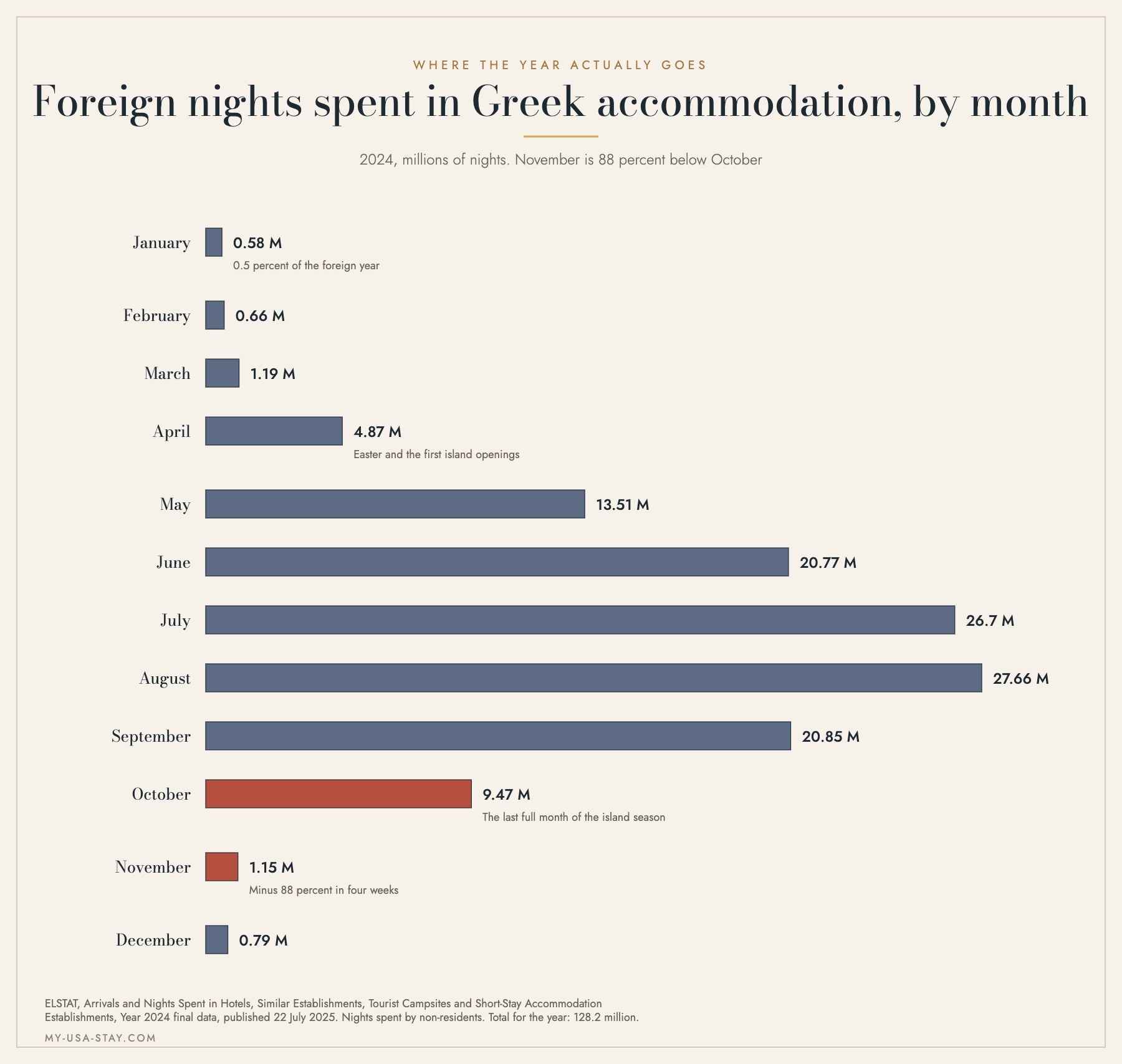
Foreign overnight stays by month in 2024. November is 88 percent below October.
Those numbers measure what is open, not what is fashionable. A hotel that fills for five months does not stay staffed for the other seven, so it shuts, and so do the taverna next door, the rental car desk and the ferry timetable. ELSTAT's occupancy series makes the same point from the other side: counting only establishments that are open at all, Greek hotel beds were 81.0 percent full in August 2024 and 12.1 percent full in February.
Book a November week on Santorini or Mykonos and you will land somewhere real and beautiful with almost nothing running. For Greece in winter, go to Athens, Thessaloniki, Crete or Rhodes, which have year round populations.
Understanding the climate in Greece
Greece has a Mediterranean climate with hot dry summers and mild wet winters, but the spread between its regions is wider than most visitors expect. The figures below are the Hellenic National Meteorological Service normals, published through the WMO World Weather Information Service.
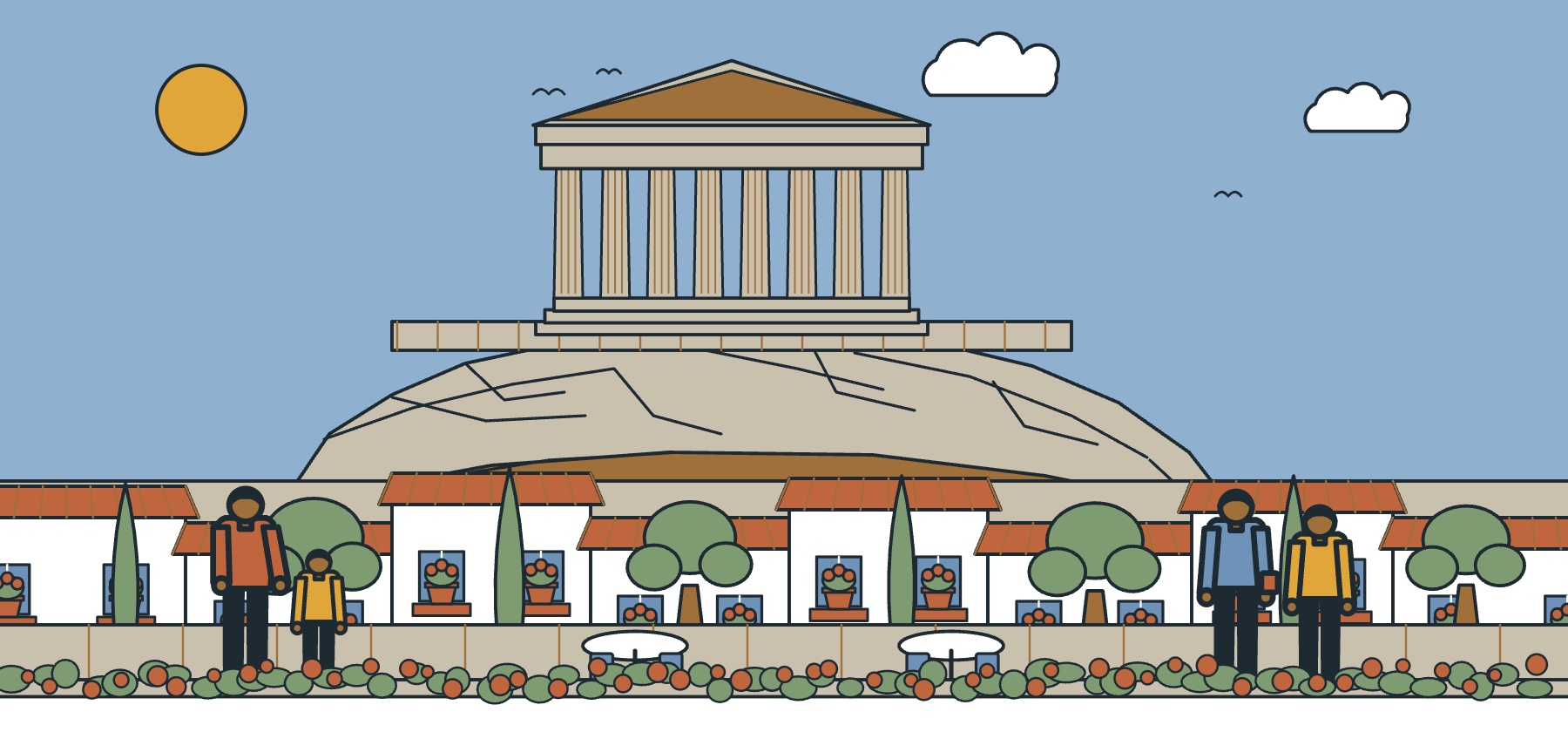
The Acropolis seen from Plaka, the neighbourhood most first visits are based in. Illustration: my-usa-stay.com.
Athens, measured at the coastal Hellinikon station in south Attica, averages a high of 89 F (31.8 C) in July and August and 56 F (13.6 C) in January. It is dry: 5.2 mm of rain in July across 1.6 rain days. Central Athens runs hotter than the coast, and the ERA5-Land reanalysis puts the July high downtown at 91 F (33.0 C), which is what you feel on the Acropolis rock.
Thessaloniki, 300 miles north, is the continental one. Its January low averages 34 F (1.3 C), ten degrees colder than Athens, and it gets rain in every month, including 44.4 mm in May. Pack differently for the north in spring.
Heraklion on Crete is the southern extreme, and the most useful station for anyone heading to the islands. Its summer is gentler than Athens (a July high of 84 F, not 89) but its winter is far milder: a January high of 60 F (15.3 C) and a low of 48 F. It is also the driest place in high summer in this comparison, with 0.6 mm of August rain across 0.4 rain days.
Corfu, on the Ionian side, is the wet one: roughly 1,097 mm of rain a year against 405 mm in Athens, with 187.4 mm in November alone. Rhodes sits between Crete and Athens, with a July high of 87 F, almost no summer rain, and 157.4 mm in December.
One caution about Santorini. Reanalysis grids over a small island are dominated by the surrounding water and flatten the highs, which is why our dataset returns an August high of only 78 F for Thira and why we do not quote it. The Hellenic National Meteorological Service publishes no Santorini station through the WMO service, so this page uses Heraklion as its official south Aegean reference and says so each time.
Spring in Greece: March to May
Spring is the best time to walk in Greece and the worst time to count on a swim. Athens climbs from a 60 F high in March to 75 F in May, and rain days drop from 11.9 to 6.8 across the same three months. The sea, however, lags badly: the Aegean sits at 62 F (16.9 C) in March and only reaches 67 F (19.5 C) in May. It is the coldest water of the year in February and March, colder than the air.
What spring gives instead is the mainland at its best and a country that is still cheap: national hotel occupancy is 18.6 percent in March and 30.2 percent in April. Sites stay on winter hours until 31 March, so the Acropolis closes at 17:00 and you should start early.
Precautions for a spring trip:
- Check Easter before you book. Orthodox Easter falls on 2 May in 2027, and it is the one week when Greeks themselves travel. Ferries, domestic flights and mainland hotels fill.
- Do not assume the islands are open in March or April. Many Cycladic hotels open for Easter week, then close again until May.
- Pack a rain layer for the north. Thessaloniki records 12.4 rain days in March and 10.7 in May.
- Swim in Crete, not the Cyclades. The Sea of Crete runs about one degree warmer than the Aegean all spring.
Three of the year's free admission days at Greek state sites fall in this window: 6 March, 18 April and 18 May, published by the Hellenic Ministry of Culture.
Summer in Greece: June to August
Summer is when Greece works exactly as advertised and when it is hardest to enjoy. June is the honest sweet spot: Athens averages 84 F, the Aegean has reached 72 F (22.5 C), everything is open, and occupancy is 69.2 percent rather than August's 81.0.

A Santorini village on the caldera, at the height of a season that runs May to October. Illustration: my-usa-stay.com.
July and August bring three specific problems that the brochures skip.
Heat closures at archaeological sites. On the hottest afternoons the Greek Ministry of Culture shuts the Acropolis and other exposed sites. On 8 July 2025 it ordered the site closed until 17:00, with 42 C (108 F) forecast in parts of the country and 38 C (100 F) in Athens, while the labour ministry paused outdoor work from noon to 17:00. The same happened during the heatwave of 21 to 23 July 2026. In July and August, book the 08:00 slot: it is the coolest hour, the least crowded, and it cannot be caught by an afternoon closure.
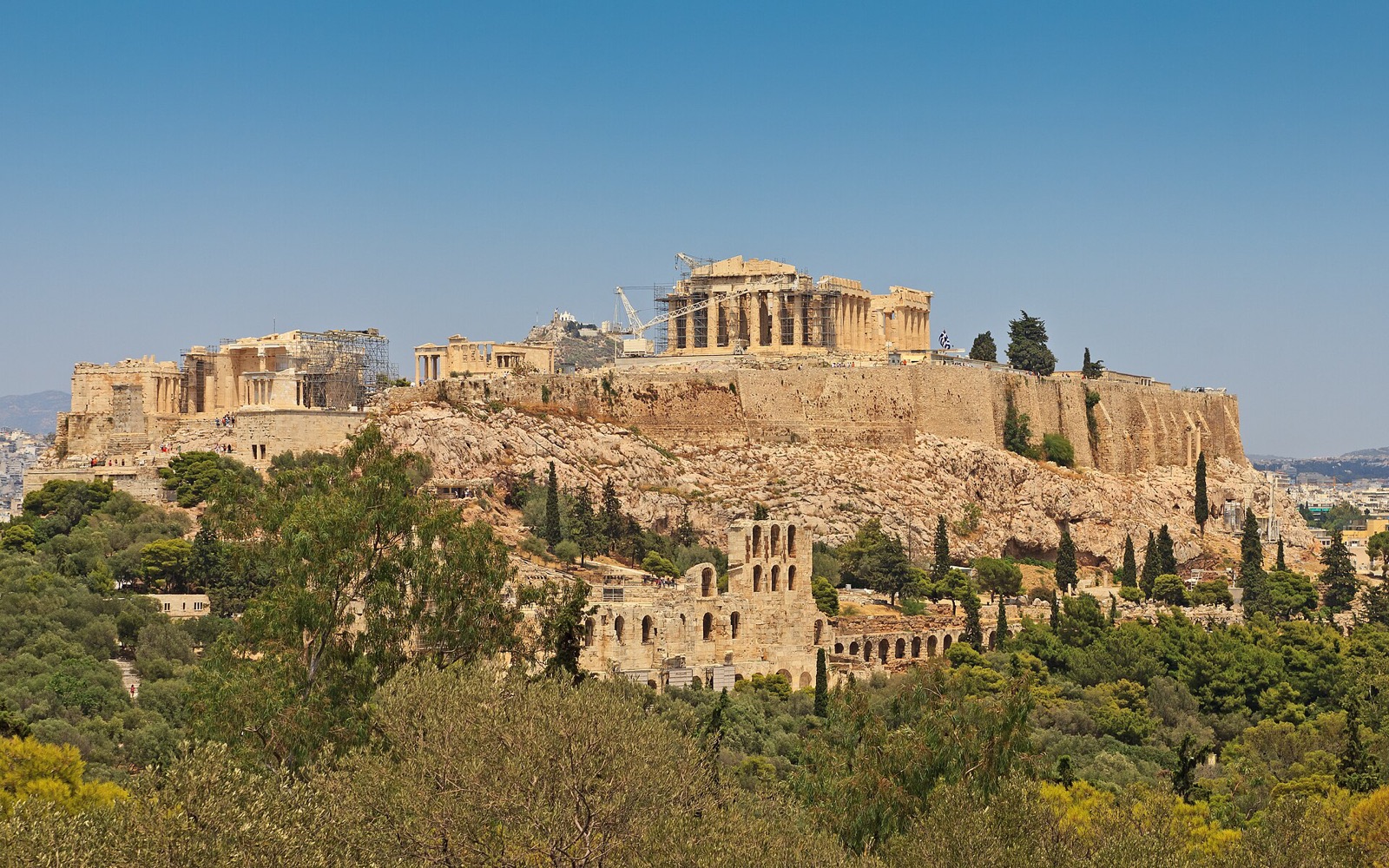
The Acropolis from Philopappos Hill. The rock has no shade, which is why the site closes on the hottest afternoons. Photo: A.Savin, Wikimedia Commons, CC BY-SA 3.0.

The meltemi. The etesian winds blow from the north across the Aegean, build through July and peak in August. They are what makes a Cycladic summer bearable and what cancels your ferry. Greek port authorities at Piraeus, Rafina and Lavrio suspend departures in gale force conditions, and did so on 31 July 2026 and 14 August 2026 among other dates. High speed catamarans stop before conventional ferries, which matters because the fast boats are the ones Americans book to save a morning.
The crowd. August takes 21.6 percent of the entire foreign year in four weeks, and it collides with the European holiday month.
Precautions for a summer trip:
- Leave a buffer day before your flight home. One cancelled ferry and a same day connection through Athens is gone.
- Book the first Acropolis slot. Summer hours are 08:00 to 20:00, last entrance 19:30.
- Prefer a conventional ferry to a high speed one in July and August if your schedule is tight.
- Plan the middle of the day indoors. Museums, a long lunch, the hotel pool. Greeks do.
- Consider Crete or the Ionian over the Cyclades. Both are far less exposed to the meltemi.
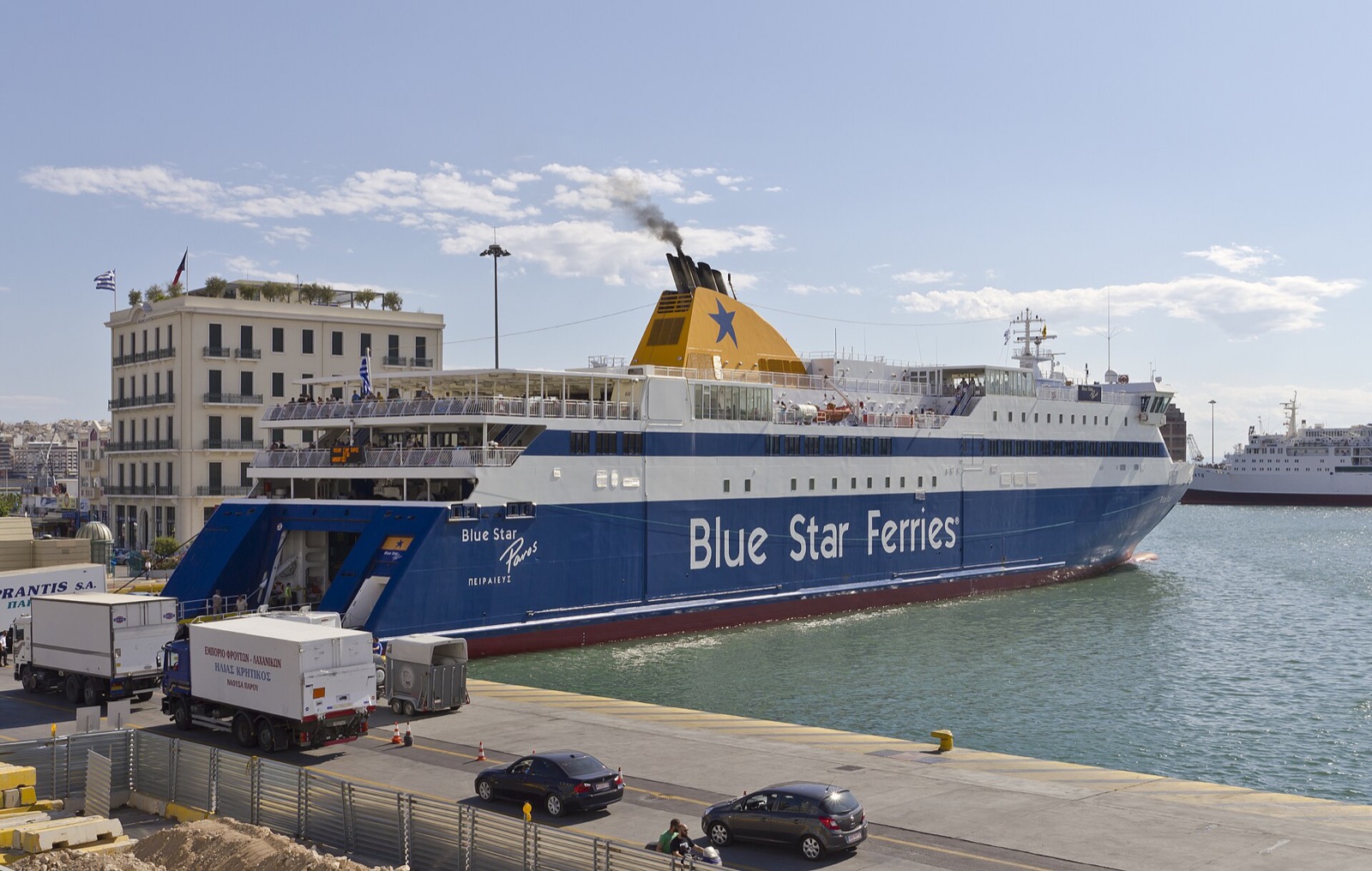
The port of Piraeus, where nearly every island crossing starts and where gale force winds suspend departures. Photo: A.Savin, Wikimedia Commons, CC BY-SA 3.0.

Autumn in Greece: September to November
September is the month this page would book. Athens falls to an 83 F high, the Aegean is at its second warmest of the year at 76 F (24.6 C), rain is still rare at 3.9 days in Athens, the meltemi has eased, and occupancy has dropped to 68.0 percent. Everything is open and nothing is at capacity.
A Cretan cove in September, when the sea off Crete is still 78 F. Illustration: my-usa-stay.com.
October is the underrated one. The sea off Crete holds 74 F (23.1 C), exactly what it measured in June, while national occupancy has halved to 38.4 percent. Air temperatures are pleasant rather than hot, 74 F in both Athens and Heraklion. Rain returns, though: 8.9 rain days in Athens, 64.9 mm on Crete.
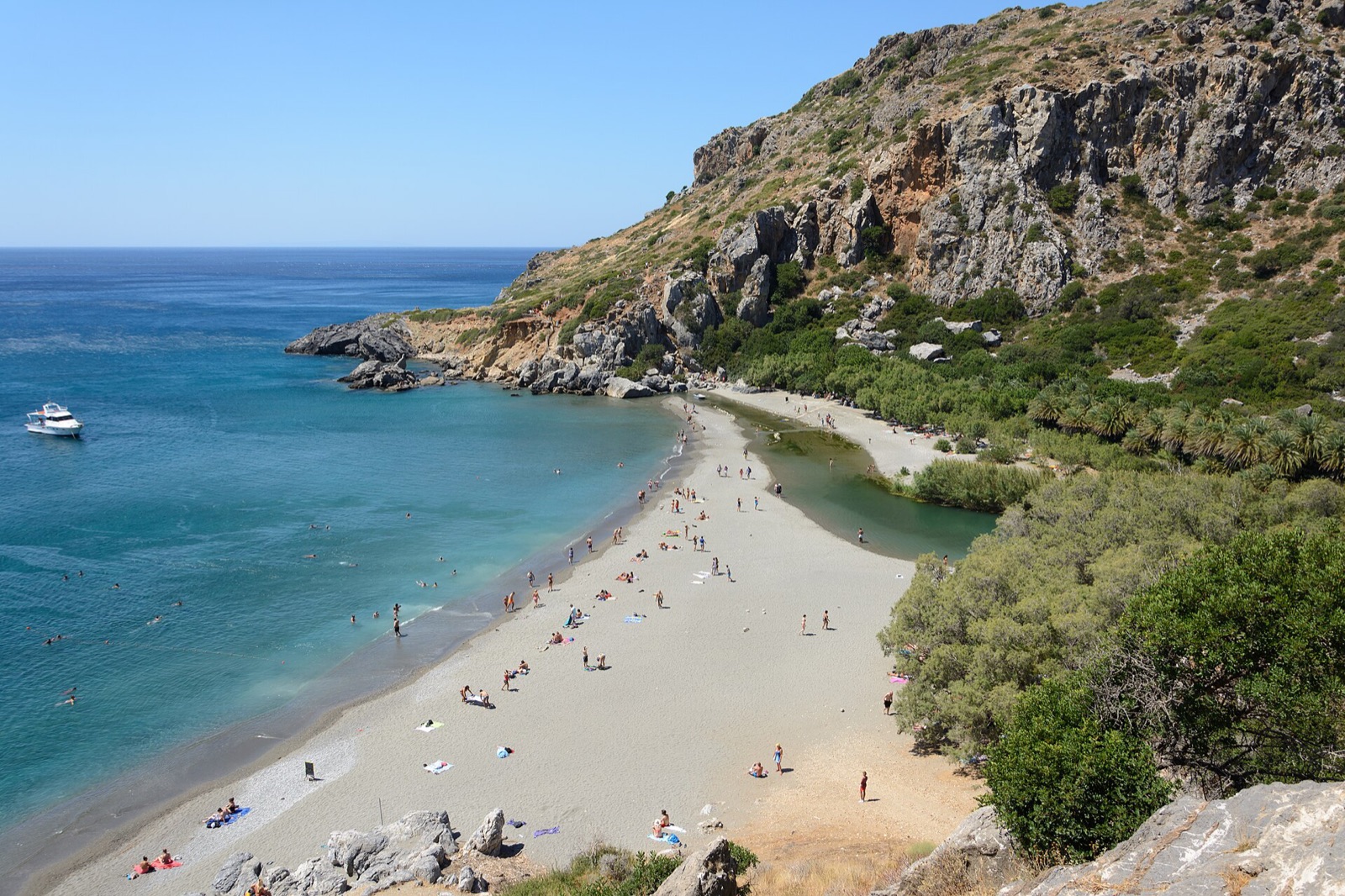
Preveli beach on the south coast of Crete. The Sea of Crete still holds 74 F in October. Photo: Uoaei1, Wikimedia Commons, CC BY-SA 4.0.

Then the shutter comes down. November is the cliff described above, and it is genuinely wet: 187.4 mm in Corfu, 55.4 mm in Athens. Sites go to winter hours on 1 November, and the Acropolis closes at 17:00. From September the closing time steps back every fortnight, from 19:30 to 18:00 by late October, so an afternoon that worked in September does not work six weeks later. 28 October is both a free admission day and a national holiday.
Winter in Greece: December to February
Winter Greece is a city trip, and a good one. Athens holds an average high of 56 F (13.6 C) in January with lows around 45 F. Heraklion is milder still at 60 F. What you trade is daylight, rain and choice: December brings 13.7 rain days to Athens, January brings 16.0 to Heraklion.
The advantage is that the Acropolis, the Acropolis Museum, the National Archaeological Museum and the Athenian restaurant scene all run with no queue. Foreign hotel nights in January are 0.5 percent of the year, so you have the city largely to yourself.
Precautions for a winter trip:
- Do not build an itinerary on ferries. Winter timetables are thin and cancellations common.
- Check that your island hotel is open before booking a flight, not after.
- Winter site hours are 08:00 to 17:00, last entrance 16:30. Plan two sites a day, not four.
- Northern Greece gets cold. Thessaloniki's January low averages 34 F (1.3 C).
Greece month by month
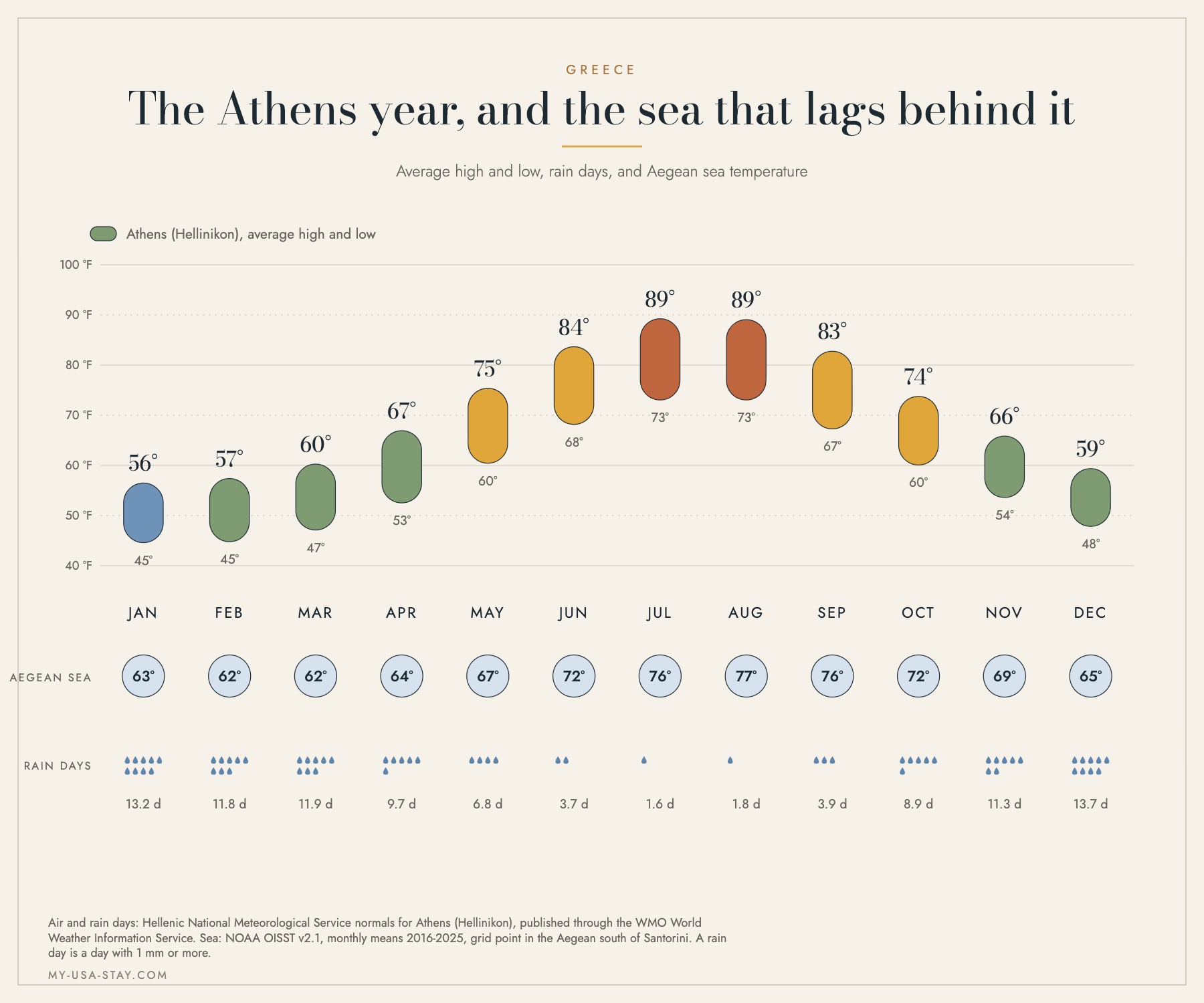
The Athens year, and the Aegean that lags two months behind it.
| Month | Athens high / low | Crete high / low | Sea | Rain days, Athens | Hotel beds filled | Verdict |
|---|---|---|---|---|---|---|
| January | 56 / 45 F | 60 / 48 F | 63 F | 13.2 | 15.5 % | Cold, wet, shut |
| February | 57 / 45 F | 60 / 48 F | 62 F | 11.8 | 12.1 % | Cheapest, mainland only |
| March | 60 / 47 F | 62 / 49 F | 62 F | 11.9 | 18.6 % | Mainland wakes up |
| April | 67 / 53 F | 68 / 53 F | 64 F | 9.7 | 30.2 % | Islands start opening |
| May | 75 / 60 F | 74 / 59 F | 67 F | 6.8 | 50.2 % | Sweet spot begins |
| June | 84 / 68 F | 81 / 66 F | 72 F | 3.7 | 69.2 % | Hot, open, swimmable |
| July | 89 / 73 F | 84 / 71 F | 76 F | 1.6 | 78.0 % | Peak heat, meltemi |
| August | 89 / 73 F | 83 / 71 F | 77 F | 1.8 | 81.0 % | Fullest, hottest, priciest |
| September | 83 / 67 F | 80 / 67 F | 76 F | 3.9 | 68.0 % | The best month |
| October | 74 / 60 F | 74 / 62 F | 72 F | 8.9 | 38.4 % | Warm sea, emptying |
| November | 66 / 54 F | 68 / 56 F | 69 F | 11.3 | 14.5 % | Islands shut down |
| December | 59 / 48 F | 63 / 51 F | 65 F | 13.7 | 24.8 % | Athens only, festive |
Air and rain days: Hellenic National Meteorological Service normals for Athens (Hellinikon) and Heraklion, published through the WMO World Weather Information Service; a rain day is a day with 1 mm or more. Sea: NOAA OISST v2.1 monthly means 2016 to 2025, Aegean grid point south of Santorini. Hotel beds filled: ELSTAT occupancy rate of bed places, 2024 final data, measured on establishments that are open.
The best time for what you want to do
The right month depends less on Greece than on what you came for.
- Swimming and beaches: July to early October. The sea off Crete is at or above 74 F from June through October and peaks at 79 F in August. September is the best combination of warm water and thin crowds.
- Island hopping by ferry: late May to late June, or September. Full timetables without the August meltemi risk.
- Archaeology in Athens, Delphi and the Peloponnese: April, May, October. Walking unshaded ruins at 89 F is not the memory you want, and in July the site may be closed when you arrive.
- Hiking, including the Samaria Gorge on Crete: May and October, when highs sit in the seventies.
- Value: March, April and November on the mainland, when occupancy is under 31 percent.
- Families with school age children: the last two weeks of August into early September, the only window that overlaps the US school calendar and still catches the warmest sea of the year.
- City breaks and museums: any month. Athens in January is a 56 F city with no queues.
Events that shape the year
Greece's calendar moves with the Orthodox church, so the dates that matter most are not fixed.
Orthodox Easter is the biggest. In 2027 it falls on Sunday 2 May, five weeks after Western Easter. Greeks travel to their villages, mainland hotels fill, ferries run at capacity and many island businesses choose that weekend to open for the season. Book months ahead or avoid the week entirely.
Free admission days at state sites and museums, published by the Hellenic Ministry of Culture, fall on 6 March, 18 April, 18 May, the last weekend of September for European Heritage Days, and 28 October. Free means crowded, which cuts both ways.
The Acropolis hours change four times between September and November. From the Ministry of Culture: 08:00 to 19:30 in the first half of September, 08:00 to 19:00 in the second half, 08:00 to 18:30 in the first half of October, 08:00 to 18:00 in the second half, then winter hours of 08:00 to 17:00. Full admission is 30 euros, reduced 15 euros, with timed slots sold through the ministry's official service.
Where to go, region by region
Athens and Attica work in every month of the year. The historic centre around Plaka, under the Acropolis, is walkable in January as easily as in June. The classic route from Marathon to the Panathenaic Stadium has its own cluster of hotels along the marathon course. For water without a long crossing, the Saronic Gulf islands off Attica are an hour or two from Piraeus and keep more life through the shoulder season than the Cyclades.
The Greek islands are the seasonal ones. Our island hotel selection is the place to start, but read the season first: May to October for the Cyclades, a longer window for Crete and Rhodes.
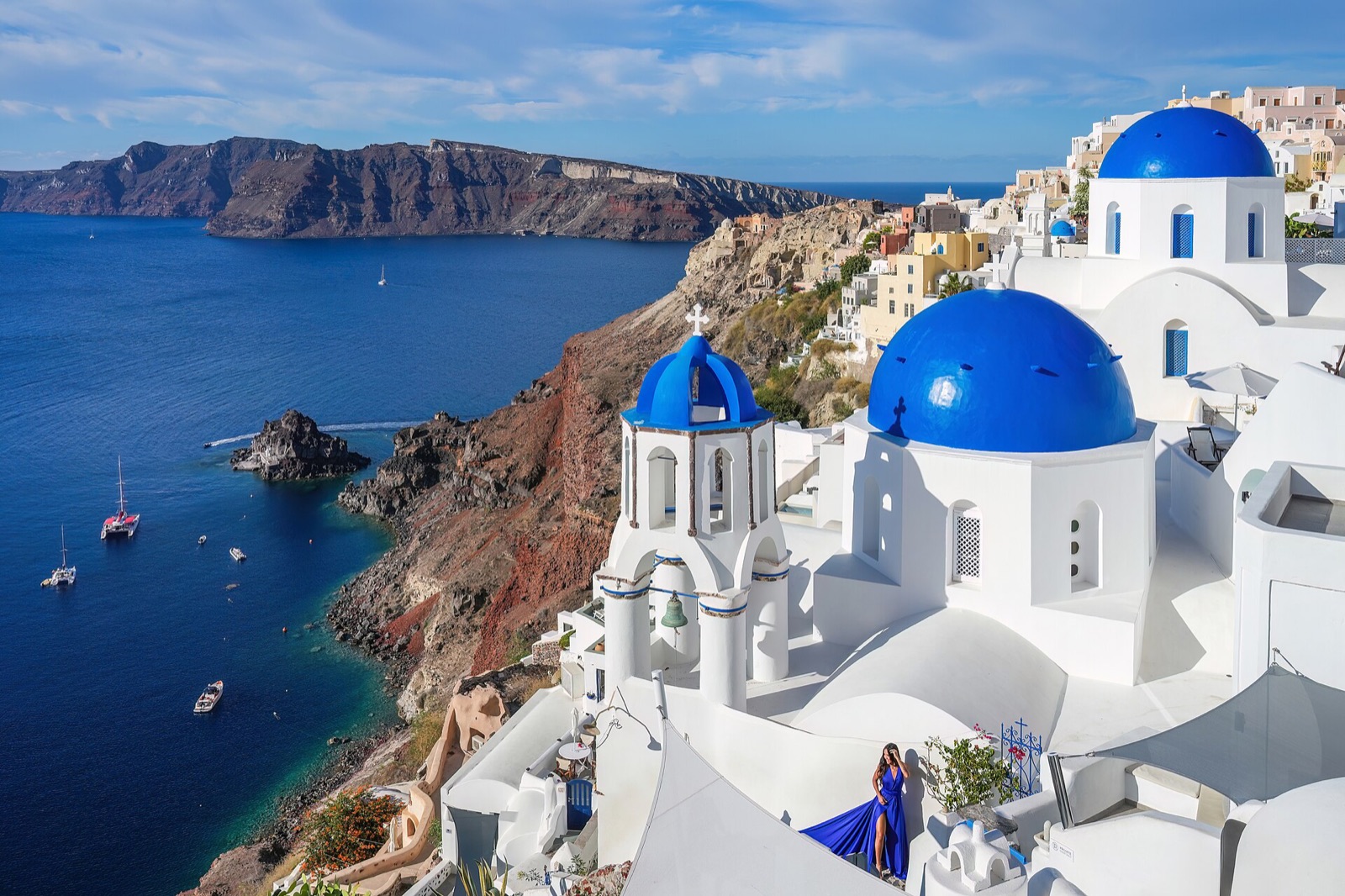
Oia on Santorini. The Cyclades run a season that opens around Orthodox Easter and closes in late October. Photo: Giles Laurent, Wikimedia Commons, CC BY-SA 4.0.

Corfu and the Ionian sit on the other side of the country and follow a different rainfall pattern entirely. Corfu is greener, wetter and milder, with 1,097 mm of rain a year against Athens's 405. July and August are dry there too, but the shoulder months are noticeably less reliable than in the Aegean.
Northern Greece is the year round alternative when the islands are shut. Thessaloniki and its surroundings give you a working city with a Byzantine core and a food scene that does not close in November, and Central Macedonia reaches from the Halkidiki beaches to Mount Olympus. The climate is continental, so the summer is as hot as Athens and the winter is genuinely cold.
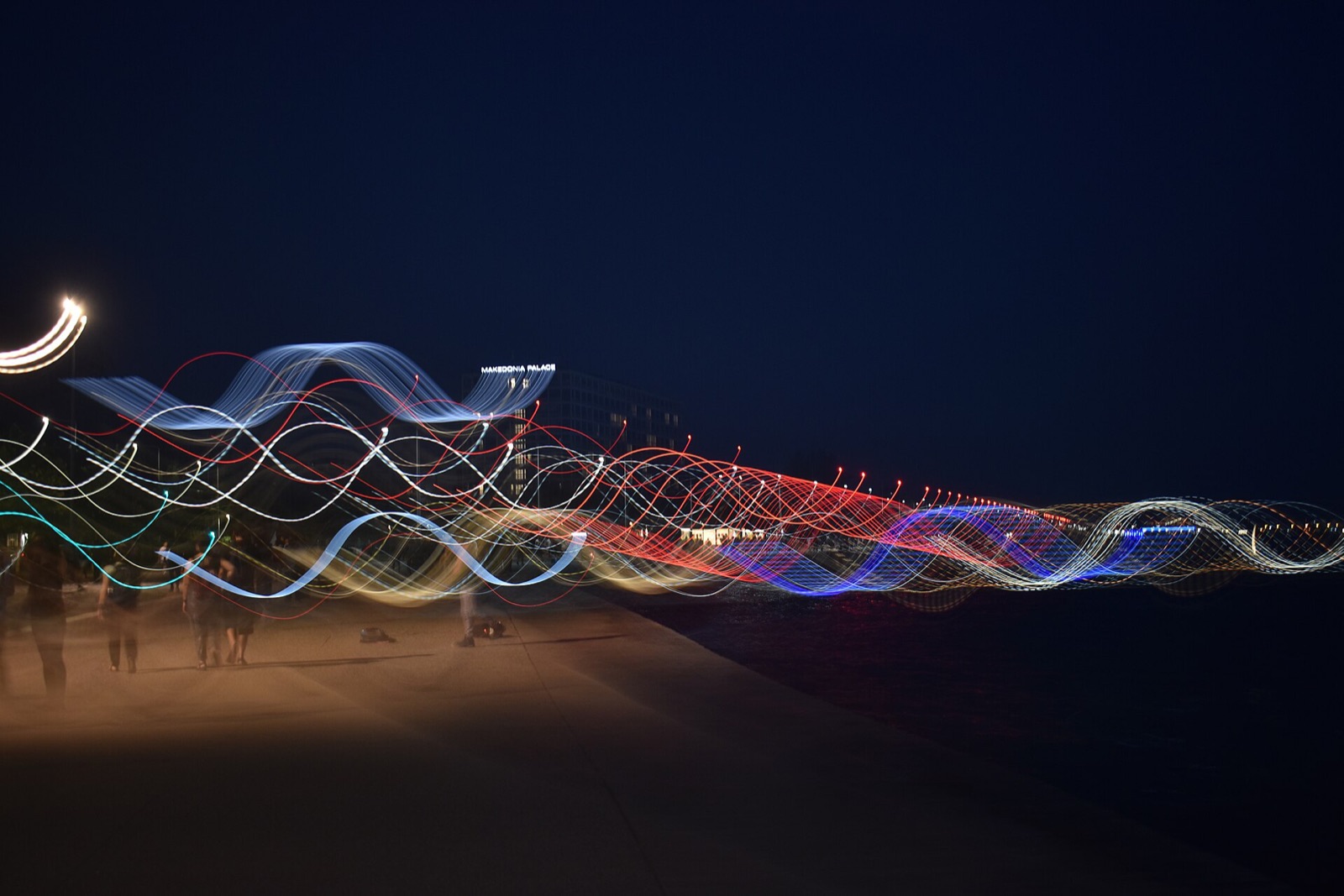
The Thessaloniki seafront. Northern Greece works all year, which is what makes it the winter alternative to the islands. Photo: Annatsach, Wikimedia Commons, CC BY-SA 4.0.

Inland Thessaly holds Meteora, whose monasteries on rock pillars are at their best in spring and autumn, when the valley is green and the light is low.
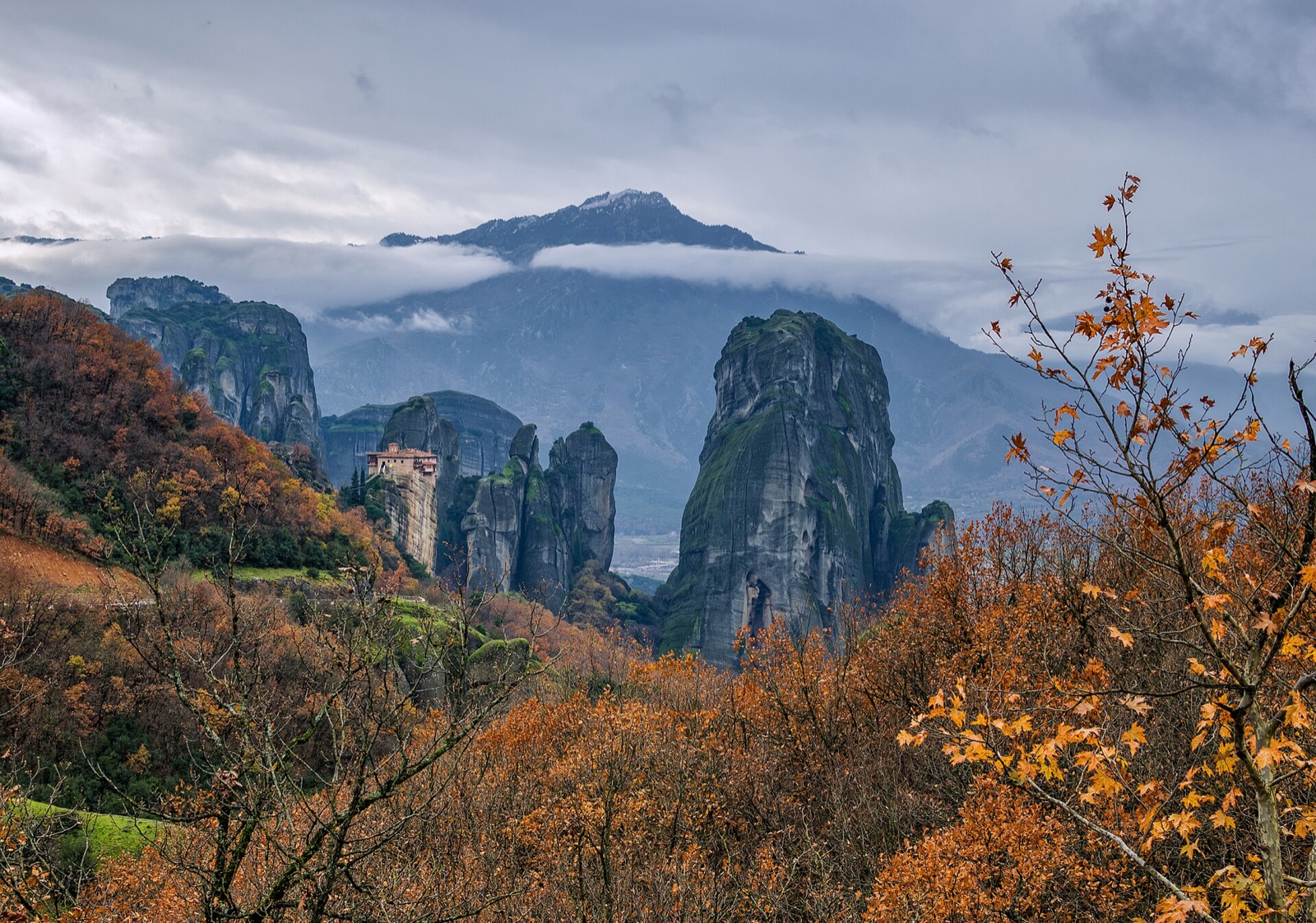
Rousanou Monastery at Meteora, in the autumn light that makes spring and fall the best seasons inland. Photo: Dimitris Eleftheriou, Wikimedia Commons, CC BY-SA 4.0.

Where to stay across the country sits on our Greece hotel guide for American travelers.
Getting there from the United States
Nonstop service from the United States to Athens is itself seasonal, which is part of the planning problem. Carriers add transatlantic Athens routes for the summer and thin them out in late autumn, so a November trip usually means a stop at a European hub even when a nonstop existed in July. Block time from the East Coast is roughly nine to ten hours.
Time difference. Greece runs on Eastern European Time, UTC+2 in winter and UTC+3 in summer, so Athens is 7 hours ahead of New York and 10 hours ahead of Los Angeles for most of the year. Two short windows narrow that gap to 6 hours from the East Coast, because Europe changes its clocks on the last Sunday of March and of October while the United States changes on the second Sunday of March and the first Sunday of November. Booking a connection in mid March or late October, check the local departure time rather than assuming the usual offset.
Entry requirements. Greece is in the Schengen area, so a US passport holder may stay 90 days in any 180 day period without a visa. Two changes matter for 2026 and 2027. The EU's Entry/Exit System began on 12 October 2025 and completed its rollout across the 29 participating countries on 10 April 2026: on your first crossing you give a facial image and four fingerprints at a kiosk or a booth, and the passport stamp is replaced by a digital record. Allow extra time at Athens airport for a first registration. ETIAS, the travel authorisation that visa exempt travelers will have to buy online before departure, is expected in the last quarter of 2026 and becomes mandatory afterwards. It is not required at the time of writing. Check your own case with the US Department of State before you fly.
American holidays that move Greek prices. The US summer break, Memorial Day and Labor Day all land inside the Greek high season, and Thanksgiving falls in the dead month. The one useful overlap is the last week of August into early September, when American schools are going back, European holidays are ending and the sea is at its warmest.
If you would rather stay closer to home for the same season, our guide to the best time to visit the USA covers the same ground on this side of the Atlantic.
FAQ
What is the best month to go to Greece?
September is the best single month. The Aegean is still 76 F, Athens averages a high of 83 F rather than August's 89 F, rain is rare at 3.9 days, and national hotel occupancy has fallen from 81 percent in August to 68 percent. Every island is still open, and the meltemi wind has eased off.
What is the cheapest time to go to Greece?
February is the cheapest, with national hotel occupancy at 12.1 percent, but most islands are closed. The best value with usable weather is March and April on the mainland, when occupancy runs 18.6 and 30.2 percent, or October, when it drops to 38.4 percent while the sea off Crete still holds 74 F.
What is the worst time to visit Greece?
November is the worst month. Foreign overnight stays fall 88 percent from October, so island hotels, restaurants and ferry routes shut, while the weather turns genuinely wet: 187 mm of rain in Corfu and 11.3 rain days in Athens. August is the other one to avoid, for heat, crowds and price rather than closures.
Is Santorini closed in the winter?
Largely, yes. Santorini and the other Cyclades run a season from roughly late April to late October. Outside it most hotels, restaurants and boat trips close and the ferry timetable thins to a few sailings a week. Greece's foreign hotel nights from November to March total just 3.4 percent of the year, which is the scale of the shutdown.
Which month is the rainiest in Greece?
It depends on the coast. Athens is wettest in December with 64.1 mm across 13.7 rain days. Heraklion on Crete peaks in January with 90.1 mm and 16 rain days. Corfu, on the Ionian side, is far wetter than either and peaks in November with 187.4 mm, part of roughly 1,097 mm a year.
Is Santorini warm all year?
It is mild rather than warm. There is no Hellenic National Meteorological Service station on Thira in the WMO record, so Heraklion on Crete is the closest official reference: a January high of 60 F and a low of 48 F, rising to 84 F in July. The sea drops to 62 F in February and March, too cold to swim.
Do ferries get cancelled in Greece in summer?
Yes. The meltemi, a northerly wind, peaks across the Aegean in July and August, and Greek port authorities at Piraeus, Rafina and Lavrio suspend departures in gale force conditions, as they did on 31 July and 14 August 2026. High speed catamarans stop before conventional ferries. Leave a buffer day before your flight home.
Is the Acropolis ever closed because of heat?
Yes. The Greek Ministry of Culture shuts the Acropolis and other exposed archaeological sites during the hottest afternoons of a heatwave. On 8 July 2025 it closed the site until 17:00 with 38 C forecast in Athens, and it did so again from 21 to 23 July 2026. Book the 08:00 slot in July and August.