The best time to visit Canada is September to mid October, when the summer crowds go home, the maple forests turn and most roads are still open. July and August give the warmest weather and the fullest hotels: Statistics Canada counted 3.5 million US-resident trips in July 2026 and only 1.1 million in January. Avoid April, when the snow has gone and the mountain roads have not yet opened. Winter is not a dead season here, it is the main event in Quebec and the Rockies. Start with our guide to planning a stay.
The short answer
- Best overall: September to mid October. US visitor numbers fall from 3.2 million in August to 2.1 million in September while Toronto still averages 72 °F.
- Warmest: July, when Toronto averages 81 °F by day and Montreal 80 °F.
- Cheapest and quietest: January and February, at 1.1 million US trips each against 3.5 million in July.
- Worst value: April. Ski season is ending, Moraine Lake Road is still shut and the colour has not come back.
- Coldest: January. Montreal averages 23 °F by day and 8 °F at night; Vancouver the same month averages 44 °F.
- Northern lights: mid August to late September, then mid November to early April in the Northwest Territories.
- Documents: no visa and no eTA for US citizens, but carry a passport. Most Americans arrive by car, and the land border has its own document rules.
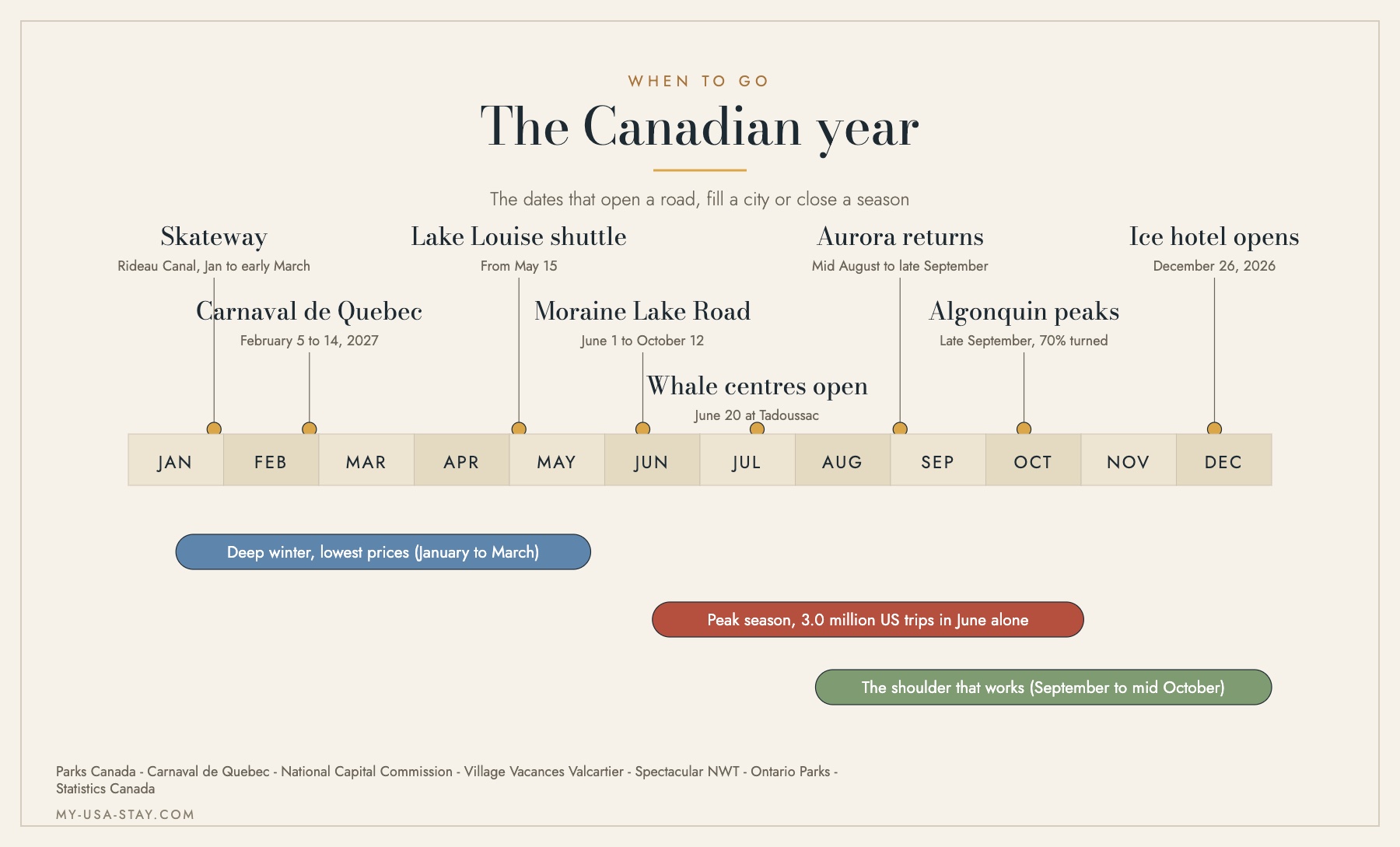
The dates that decide a Canadian trip, from the skateway in January to the ice hotel in December.
Understanding the climate in Canada
Canada does not have one climate, it has four calendars running at once. In January, Vancouver averages 44 °F by day while Montreal averages 23 °F: a 21 °F spread inside the same country on the same date.
All the figures on this page come from Environment and Climate Change Canada and its Canadian Climate Normals 1991-2020, read station by station rather than taken from a model. That distinction matters in Toronto: a gridded reanalysis smears the city into Lake Ontario and returns a July high near 76 °F, while the Toronto City station itself records 81 °F. Five degrees is the difference between packing a jacket and not.
Toronto and southern Ontario run four full seasons and are the warmest big-city summer in the country: 81 / 65 °F in July, a month that alone carries six days above 86 °F. Montreal and Quebec City are almost as hot in July and far colder in January, with Montreal recording 85 inches of snow a year and Quebec City close to 117 inches. Vancouver is the outlier: it almost never freezes, it almost never gets truly hot, and it rains on 137 days a year, more than any other city here. Banff, at 4,583 feet in the Rockies, is the one that catches people out. July there averages 72 / 44 °F. The afternoon is a t-shirt; the evening on a lakeshore is a fleece.
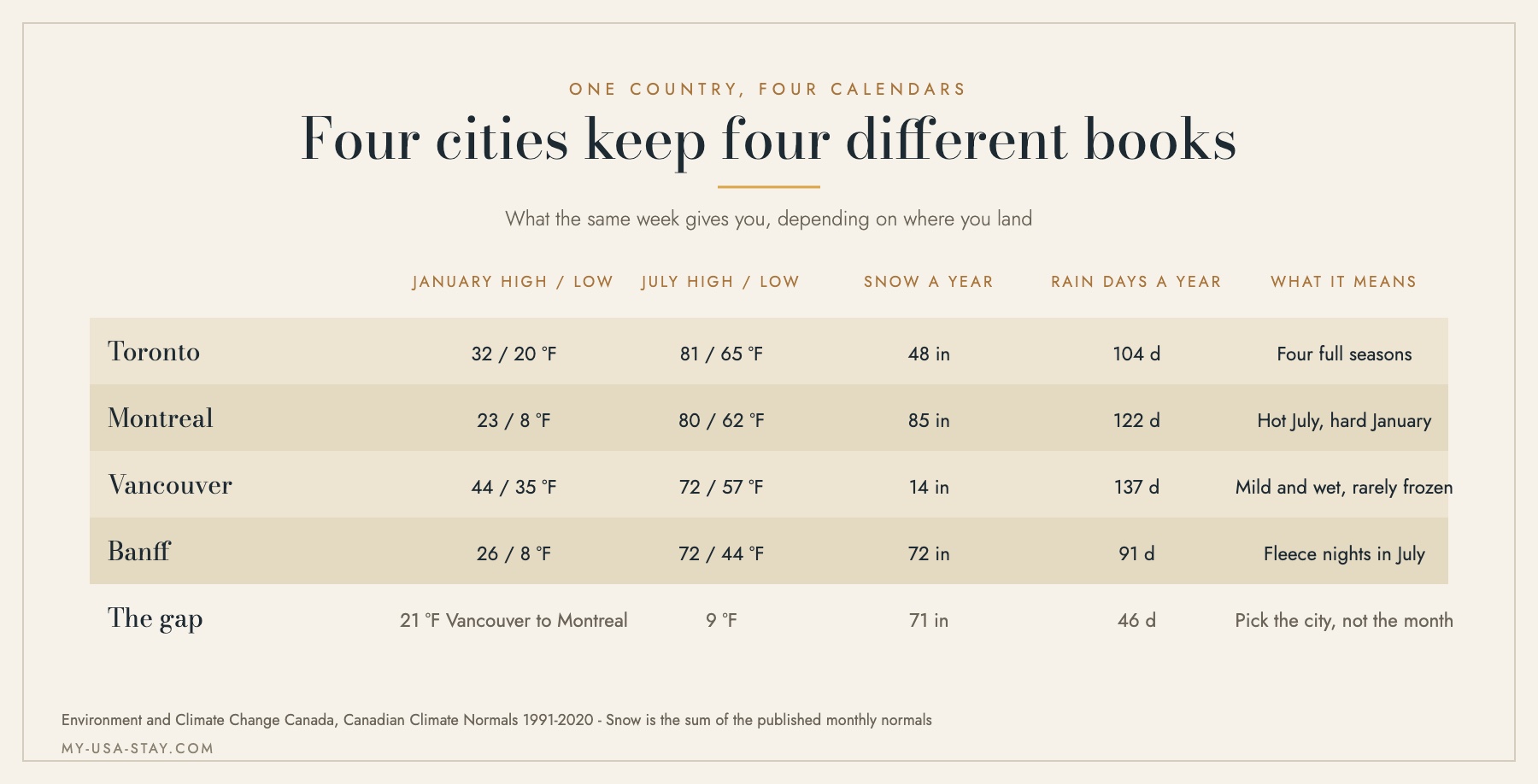
Toronto, Montreal, Vancouver and Banff, compared on the same four measures.
Winter, December to March: the season everyone else warns you about
Most guides treat a Canadian winter as a warning. That is a mistake: winter is when Canada sells its best product and charges the least for it. Demand collapses after the holidays, and the calendar fills with things that cannot happen in July.
Quebec City runs the Carnaval de Quebec from February 5 to 14, 2027, ten days of ice palaces, night parades and outdoor bars in a walled city under snow. Half an hour north, the Hotel de Glace at Village Vacances Valcartier opens on December 26, 2026, the only ice hotel in North America, rebuilt from scratch every winter and melted every spring; a visit starts at $25.99. In Ottawa, Winterlude runs from 29 January to 15 February 2027 across Ottawa and Gatineau, and the National Capital Commission clears 7.8 kilometres of the Rideau Canal into a skateway that "typically runs from January to early March, but it is weather-dependent". Read that caveat literally: the commission puts the average season at 50 days, and the canal did not open at all in 2022-23 or in 2023-24 because of above-normal temperatures. Book Ottawa for Winterlude, not for the ice. Quebec, meanwhile, maintains "more than 32,000 km of trails maintained by 4,000 passionate volunteers", a snowmobile network with no equivalent in the United States; a full-season trail pass for 2026-2027 costs $440 bought in October and $90 for a single day.
What to know before you commit to a winter trip:
- Cold in Montreal is real but countable. The station records 6.7 days in January with a low below minus 4 °F, and 12 days across the whole winter. Dress for it and it is manageable.
- Daylight is short. Plan indoor anchors for the late afternoon.
- Mountain roads close. The Moraine Lake Road in Banff is shut outside its summer window, and high passes can close on short notice.
- The aurora season in the Northwest Territories runs from mid November to early April, which is exactly when southern Canada is cheapest.
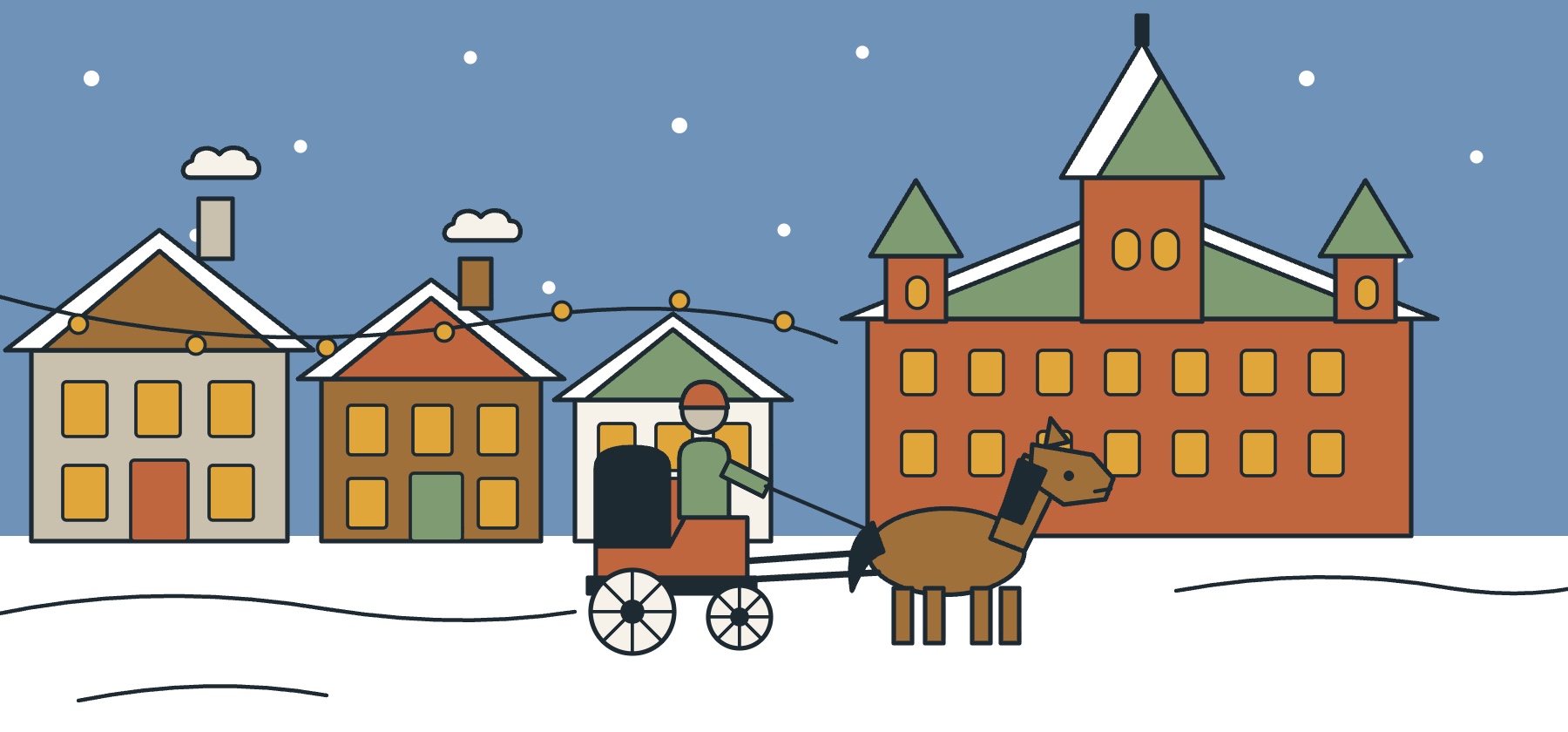
Old Quebec in winter, the city that turns the coldest weeks of the year into its main season. Illustration: my-usa-stay.com.
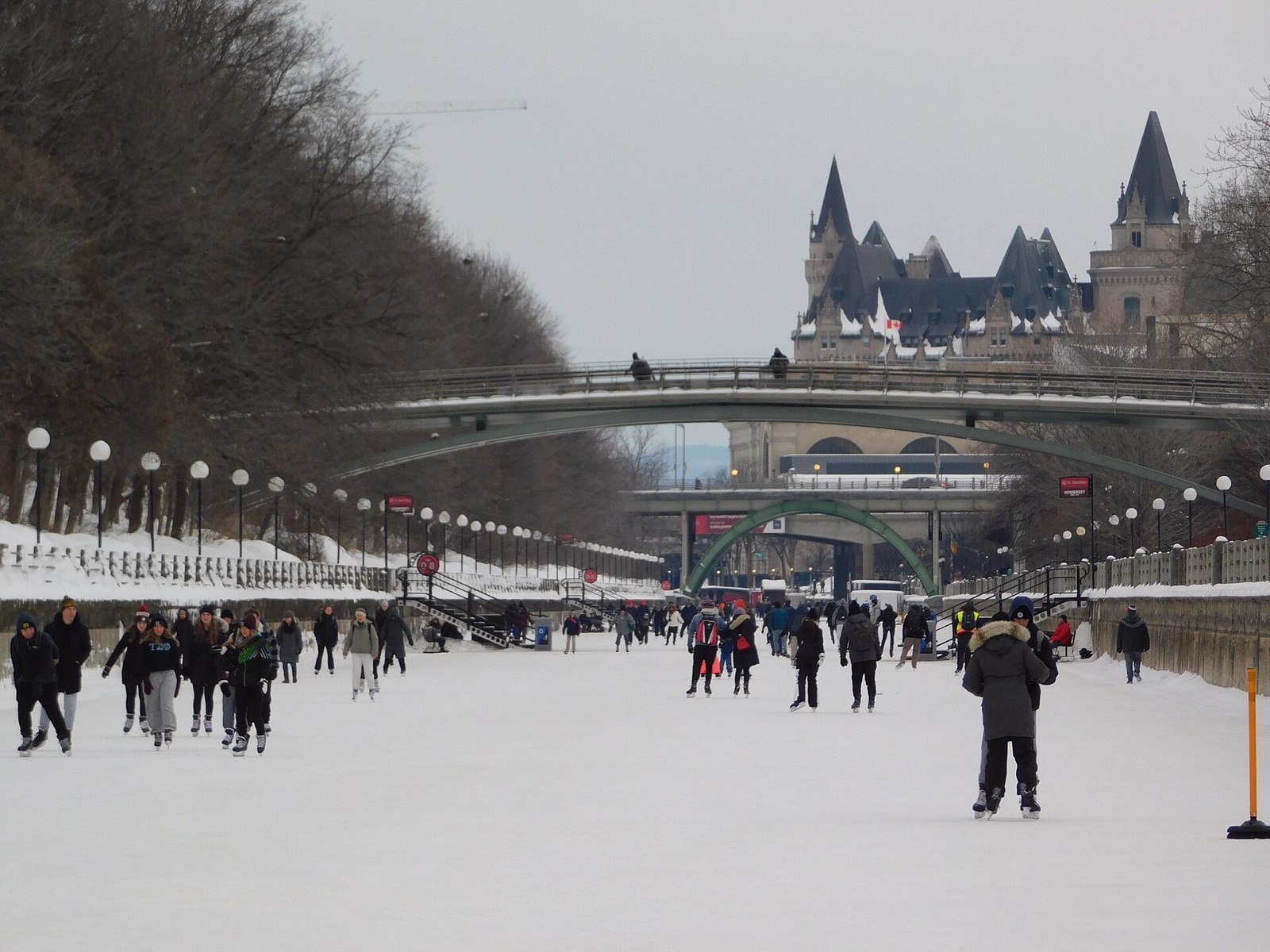
Skating the 7.8 kilometres of the Rideau Canal Skateway in Ottawa. Photo: Ahunt, Wikimedia Commons, CC0.

Spring, April to June: the awkward gap and then the reopening
April is the weakest month in the Canadian year. The snow has turned to slush in the cities, the ski hills are winding down, and the mountain infrastructure has not opened. Banff in April still averages 48 / 26 °F, with 30 centimetres of snowfall in the month. Then the calendar turns quickly. Parks Canada runs the Lake Louise Lakeshore shuttle from May 15 to October 12, 2026, and the Moraine Lake shuttle from June 1 to October 12, 2026, weather permitting. This is the most misunderstood fact about a Rockies trip: Parks Canada states plainly that "Moraine Lake Road is closed to personal vehicles year-round". You cannot drive to the lake on the postcard. Seats for the 2026 season went on sale on April 15, 40 percent that day and the remaining 60 percent at 8 am mountain time two days before departure.
By June the country is fully open and already full. May rewards planning: Toronto averages 66 / 50 °F, the Banff lakes are still frozen blue-white rather than turquoise, and the crowds have not arrived.
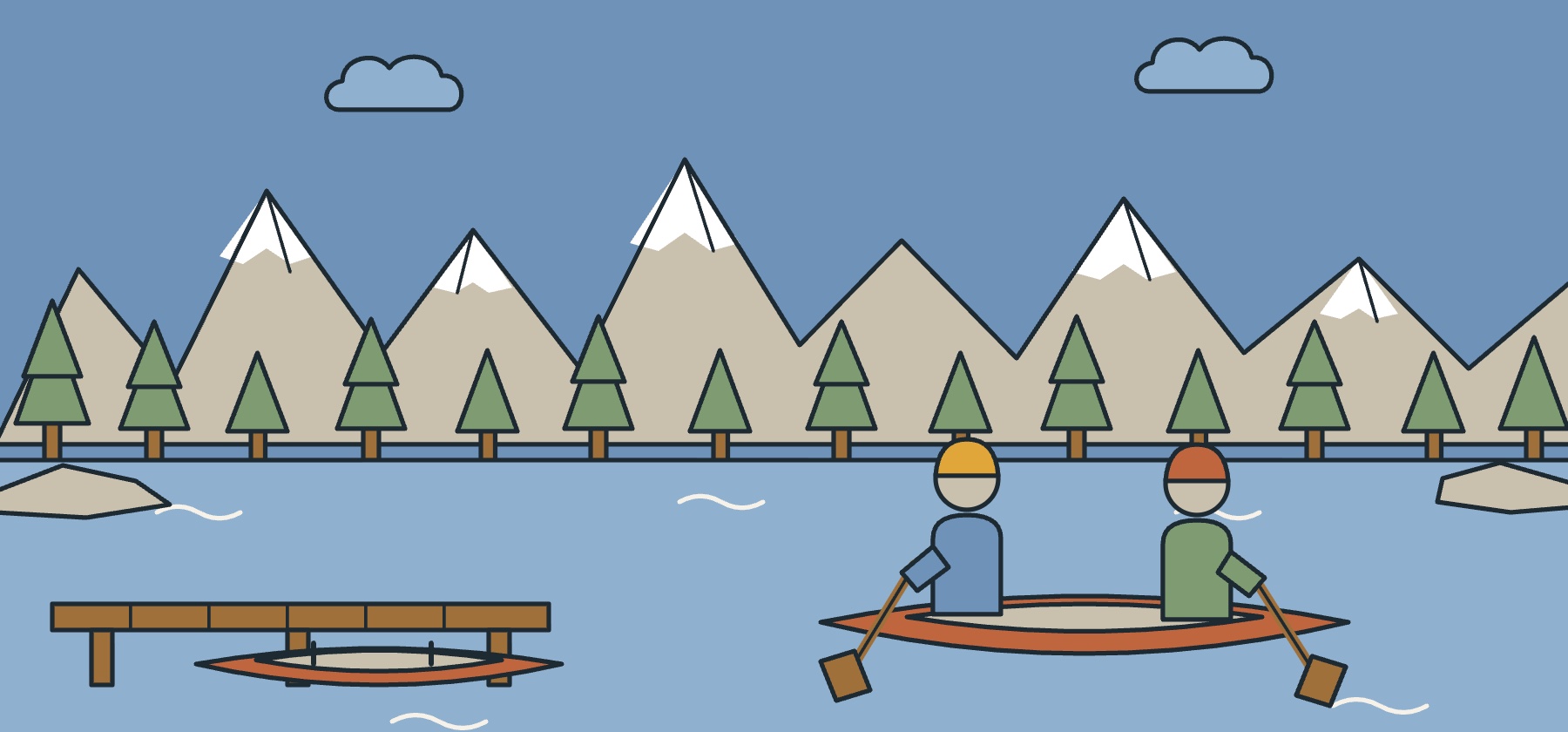
Moraine Lake, Banff National Park, reachable only by shuttle from June 1 to October 12. Illustration: my-usa-stay.com.
Summer, July and August: warm, long and shared with everyone
Summer is the only season where the whole country works at once, which is why it costs the most. Toronto averages 81 / 65 °F in July and Montreal 80 / 62 °F, both warmer than Vancouver's 72 / 57 °F, and Toronto records only 8.2 rain days in the month.
The problem is volume. Statistics Canada recorded 3.5 million US-resident trips in July 2026, the highest month of the year and up 9.1 percent on July 2025. In June, 1.7 million of the 3.0 million arrivals came by automobile against 725,600 by air. Banff, Niagara and Old Quebec absorb all of that in ten weeks.
Book summer only if you need the warm water, the long northern daylight or the school holidays. Otherwise almost the same weather arrives three weeks later with a third fewer people.
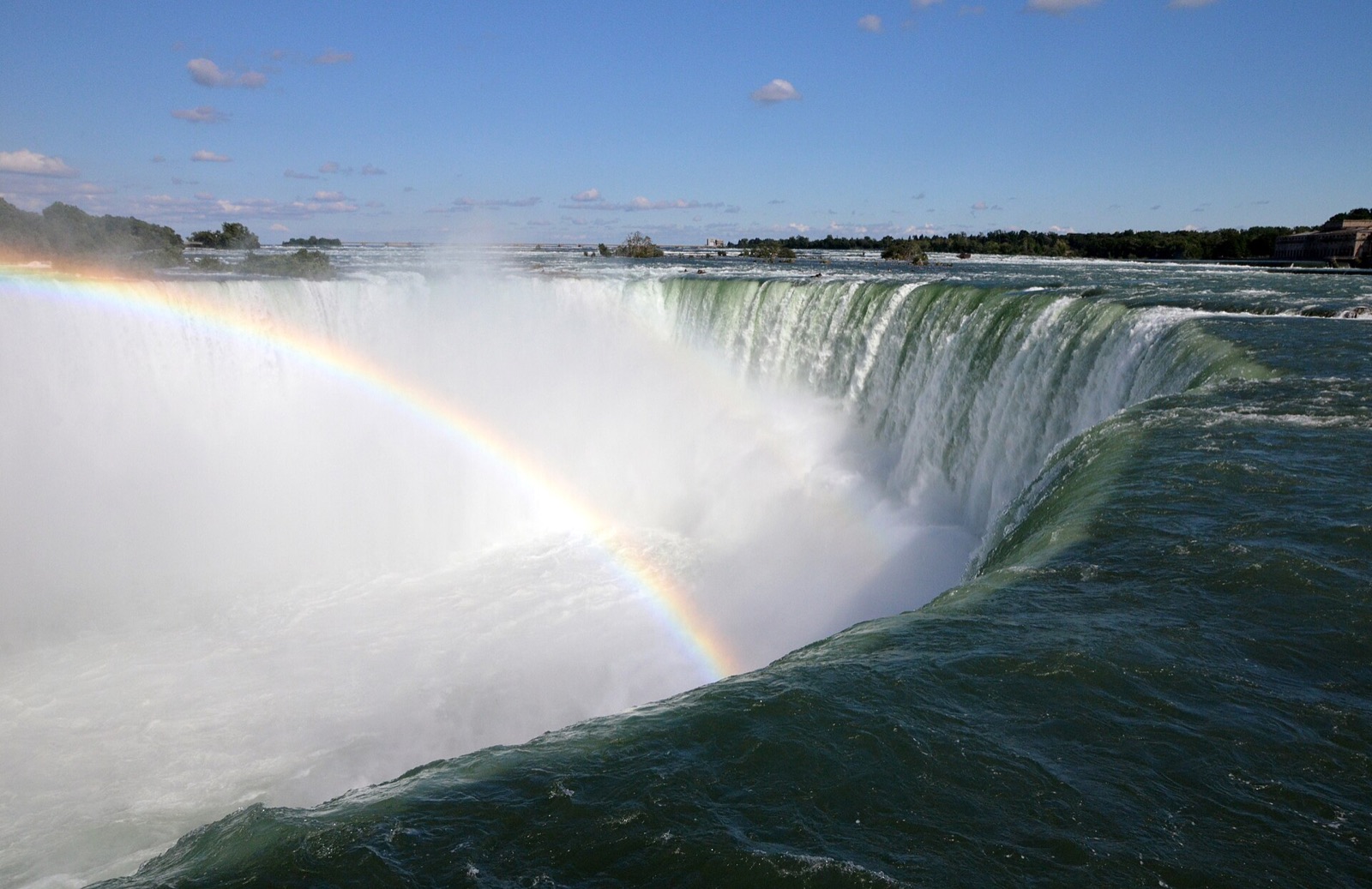
Horseshoe Falls on the Ontario side of Niagara, at its busiest in July and August. Photo: Gzzz, Wikimedia Commons, CC BY-SA 4.0.

Fall, September to mid October: the season the numbers point to
Fall is the answer for most American travellers, and the reason is measurable. The colour front moves north to south across roughly six weeks, and Ontario Parks publishes a live, park-by-park report that lets you follow it. On 25 September 2026, Algonquin Provincial Park was reported at 70 percent colour change with yellow and orange dominant, while Pinery and Port Burwell in the far south of the province were still at 0 percent. Arrowhead sat at 20 percent, Killarney and Killbear at 10 percent. Killbear's own report notes that "colours usually peak around Thanksgiving weekend but stay surprisingly strong throughout October".
That means you do not have to guess. Ontario Parks puts Algonquin's maple peak at September 27 on average, from observations kept since 1973, with the park past peak by the second week of October and a second golden beech and birch peak that "can last through much of October and sometimes even into early November". Across the border in Quebec, Bonjour Québec forecasts by region: the Laurentians peak in the first week of October, Charlevoix in the second, and the Eastern Townships split between Mont-Mégantic in late September and Mont-Orford as late as the third week of October. Check both reports the week before you fly and pick the latitude that fits your dates.
Fall is also the end of the whale season. Parks Canada runs its three shore-based observation centres in the Saguenay-St. Lawrence Marine Park from 20 June to 12 October 2026: Cap-de-Bon-Desir, Pointe-Noire at Baie-Sainte-Catherine and the Marine Environment Discovery Centre at Les Escoumins. Thirteen whale species frequent these waters and six are seen regularly, among them minke, beluga, blue, humpback and fin whales. Belugas are the exception to the calendar: Parks Canada calls them "residents of the marine park", present all year, calving in July and August. One rule before you board a boat or a kayak: at least 400 metres from any beluga.
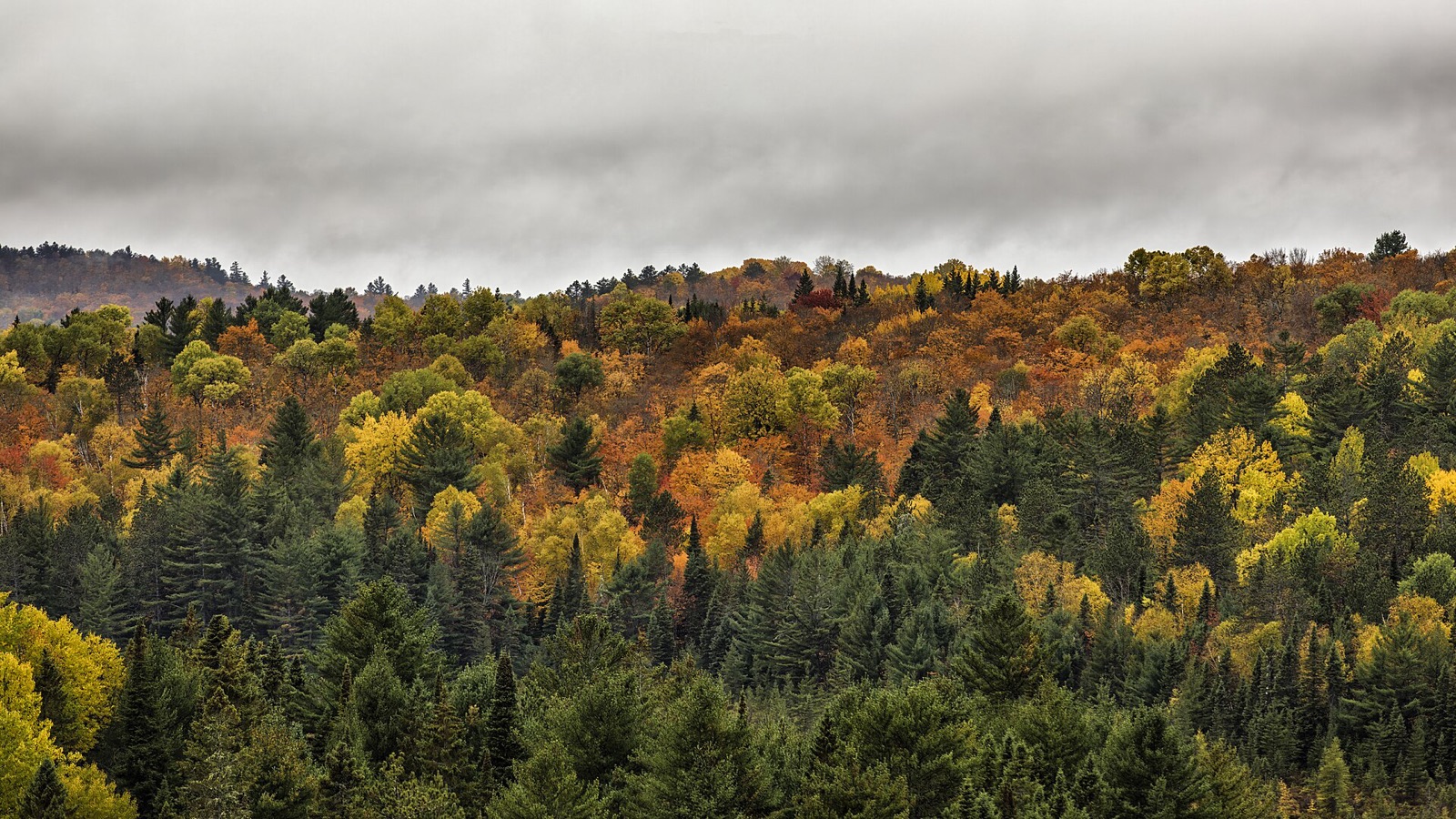
Algonquin Provincial Park, reported at 70 percent colour change on 25 September 2026. Photo: David Zhang, Wikimedia Commons, CC BY-SA 2.0.

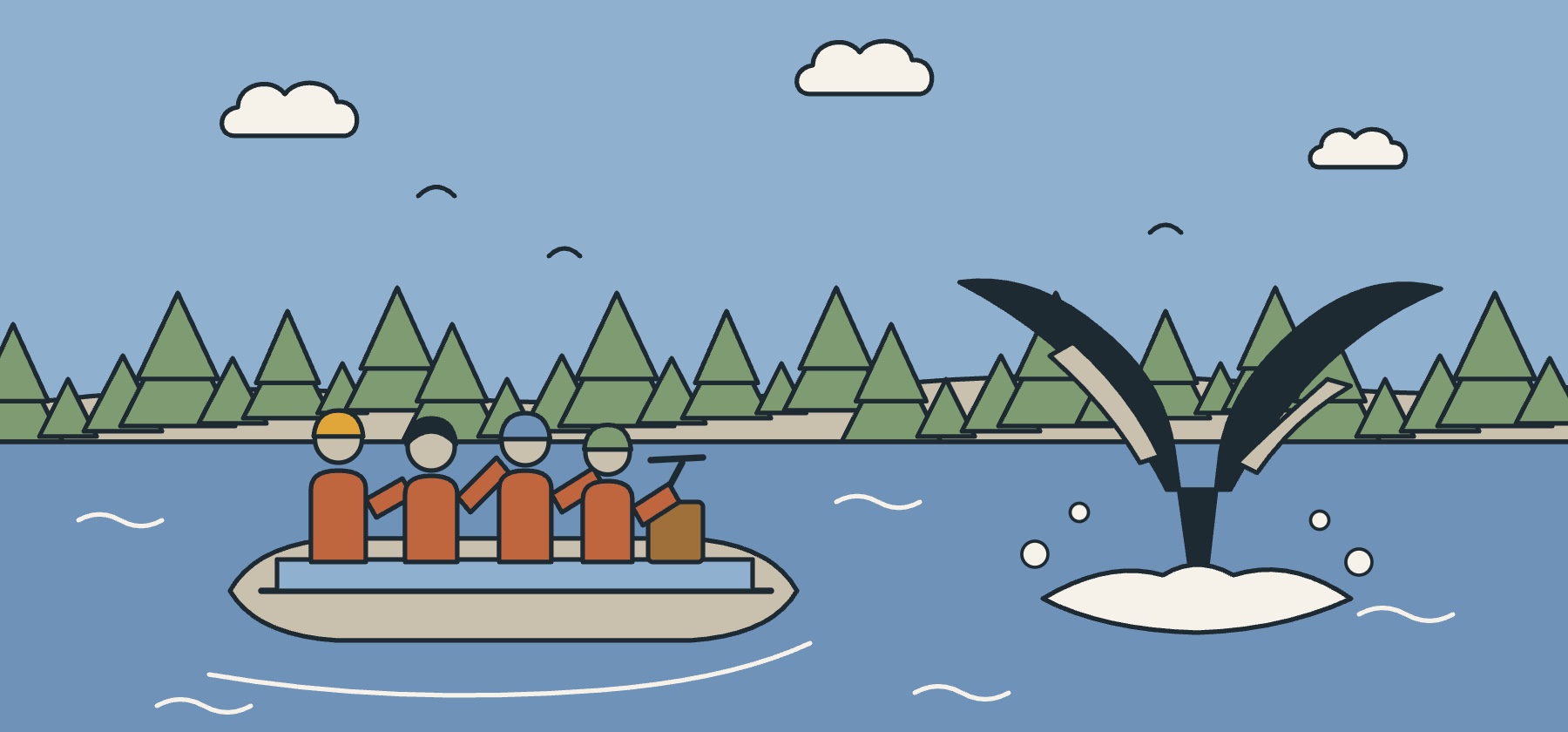
Whale watching off Tadoussac, where the Parks Canada observation centres run from June 20 to October 12. Illustration: my-usa-stay.com.
Canada month by month
Temperatures are average daily high and low in Fahrenheit, from the Environment and Climate Change Canada station in each city. Rain days are days with 1 mm, about 0.04 inches, or more. US trips are the number of US-resident trips to Canada that month, as published by Statistics Canada.
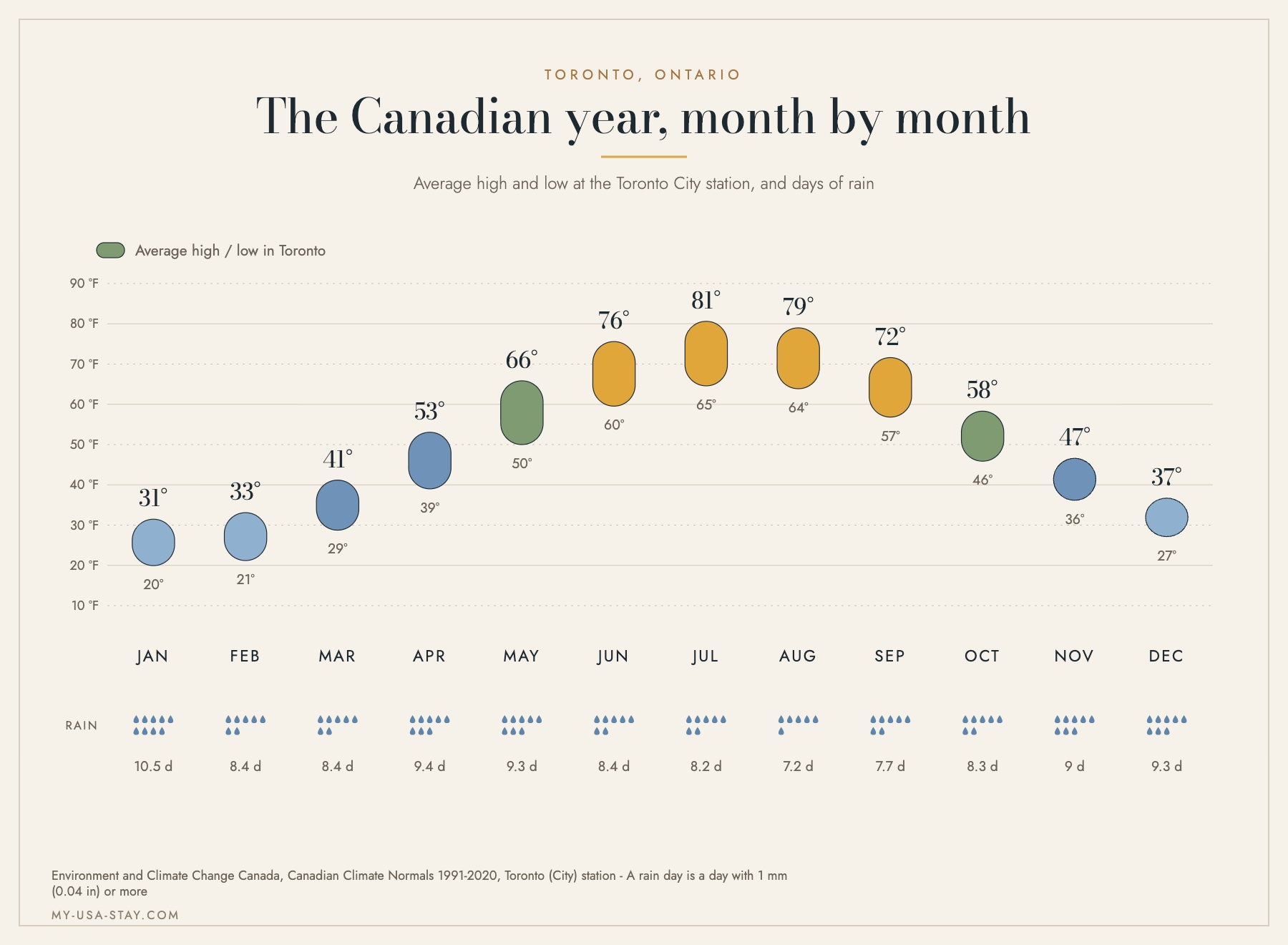
Toronto month by month, from the Environment and Climate Change Canada station in the city.
| Month | Toronto high / low | Montreal high / low | Vancouver high / low | Banff high / low | Toronto rain days | US trips | Verdict |
|---|---|---|---|---|---|---|---|
| January | 31 / 20 | 23 / 8 | 44 / 35 | 26 / 8 | 10.5 | 1.1 M | Cold, cheap, alive |
| February | 33 / 21 | 26 / 10 | 46 / 35 | 31 / 9 | 8.4 | 1.1 M | Carnival and snow |
| March | 41 / 29 | 36 / 20 | 50 / 38 | 39 / 17 | 8.4 | 1.3 M | Slush and thaw |
| April | 53 / 39 | 52 / 34 | 56 / 42 | 48 / 26 | 9.4 | 1.5 M | Wet and in between |
| May | 66 / 50 | 67 / 47 | 62 / 48 | 58 / 33 | 9.3 | 2.2 M | Everything reopens |
| June | 76 / 60 | 76 / 57 | 67 / 53 | 64 / 40 | 8.4 | 3.0 M | Long days, crowds |
| July | 81 / 65 | 80 / 62 | 72 / 57 | 72 / 44 | 8.2 | 3.5 M | Hottest, fullest |
| August | 79 / 64 | 78 / 60 | 72 / 57 | 72 / 42 | 7.2 | 3.2 M | Hot, still full |
| September | 72 / 57 | 70 / 52 | 66 / 52 | 62 / 36 | 7.7 | 2.1 M | The best compromise |
| October | 58 / 46 | 56 / 40 | 56 / 45 | 48 / 28 | 8.3 | 1.8 M | Colour, then closures |
| November | 47 / 36 | 43 / 29 | 49 / 38 | 33 / 17 | 9.0 | 1.3 M | Quiet and grey |
| December | 37 / 27 | 30 / 16 | 44 / 34 | 24 / 8 | 9.3 | 1.6 M | Snow and markets |
Sources: Environment and Climate Change Canada, Canadian Climate Normals 1991-2020, stations Toronto (City), Montreal Trudeau, Vancouver International and Banff. US trips from Statistics Canada, Travel between Canada and other countries, table 24-10-0053-01, the twelve months from August 2025 to July 2026, the most recent published at the time of writing.
The best time for what you want to do
The right month depends on the activity far more than on the country. Pick the thing first, then the date.
- Northern lights: mid August to late September, then mid November to early April. Northwest Territories Tourism states that "there are two Aurora seasons in the Northwest Territories" and that the lights dance on up to 240 nights a year across the territory. Yellowknife sits at 62.45 degrees north, inside the auroral oval NOAA describes as the band between about 60 and 75 degrees where the aurora shows more than half the nights of the year. Travel Manitoba gives Churchill a January to March season with a rarer late August window.
- Whales: late June to mid October in the St. Lawrence. Belugas are there year-round; the big rorquals come with the summer feed.
- The Rockies on foot: July to mid September. Earlier the trails hold snow, later the shuttles stop.
- Skiing: Lake Louise publishes a November 6 to May 2, 2027 season, one of the longest in North America, with the deepest base usually in February and March.
- Fall colour: around September 27 in Algonquin, the first two weeks of October in Quebec's Laurentians and Charlevoix, mid to late October in southern Ontario.
- City breaks on a budget: January to March in Toronto, Montreal and Vancouver, when rates track the visitor numbers down.
- Families: late August, when the water is warmest and Canadian school boards go back before the American ones. See our guide to hotels that understand families.
Events that shape the year
A handful of fixed dates change what a Canadian city feels like, and two move hotel prices sharply.
- Carnaval de Quebec, Quebec City: February 5 to 14, 2027. The old town books out; reserve months ahead.
- Winterlude, Ottawa and Gatineau: 29 January to 15 February 2027, the 49th edition, free outdoor programming across both cities.
- Rideau Canal Skateway, Ottawa: January to early March, weather dependent, 7.8 kilometres of cleared ice, average season 50 days.
- Hotel de Glace, near Quebec City: opens December 26, 2026 and melts in spring.
- Canada Day, 1 July: national holiday, and in Quebec the traditional moving day, so cities are chaotic.
- Canadian Thanksgiving, the second Monday of October: a long weekend that coincides with peak colour and fills the Laurentians and Muskoka.
- US school holidays: Presidents' Day week and spring break move Whistler and Banff prices more than any Canadian date.
Where to go, and when
Canada is wider than the continental United States, so one trip should take one corridor. Browse the country on our Canada hotel pages, then match the corridor to your month.
Ontario and Quebec are the easy first trip from the East Coast: Toronto, Ottawa, Montreal and Quebec City sit within a day's drive of each other, with Niagara at one end. Best in September and early October, or in February for the winter version. The Rockies, meaning Banff, Lake Louise, Jasper and the Icefields Parkway, work from mid June to mid September for hiking and from December to April for snow. British Columbia's coast, from Vancouver to Tofino, is the mildest year-round option and the wettest; July and August are its only reliably dry months, with just 4.5 and 4.8 rain days. Atlantic Canada, from the Cabot Trail to Prince Edward Island, peaks from July to early October, and Halifax averages 76 / 58 °F in July. The North is an aurora destination rather than a weather one.
For what to build a trip around, see our pages on outdoor activities and hidden gems.
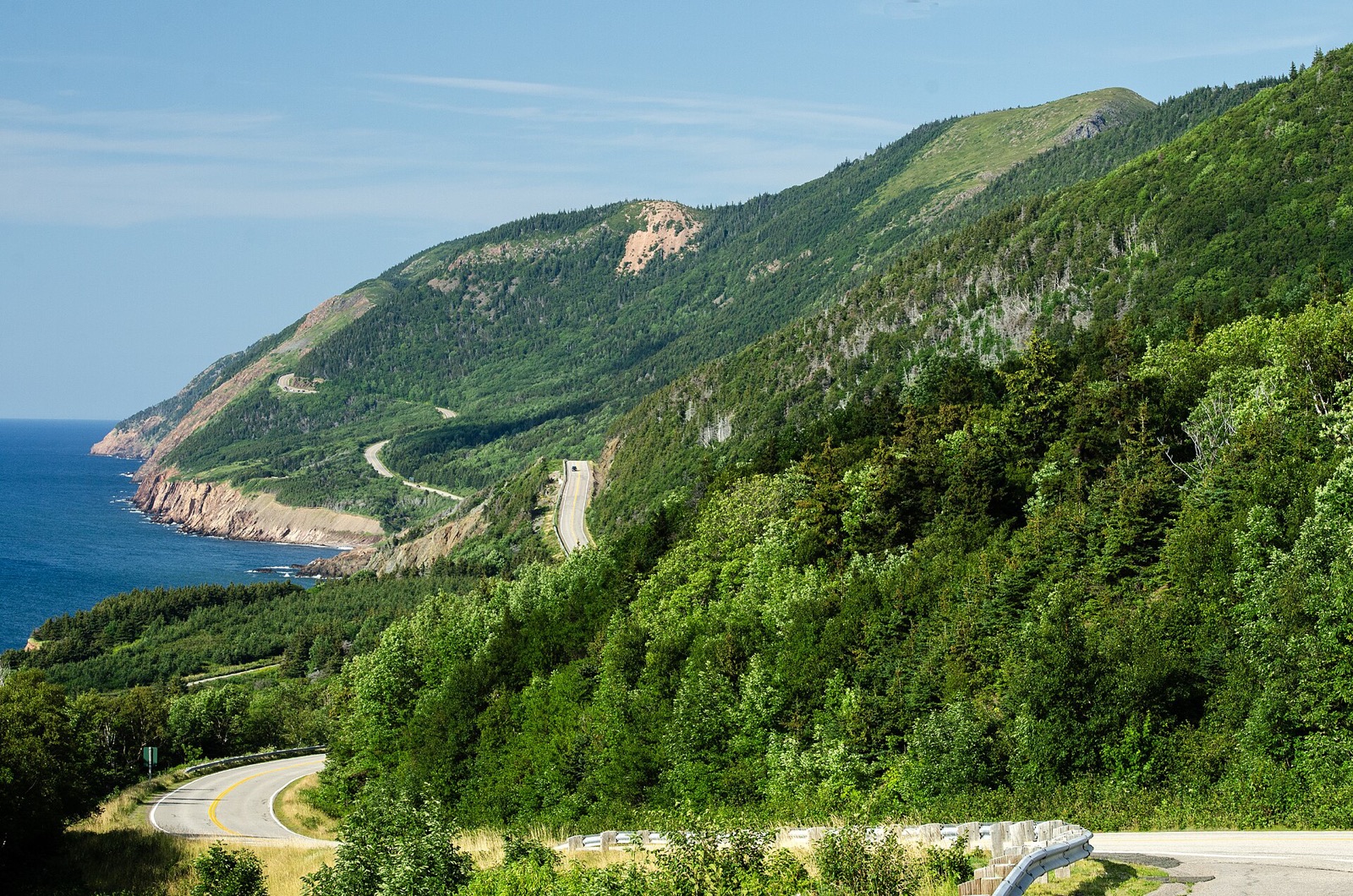
The Cabot Trail in Cape Breton Highlands National Park, Nova Scotia, at its best from July to early October. Photo: Elviroyage, Wikimedia Commons, CC BY-SA 4.0.

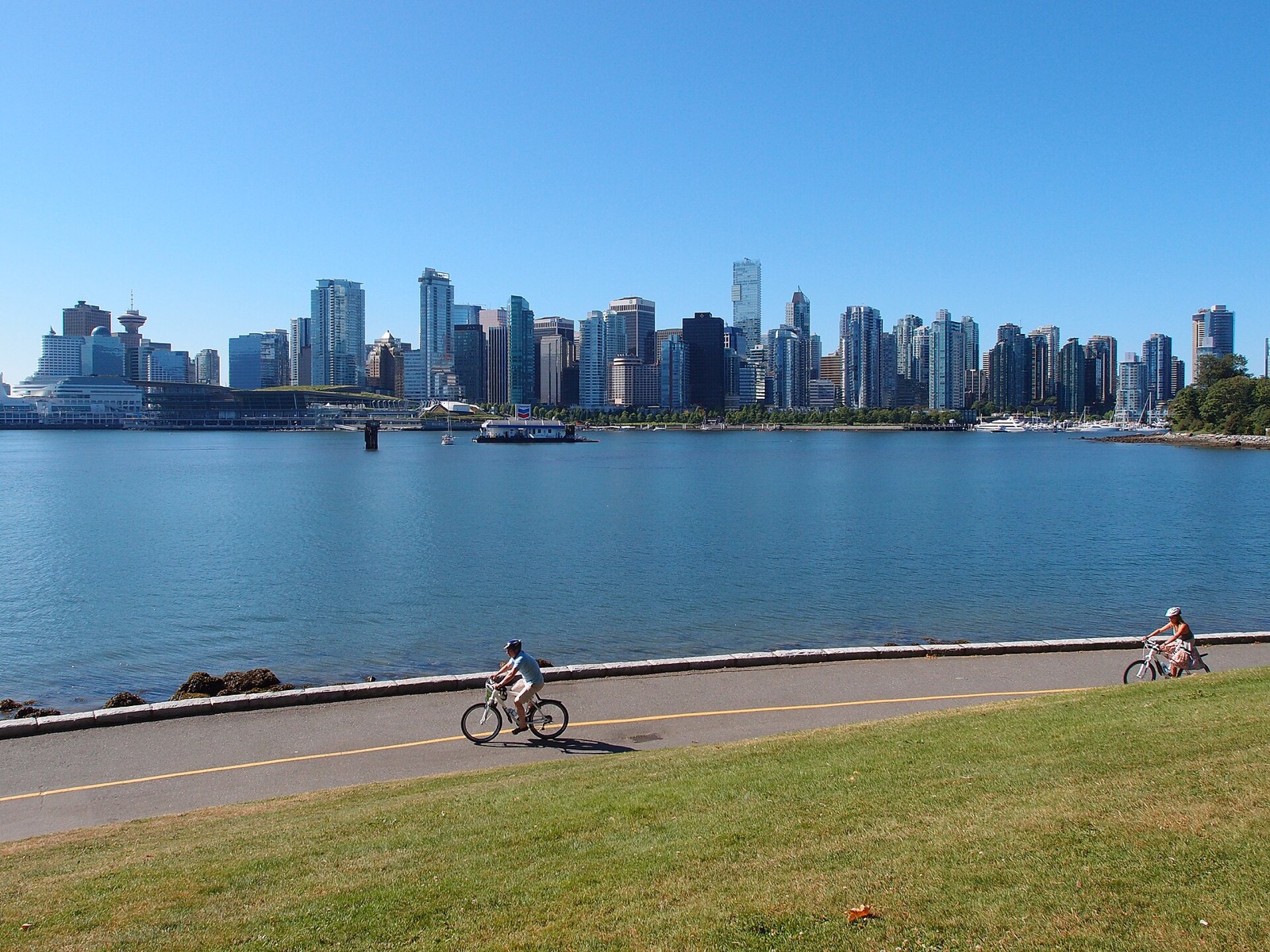
The Stanley Park seawall in Vancouver, the mildest year-round city in Canada. Photo: Guilhem Vellut from Annecy, France, Wikimedia Commons, CC BY 2.0.

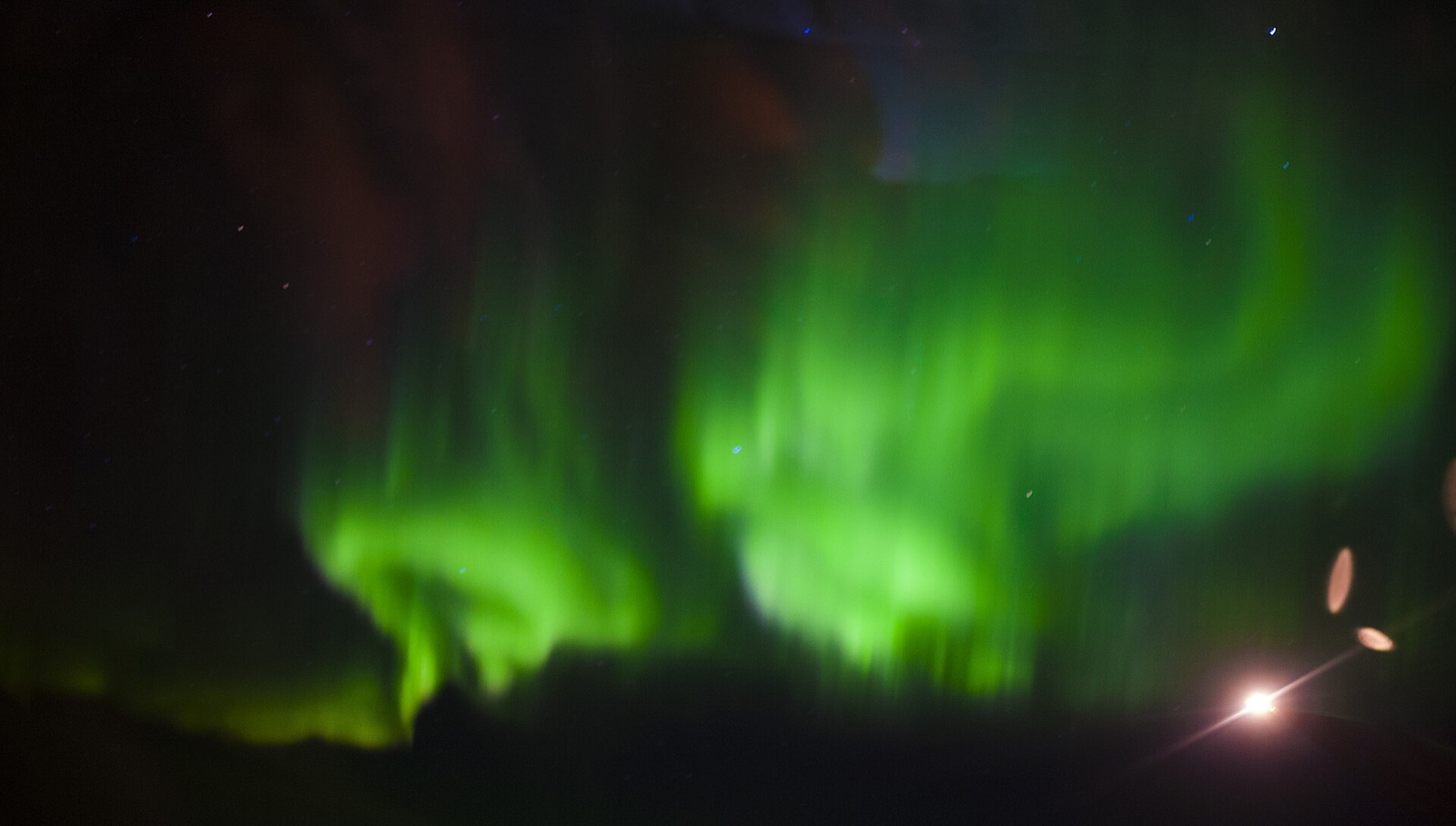
Aurora over Hudson Bay, on the same latitudes that give Churchill its January to March season. Photo: Doc Searls, Wikimedia Commons, CC BY 2.0.

Getting there from the United States
Canada is the one foreign country most Americans reach without flying, and that changes the whole practical picture. In June 2026, 1.7 million US residents entered Canada by car against 725,600 by air. If you drive, the rules that apply to you are not the ones in an airline guide.
Documents. US citizens need no visa and no eTA. Immigration, Refugees and Citizenship Canada is explicit: "U.S. citizens are exempt from the eTA requirement and must carry proper identification such as a valid U.S. passport." By land or sea, a US citizen without a passport may present documents showing full name, date of birth and citizenship, and the Canada Border Services Agency may then ask for separate photo identification. Most visitors are admitted for up to six months; if your passport is not stamped, the six months run from the day you entered.
Getting back in. This is where people get caught. Under the Western Hemisphere Travel Initiative, US Customs and Border Protection accepts, for re-entry by land or sea, a US passport, a passport card, an enhanced driver's licence, a NEXUS, SENTRI or FAST card, a military identification card on orders, a merchant mariner document or Form I-872. By air, the list is far shorter: a passport or a Trusted Traveler card. Children under 16 crossing by land or sea may present a birth certificate, but a child flying home needs their own passport.
ArriveCAN. It is no longer mandatory. Since 1 October 2022 travellers no longer submit health information through the app, and the CBSA states that "the Advance CBSA Declaration is optional". You can file customs and immigration information up to 72 hours before you land at ten airports including Toronto, Montreal, Vancouver and Calgary, which the CBSA says cuts kiosk processing by up to half. It does not work with NEXUS kiosks.
Children with one parent. IRCC strongly recommends a consent letter signed by the non-travelling parent, with that parent's address, phone number and a photocopy of their signed passport, plus the child's birth certificate. A child will not be admitted if the officer is not satisfied the parents authorised the stay.
Driving in winter. Two provinces have laws, and they work differently. Quebec requires winter tires from December 1 to March 15 on vehicles registered in Quebec, and the province states that this "does not apply to trailers and vehicles registered outside of Quebec". So your own car from Vermont is exempt, but a car you rent in Montreal must be equipped, and the fine is $200 to $300. British Columbia is the opposite: winter tires or chains are required on most designated highways from October 1 to April 30, and the requirement applies to every vehicle regardless of where it is registered, with a $121 fine. On the Sea to Sky to Whistler or the Coquihalla, an out-of-state car on all-season tires can be turned around.
Money. The exchange rate is quietly in your favour. On 24 September 2026, the Bank of Canada's daily average put one US dollar at 1.4136 Canadian dollars. Canadian prices you see quoted, including Parks Canada's, are in Canadian dollars: Banff's daily adult admission of $12.25 and the annual Discovery Pass at $83.50 for an adult or $167.50 for a family or group are all CAD, so divide by roughly 1.4 to read them in your own currency. Two corrections to things you may have read elsewhere. The Canada Strong Pass, which made national park admission free, ended on 7 September 2026; normal fees resumed the next day. And there is no tourist tax refund: the Canada Revenue Agency states that "if you are a non-resident visitor to Canada, you cannot claim a rebate of the GST/HST that you paid for purchases made in Canada".
Time zones. There is no jet lag to speak of. Toronto, Ottawa, Montreal and Quebec City keep the same clock as New York; Vancouver the same as Seattle; Banff and Calgary are on Mountain time. Halifax runs one hour ahead of New York and Newfoundland keeps its own half-hour offset. Daylight saving changes on the same dates as in the United States.
If you are weighing Canada against a domestic trip, our companion guide to the best time to visit the USA uses the same method on the other side of the border.
FAQ
What is the cheapest month to visit Canada?
January and February are the cheapest. Statistics Canada recorded 1.1 million US-resident trips in each of those months in 2026, against 3.5 million in July, and hotel rates follow that curve. The trade-off is cold and short daylight, but it buys you the Carnaval de Quebec, the Rideau Canal Skateway and the aurora season at once.
What month is best to visit Canada?
September is the best single month. Toronto still averages 72 °F by day, Montreal 70 °F, the summer crowds have gone home, the fall colour starts in the last week, and shuttles and park roads in the Rockies stay open until 12 October. Early October is almost as good if you want peak colour rather than warmth.
How hot is it in August in Canada?
Warmer than most Americans expect in the east and cooler than they expect in the west. Toronto averages 79 °F by day in August and Montreal 78 °F, both close to their July figures. Vancouver averages 72 °F, and Banff, at 4,583 feet, averages 72 °F by day but only 42 °F at night.
What part of Canada has the best weather year round?
Vancouver and the southwest coast of British Columbia. Vancouver averages 44 °F in January, warmer than any other major Canadian city, and 72 °F in July, and it records only 14 inches of snow a year. The price is rain: 137 rain days a year, concentrated from October to March.
When can you see the northern lights in Canada?
There are two windows. Northwest Territories Tourism describes a fall season from mid August to the end of September and a winter season from mid November to early April, with the lights active on up to 240 nights a year across the territory. Churchill, Manitoba runs January to March. Clear skies and darkness matter more than the exact month.
What is the best time for whale watching in Canada?
Late June to mid October on the St. Lawrence. Parks Canada operates its three observation centres in the Saguenay-St. Lawrence Marine Park from 20 June to 12 October 2026. Belugas live there year-round and calve in July and August; minke, fin, humpback and blue whales arrive with the summer feed. Keep 400 metres from any beluga.
Do Americans need a passport to drive into Canada?
Not strictly to enter Canada, but you should carry one. Canada accepts other proof of citizenship at a land border, and US Customs and Border Protection accepts a passport card, an enhanced driver's licence or a NEXUS card for re-entry by land or sea. Flying home is different: only a passport or a Trusted Traveler card works, and children need their own passport.
Is April a bad time to visit Canada?
April is the weakest month almost everywhere. The ski season is closing, the mountain roads and shuttles have not opened, the cities are between snow and green, and Banff still averages 48 °F by day with 30 centimetres of snowfall. If your dates are fixed in April, choose Vancouver or the Ontario cities rather than the Rockies.
Read next
- Where to stay in Canada, city by city.
- The best time to visit the USA, the same method at home.
- Outdoor activities worth planning a trip around.
- Hotels that genuinely understand families.
- Hidden gems for a second visit.