
The best time to visit Costa Rica is December to April on the Pacific side, when Liberia records 2 mm of rain in January and highs near 85 F (29 C). Skip September and October if you are heading for the Pacific: those are the wettest weeks of the year there, and the two months when the fewest Americans come. But the Caribbean coast runs the opposite calendar, and September is one of its two driest spells. Costa Rica is not one destination with one season, it is two coasts 97 miles apart that disagree about the weather. Compare it with the best time to visit the USA on my-usa-stay.com.
The short answer
- Best overall window: late December to mid April, the Pacific dry season the Instituto Costarricense de Turismo (ICT) dates as December to March with April as a transition month.
- Driest place, driest month: Liberia in Guanacaste, 1.4 mm in February and rain on 0.2 days. Across January, February and March it records rain on barely 1.5 days combined.
- Wettest place: Quepos, next to Manuel Antonio, at 7,420 mm a year (292 inches). That is four times Liberia, 120 miles away.
- The Caribbean exception: the ICT and the Instituto Meteorologico Nacional (IMN) both put the Caribbean coast's drier spells in February to March and September to October, precisely when the Pacific is at its wettest.
- Quietest month: September. Costa Rica received 121,815 international arrivals that month in 2025 against 347,143 in December, and only 57,064 Americans against 200,831 in March.
- Sea temperature never drops: the Pacific off Manuel Antonio sits between 82 F and 86 F all twelve months, the Caribbean off Puerto Viejo between 82 F and 85 F.
- The July surprise: the veranillo, a genuine break in the rains that the IMN concentrates between 12 July and 14 August on the Pacific slope.
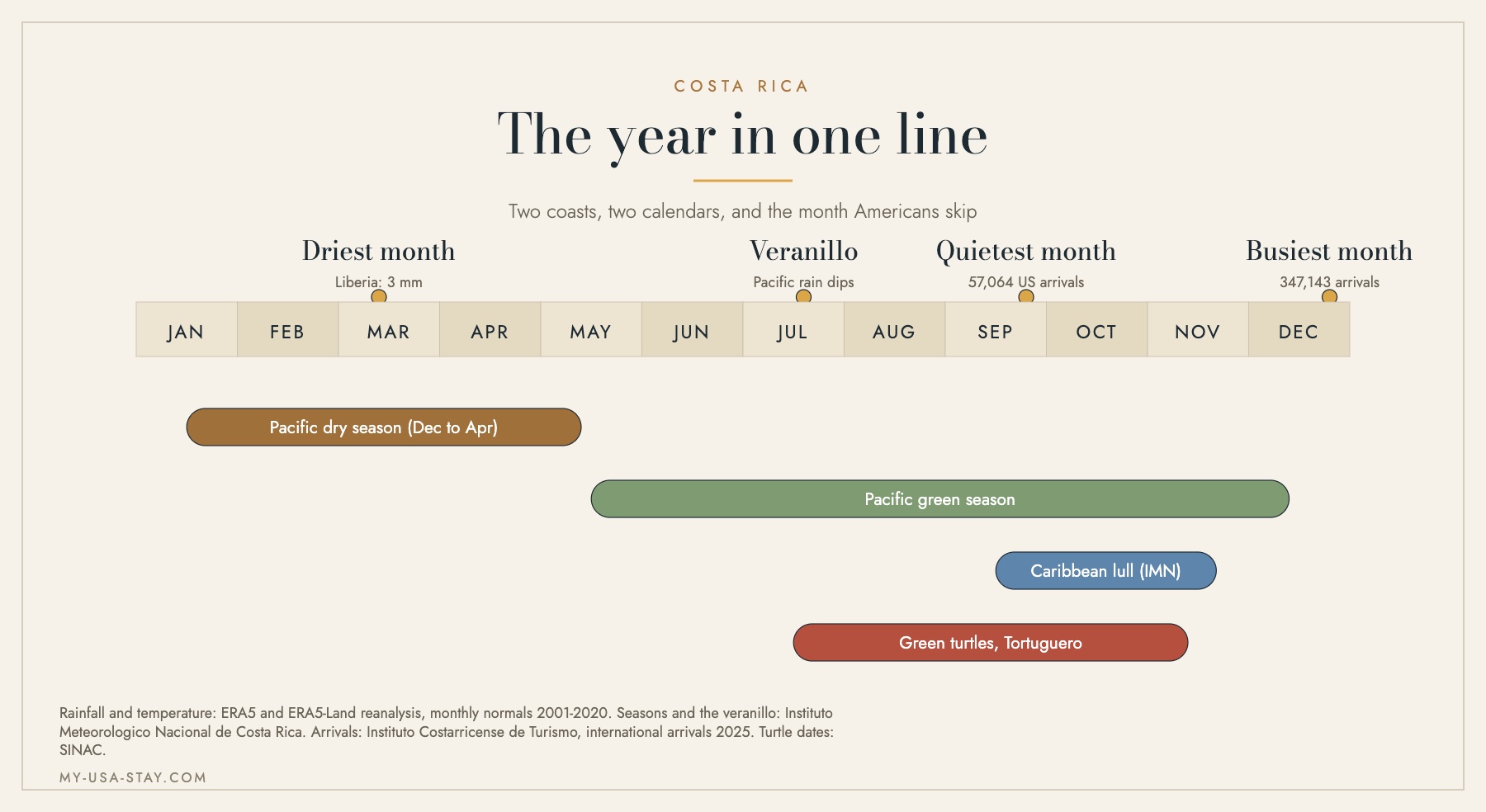
The Costa Rican year in one line. The Pacific and the Caribbean do not share a calendar.
Understanding the climate in Costa Rica
Costa Rica is smaller than West Virginia and contains some of the sharpest rainfall gradients in the Americas. The single number that explains the country is this one: Liberia collects 1,842 mm a year (73 inches) and Quepos collects 7,420 mm (292 inches), and the two towns are 120 miles apart. Any advice that treats Costa Rica as one climate is wrong somewhere.
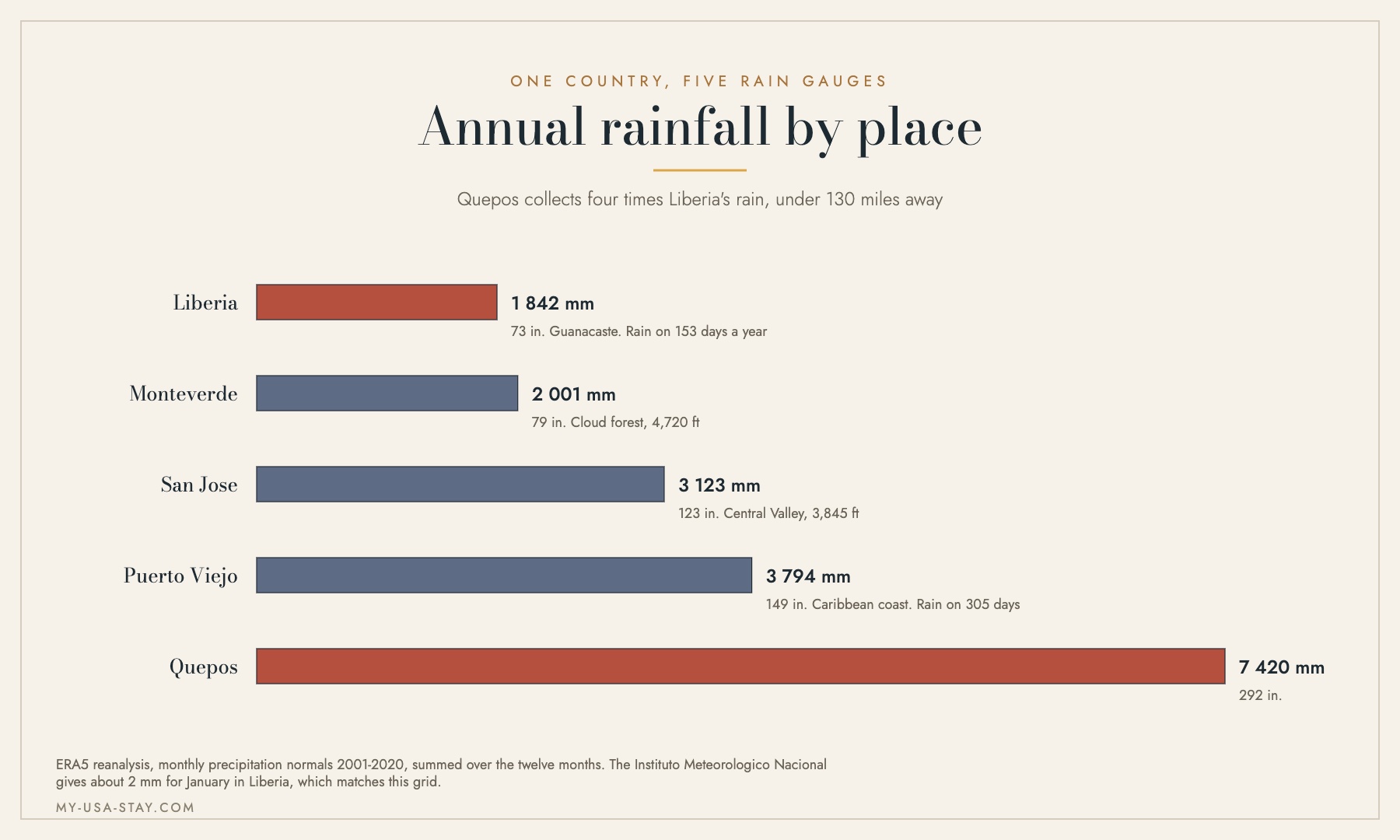
Five places, one country. Quepos gets 7,420 mm a year, Liberia 1,842 mm.
Four climates you can actually feel
Guanacaste and the northwest Pacific hold the tropical dry forest. Liberia averages a high of 92 F (33.5 C) in April, the hottest month anywhere in the dataset, and records 153 rain days a year, fewer than half of what the Caribbean gets. The IMN puts January rainfall at Liberia at "approximately 2 mm", which matches the 2.3 mm in the reanalysis grid used for this page.
The central Pacific around Quepos and Manuel Antonio is a different country. Rain falls on 346 days a year, and every single month from May to December clears 470 mm. A note of caution on the figures for this town: the reanalysis cell here is dominated by open ocean, which flattens the daytime highs to 83 F when the reality is warmer. The IMN station record is the authority on that coast, and the rainfall totals are the trustworthy part of the grid.
The Central Valley, where San Jose sits at 3,845 feet, runs cooler and steadier: highs of 74 F to 80 F all year and lows around 62 F to 65 F. It collects 3,123 mm, most of it in afternoon downpours between May and October.
The cloud forest at Monteverde, 4,720 feet up, takes 2,001 mm a year, less than San Jose, but the mist does not show in a rain gauge. Highs sit between 72 F and 80 F, nights near 62 F. This is the one place in Costa Rica where American visitors regularly wish they had packed a fleece.
Why the Pacific and the Caribbean disagree
The IMN describes the two annual cycles explicitly. At Liberia the year has two rainfall maxima, June and September, and two minima, July and the long dry season from November to April. At Limon on the Caribbean the minima fall in March and September and the maxima in July and December. Read those two sentences together and the whole planning problem resolves: July is the Pacific's break and the Caribbean's peak, September is the Pacific's peak and one of the Caribbean's two breaks.
The mechanism is the trade winds. They come from the northeast, dump their moisture on the Caribbean slope, then cross the mountains. The ICT notes the practical consequence for a traveler: on the Caribbean side rain falls mostly at night and in the morning, while on the Pacific it arrives in the afternoon and early evening. A wet morning in Puerto Viejo and a wet afternoon in Manuel Antonio are not the same holiday.
The dry season, December to April
This is the season most Americans book, and the numbers explain why. Liberia records 2.3 mm in January, 1.4 mm in February and 2.9 mm in March, with rain on 0.4, 0.2 and 0.9 days respectively. Skies are open, the dry forest drops its leaves, and wildlife concentrates around the few remaining waterholes, which is why Guanacaste's national parks are easier to work in these months than at any other time.
Illustration: my-usa-stay.com.
April is the hinge. Liberia's high climbs to 92 F (33.5 C), the hottest reading in the year, and rainfall jumps to 30 mm. The ICT calls April a transition month rather than a dry one, and by the last week the afternoon storms have usually started.
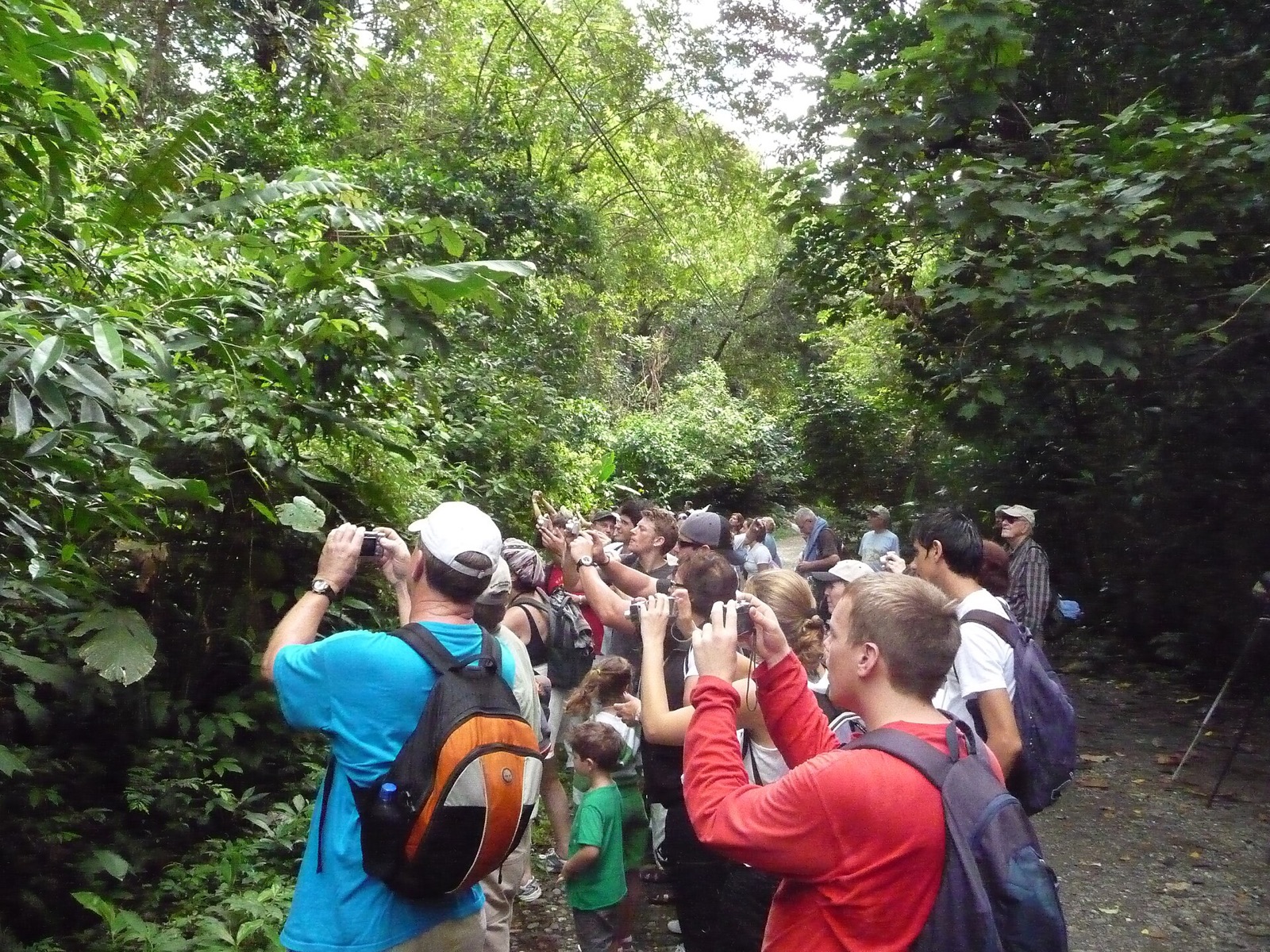
Rincon de la Vieja National Park, Guanacaste. The northwest is the part of Costa Rica that really dries out. Photo: Patrick Nouhailler, Wikimedia Commons, CC BY-SA 2.0.

What the dry season costs you:
- Crowds and prices. December brought 347,143 arrivals in 2025 and March 336,476, the two busiest months of the year. March alone accounted for 200,831 American arrivals, which is spring break arriving in one block.
- A brown landscape in Guanacaste. The dry forest looks like winter by March. If you came for the emerald Costa Rica of the brochures, the northwest in March is not it.
- Dust on unpaved roads across the Nicoya peninsula.
- Booked lodges. The last two weeks of December and the first week of January are the hardest dates of the year to find a room, and they carry local holiday demand on top of foreign demand.
The green season, May to November
Costa Rica's tourism industry calls May to November the green season rather than the rainy season, and on the Pacific that is closer to the truth than it sounds. The pattern is a bright morning, cloud building after noon and a heavy burst in the late afternoon. San Jose takes 379 mm in May across 28 rain days, which sounds like a washout until you notice most of it falls between 2 pm and 7 pm.

Illustration: my-usa-stay.com.
May and June are the value months. Arrivals fell to 205,803 in May 2025, a third below March, while the sea off the Pacific coast still reads 85 F and the forest has come back green. Rivers are running, which matters for rafting on the Pacuare and the Sarapiqui, and the waterfalls around La Fortuna and Arenal are at volume.
September and October are the extreme. Liberia takes 356 mm and 387 mm, its two wettest months, on 26 rain days each. Quepos takes 1,013 mm in October alone, which is 40 inches in 31 days. Many Pacific lodges and some tour operators close for part of this window. This is also when Costa Rica is at its emptiest: 121,815 arrivals in September, the lowest month in the ICT's 2025 series by a wide margin.
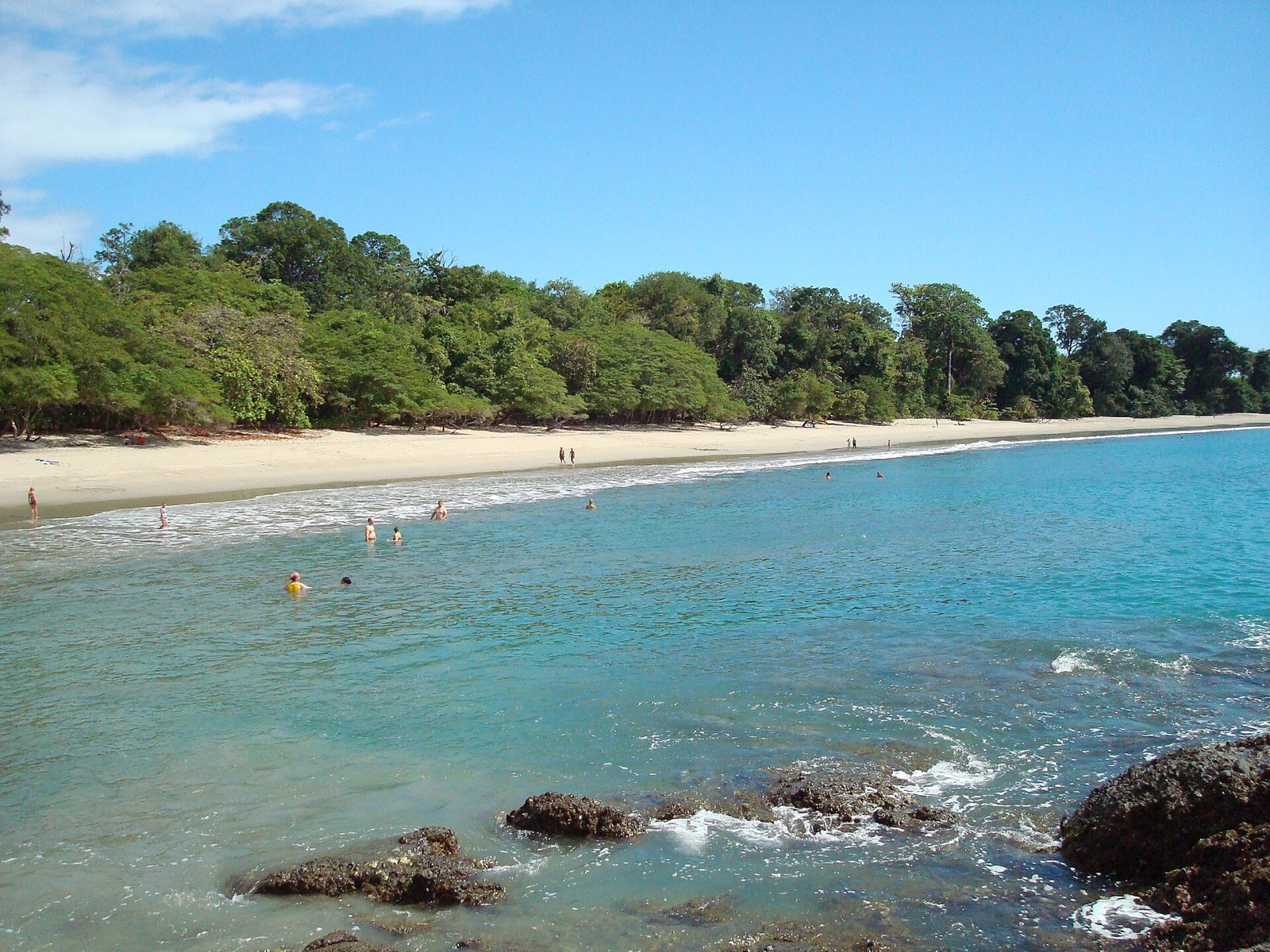
Manuel Antonio, near Quepos. The forest reaches the sand here because the rain never really stops. Photo: User:Tarrazu, Wikimedia Commons, Public domain.

Hurricanes: the honest answer
Costa Rica sits south of the main hurricane tracks and is rarely hit directly. The NOAA National Hurricane Center dates the Atlantic season 1 June to 30 November, with the statistical peak on 10 September, and the eastern Pacific season 15 May to 30 November, peaking in late August. The practical risk for Costa Rica is indirect: a storm passing well to the north pulls moisture across the country and produces the multi-day rain events Costa Ricans call temporales. The IMN records that a single temporal can drop more than 200 mm in two or three days on the Pacific slope.
The veranillo, a little summer inside the rains
The veranillo is the fact that turns a July trip from a gamble into a plan, and almost no English language guide quantifies it. The IMN defines it as a relative retreat of the rains in July and August on the Pacific slope only, and its study of the phenomenon locates the pentads that are dry most often between 12 July and 14 August.
The figures it publishes are specific. At Santa Cruz in Guanacaste, the five days from 11 to 15 July averaged 39 mm over the period 1941 to 1980, but came in under 10 mm in 14 of those 40 years, or 35 percent of the time. At Santa Ana in the Central Valley, the 5 to 9 July window fell under 10 mm in 19 years out of 40, nearly half. An older definition the IMN quotes, from Rosales in 1966, describes the veranillo as 5 to 15 consecutive days without rain.
The reanalysis used for this page shows the same dip. Liberia goes 277 mm in June, 181 mm in July, 217 mm in August. Monteverde goes 274, 207, 249. San Jose goes 372, 306, 348. Three places, three July troughs.
Two limits are worth knowing. The veranillo weakens as you move south: at San Isidro de El General the IMN finds July five-day averages holding above 45 mm, and Quepos in our dataset actually rises from 772 mm in June to 914 mm in July. And on the Caribbean slope the veranillo does not exist at all. The IMN is blunt about it: there, the same weeks coincide with a very wet period.
The Caribbean coast runs on its own calendar
If you only take one thing from this page, take this. The ICT states that the Caribbean has no well defined dry season, but that coastal zones see two relatively dry periods, February to March and September to October. The IMN's own annual cycle for Limon puts the rainfall minima in March and September.
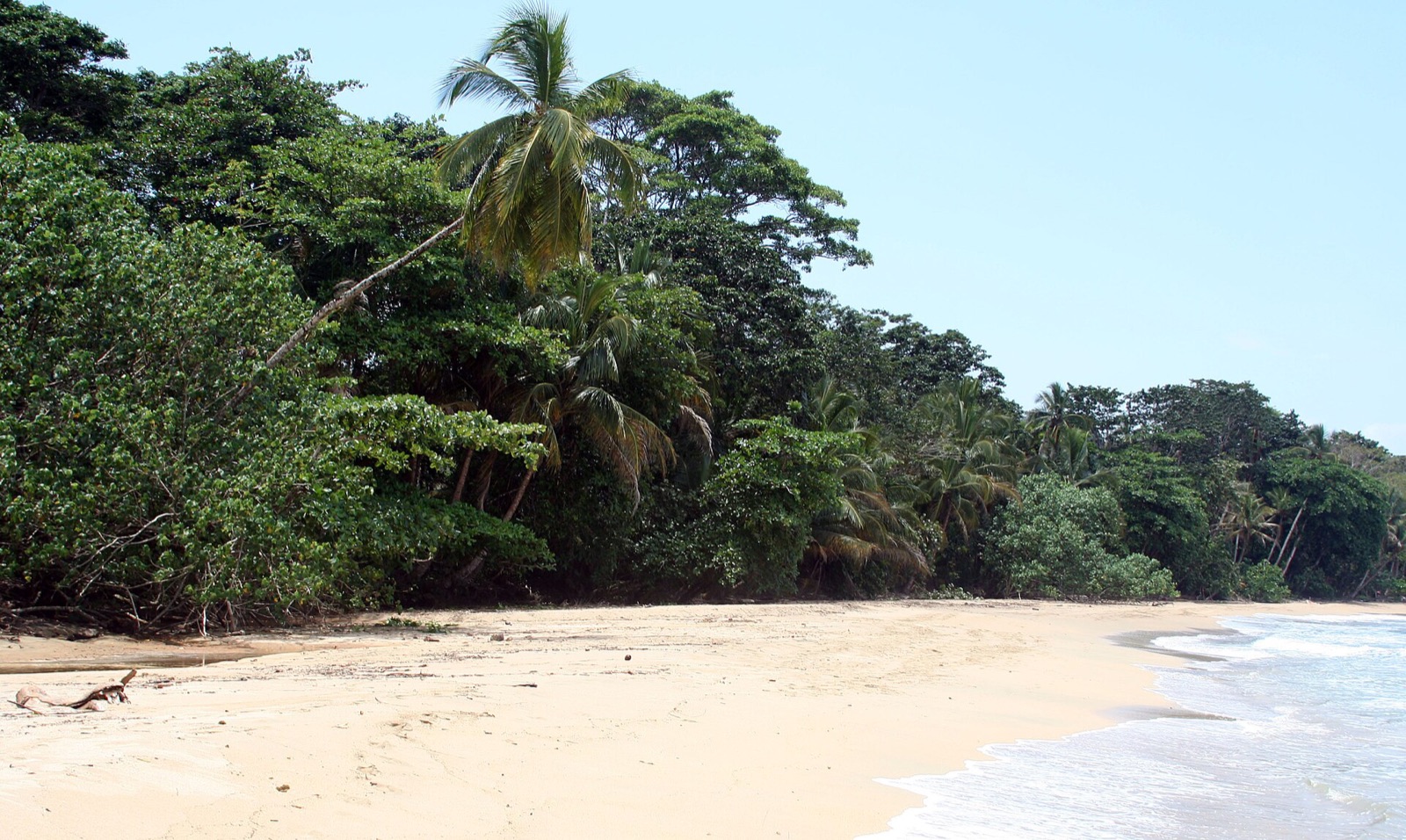
Puerto Viejo de Talamanca. September and October are the Caribbean coast's own dry window. Photo: Ben Kucinski, Wikimedia Commons, CC BY 2.0.

The numbers for Puerto Viejo de Talamanca follow: 142 mm in February and 143 mm in March, then a wet-season low of 306 mm in September against 424 mm in July. Over the year the coast takes 3,794 mm on 305 rain days. It is never dry in the Guanacaste sense. But in the two weeks either side of the September equinox, when Quepos is taking 791 mm and Liberia 356 mm, the Caribbean is having its quietest spell of the wet half of the year.
Two cautions on these figures. First, the grid cell that covers Puerto Viejo is mostly ocean, so it underestimates: the IMN notes that Limon averages roughly 300 mm in January, where the grid gives 236 mm. Second, September is clearly the low point in the data, while the official IMN and ICT description of the second dry spell runs across September and October together. Plan for the September half of that window if you want the drier odds.
The other Caribbean advantage in September is that it has the wildlife. Green turtles nest at Tortuguero from July through October, and the sea reads 85 F.
Costa Rica month by month
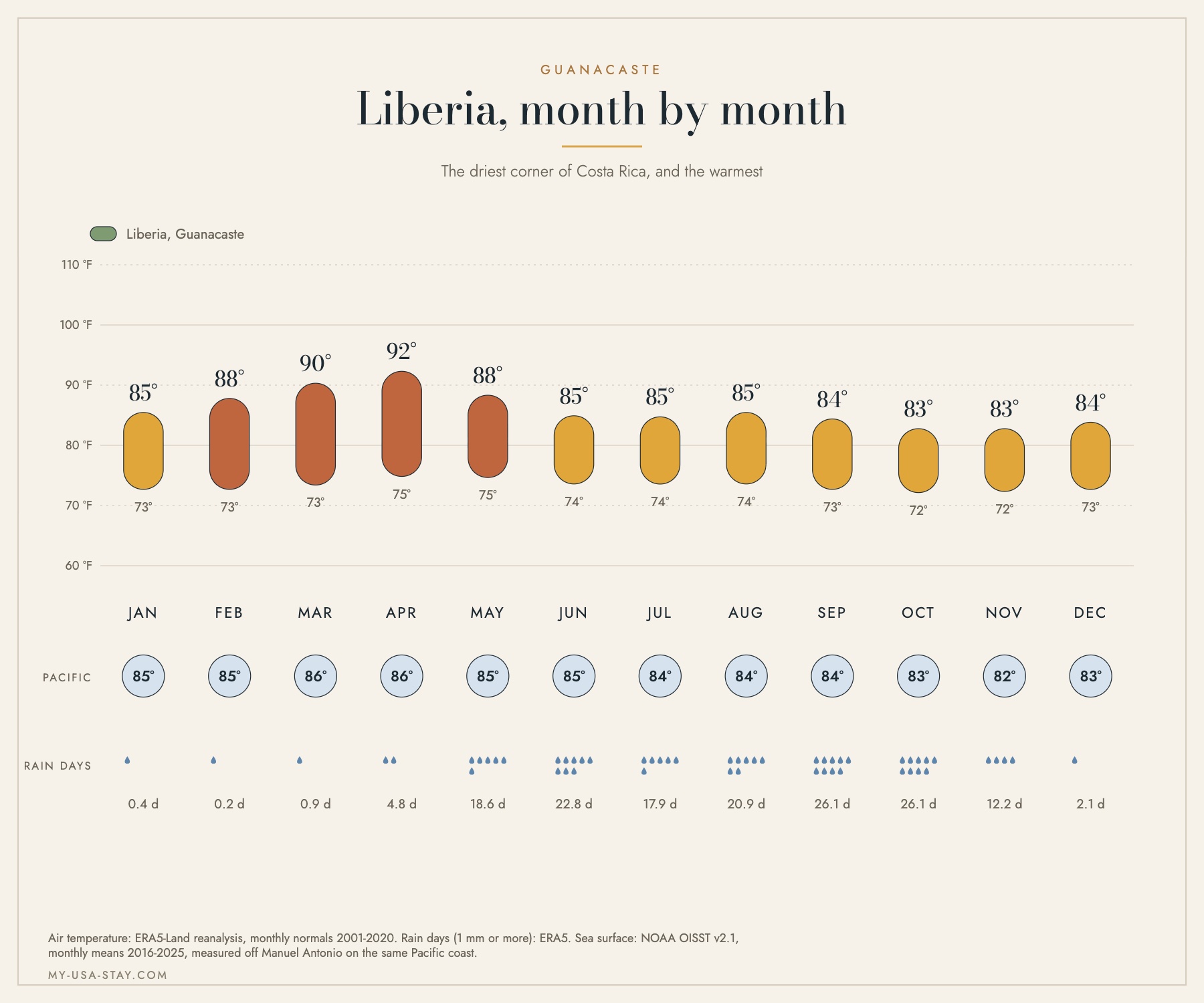
Liberia, Guanacaste, month by month. Two rain days across January, February and March combined.
| Month | Liberia high / low | Guanacaste rain | Caribbean rain | Sea, Pacific / Caribbean | Arrivals 2025 | Verdict |
|---|---|---|---|---|---|---|
| January | 85 F / 73 F | 0.1 in | 9.3 in | 85 F / 82 F | 298,475 | Dry, busy, reliable |
| February | 88 F / 73 F | 0.1 in | 5.6 in | 85 F / 82 F | 293,784 | Driest month everywhere |
| March | 90 F / 73 F | 0.1 in | 5.6 in | 86 F / 82 F | 336,476 | Peak heat, peak crowds |
| April | 92 F / 75 F | 1.2 in | 6.8 in | 86 F / 83 F | 252,867 | Hottest, turning wet |
| May | 88 F / 75 F | 10.2 in | 16.6 in | 85 F / 85 F | 205,803 | Green returns, quiet |
| June | 85 F / 74 F | 10.9 in | 14.0 in | 85 F / 85 F | 232,571 | Wet afternoons, empty |
| July | 85 F / 74 F | 7.1 in | 16.7 in | 84 F / 83 F | 262,048 | Veranillo, turtles arrive |
| August | 85 F / 74 F | 8.6 in | 14.1 in | 84 F / 84 F | 199,959 | Whales, few visitors |
| September | 84 F / 73 F | 14.0 in | 12.1 in | 84 F / 85 F | 121,815 | Caribbean yes, Pacific no |
| October | 83 F / 72 F | 15.2 in | 16.8 in | 83 F / 85 F | 145,663 | Wettest Pacific month |
| November | 83 F / 72 F | 4.4 in | 18.8 in | 82 F / 84 F | 247,387 | Pacific drying fast |
| December | 84 F / 73 F | 0.6 in | 13.0 in | 83 F / 83 F | 347,143 | Dry, and fully booked |
Sources: air temperature from ERA5-Land, rainfall from ERA5, monthly normals 2001 to 2020, for Liberia (Guanacaste) and Puerto Viejo (Caribbean). Sea surface from NOAA OISST v2.1, monthly means 2016 to 2025, measured off Manuel Antonio and off Puerto Viejo. Arrivals are international tourist arrivals through all entry points, Instituto Costarricense de Turismo, report published 19 February 2026. The Puerto Viejo grid cell is ocean dominated and runs low: the IMN gives about 300 mm for January at Limon against 236 mm here.
The best time for what you want to do
Sea turtles
Costa Rica has three separate turtle calendars, and they barely overlap. At Tortuguero on the Caribbean, SINAC lists three nesting species, the green turtle, the leatherback and the hawksbill. Green turtle nesting runs July to October, with hatchlings from September. You must be with a guide authorised by the park, and nesting observation is not permitted in the Jalova sector. The Cuatro Esquinas ticket office works 6 am to 12 pm and 1 pm to 3 pm, with trail departures at 6 am, 8:30 am, 11 am and 2:30 pm.
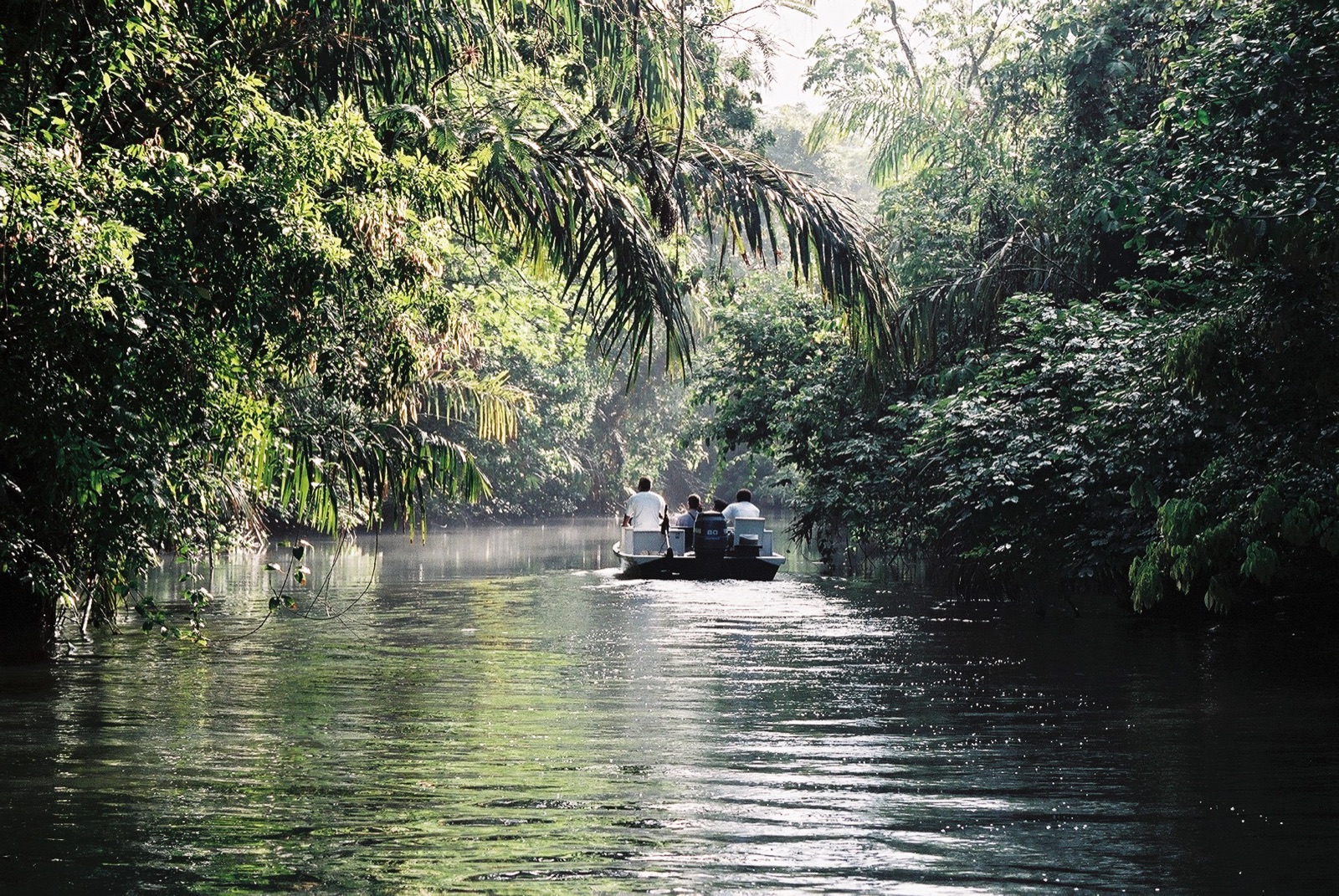
The canals of Tortuguero. The green turtles come ashore on the beach behind this forest from July to October. Photo: Lars0001, Wikimedia Commons, Public domain.

At Las Baulas National Marine Park on Playa Grande in Guanacaste, the leatherback season is dated 20 October to 15 February. Groups are capped at 15 people, a certified local guide is required on the beach at night, photography is prohibited, and only the guide carries a light, fitted with a red filter.
At Ostional, the olive ridley arribadas happen all year, one or two a month, along about 800 metres of beach and timed to the waning moon. SINAC gives the scale: 10,000 to 20,000 turtles over about three days from January to July, rising to around 200,000 over five or six days from August to December. If mass nesting is the reason for the trip, the second half of the year is not close.
Whales
The ICT states that humpback whales arrive off Ballena National Marine Park at Uvita from July to October. A second population reaches the same coast from the northern hemisphere in the northern winter, which is why Costa Rica's Pacific offers an unusually long whale window across the year. The park is open 7 am to 6 pm and tickets are card only, so bring a card rather than colones.
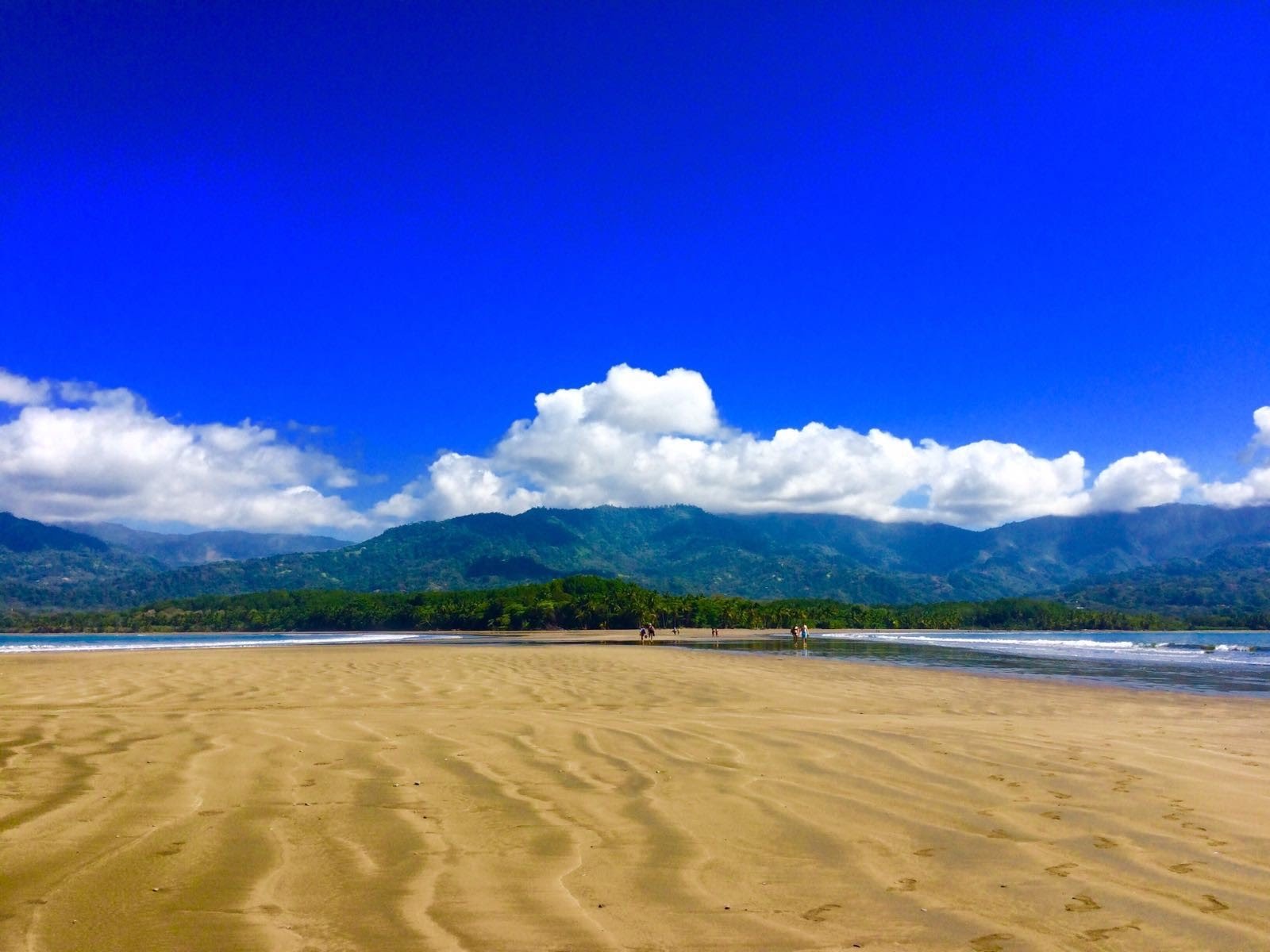
Marino Ballena National Park, Uvita. Humpbacks arrive off this coast from July to October. Photo: Mdelt, Wikimedia Commons, CC0.

Cloud forest and birds
Monteverde and San Gerardo de Dota are at their clearest from January to April, when the trade winds are strong but the rain has stopped. Resplendent quetzals are most reliably seen during their breeding months in the first half of the year. The trade off is mist: Monteverde's driest months are also its windiest, and a January afternoon on an exposed ridge is genuinely cold by Costa Rican standards.

Illustration: my-usa-stay.com.
Surfing
Pacific swells are biggest during the green season, roughly May to November, which is exactly the window most families avoid. The Caribbean at Puerto Viejo works on the opposite schedule, with its best surf in the northern winter months of December to March.
Families and first visits
For a first trip with children, late January to mid March gives the most predictable weather in the places most first visits cover, the Arenal area, Monteverde and a Pacific beach. The cost is crowding: those are also three of the four busiest months in the ICT series. Late April to early June buys near dry conditions at the start, materially fewer people, and a landscape that has turned green again.
Budget
Arrival counts are the cleanest proxy available. In 2025 the quiet half of the year was May, June, August, September and October, each below 250,000 arrivals, with September at 121,815. American arrivals collapse hardest: 57,064 in September against 200,831 in March, a ratio of more than three to one. Fewer visitors mean more room to negotiate, particularly on the Pacific coast where lodges compete for a thin market.
Events that shape the year
- Christmas and New Year, late December. The single busiest stretch of the year, with 347,143 arrivals in December 2025. Local and foreign demand land at the same time.
- Fiestas de Palmares, January. The largest of the country's town festivals, held in Palmares in the Central Valley over about two weeks.
- Semana Santa, the week before Easter. Costa Ricans travel to the coast en masse. Beaches fill, and government offices and many businesses close on the Thursday and Friday.
- Envision Festival, late February or early March. A music and arts gathering near Uvita on the south Pacific coast.
- Dia de Juan Santamaria, 11 April. A national holiday, with a parade in Alajuela.
- Whale festival season, September. Uvita marks the southern humpback season with a festival during the whales' peak weeks.
- Dia de la Independencia, 15 September. Lantern parades on the evening of the 14th, marching bands on the 15th, in every town in the country.
- Fiestas de Zapote, 25 December to early January. Bullfights without killing, rides and food stalls on the edge of San Jose.
Where to go, region by region
Guanacaste and the north Pacific. The place to be from December to April. Liberia's airport puts you within an hour of the main beaches, and the region's 1,842 mm a year makes it the most weather reliable corner of the country. From September to October it is the wettest, so this is a seasonal destination in a way the rest of Costa Rica is not. Browse hotels in Costa Rica for the Pacific coast.
Arenal and La Fortuna. Workable year round because the attraction is the volcano, the hot springs and the waterfalls rather than a beach. The northern lowlands are wetter than Guanacaste, and the volcano is more often clear in the dry months.
Monteverde and the cloud forest. Best January to April. At 4,720 feet it is the coolest place most visitors go, with nights near 62 F.
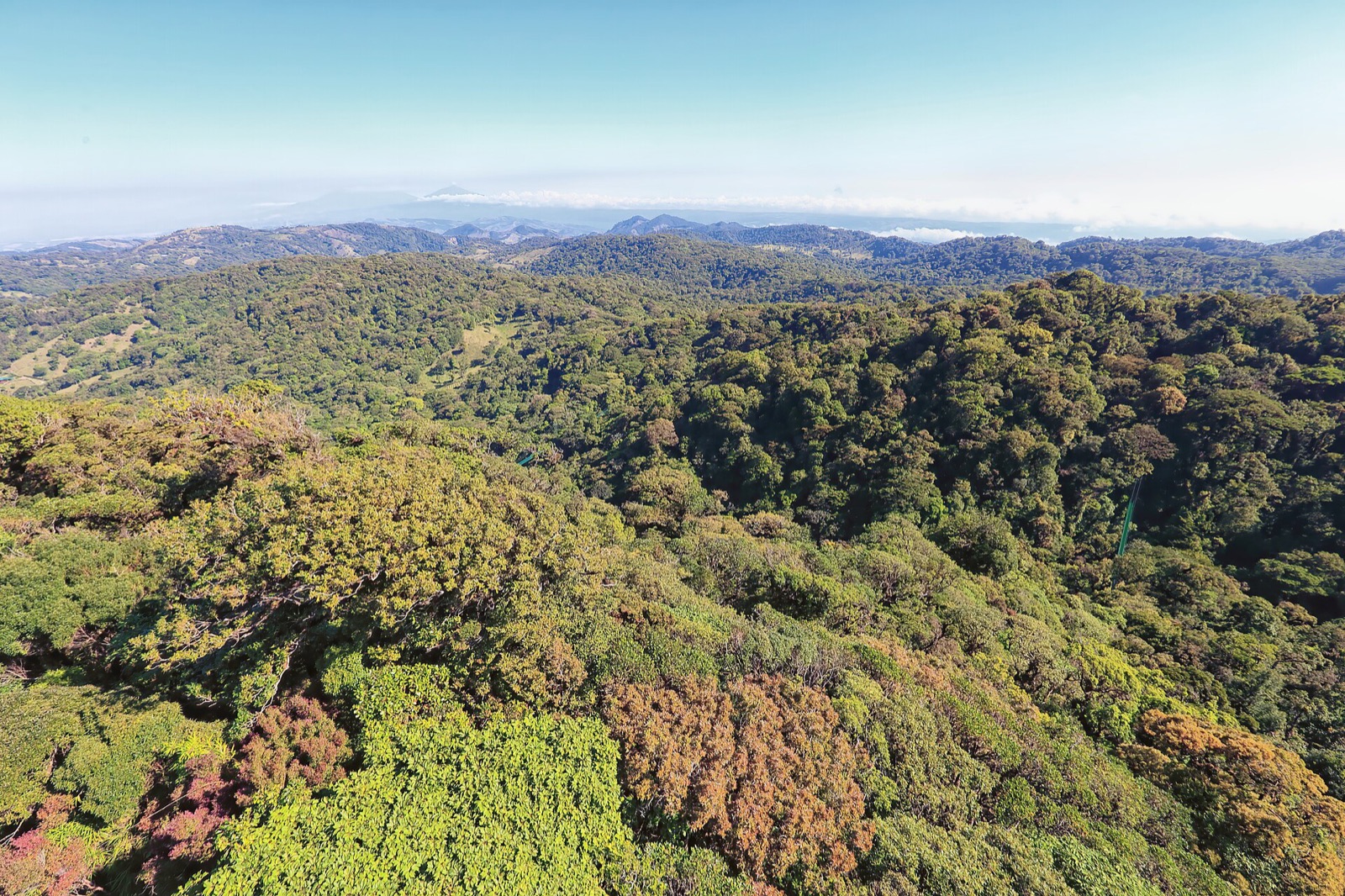
Monteverde. At 4,720 feet the nights run near 62 F, which is why a fleece belongs in the bag. Photo: Cephas, Wikimedia Commons, CC BY-SA 4.0.

Manuel Antonio and the central Pacific. The wettest data point in the country at 7,420 mm. December to April is the only genuinely dry window, and even then Quepos records 204 mm in January. The upside is that the forest here is spectacular precisely because of the rain.
The Osa peninsula and the south Pacific. The wettest region and the least seasonal. Corcovado's dry window is narrow, roughly January to March. The veranillo barely registers this far south.
The Caribbean, Puerto Viejo, Cahuita and Tortuguero. The counter cyclical choice. Aim for February to March or September to October, and accept that rain is always part of the picture at 305 rain days a year. September gives you the turtles and the emptiest country of the year at the same time.
Getting there from the United States
Two airports matter. Juan Santamaria (SJO) serves San Jose and the Central Valley, and Daniel Oduber Quiros (LIR) serves Liberia and the Guanacaste beaches. The ICT counts four air entry points in total, adding Tobias Bolanos and Limon, but those handle a small share. If your trip is a Guanacaste beach trip, flying into LIR saves a four hour drive across the country.
Great circle distances from the main US gateways to San Jose: Miami 1,121 miles, Houston 1,556 miles, Atlanta 1,634 miles, Dallas 1,781 miles, New York 2,212 miles, Chicago 2,222 miles, Los Angeles 2,723 miles. Miami is by some way the shortest hop, and the routes from Florida and Texas are the ones that run most frequently.
Time difference
Costa Rica is on UTC minus 6 all year and does not observe daylight saving. That means it matches US Central Time in winter and runs one hour behind Central in summer. From the East Coast it is one hour behind in winter, two hours behind in summer. From the West Coast it is two hours ahead in winter, one hour ahead in summer. Jet lag is not a factor from anywhere in the continental United States.
Entry requirements
The ICT publishes the rules. US citizens are in the group admitted without a visa for up to 180 calendar days, non extendable, which is unusually generous. Passport validity follows the ICAO rule rather than a fixed six month margin. A return or onward ticket is required of non residents arriving on a one way ticket, or where the return is more than 90 days after arrival. You must also be able to show at least 100 US dollars per month or part month of your stay. Check the current position with the US Department of State before you fly, since entry rules change.
What the US calendar does to prices
The ICT's monthly series shows American demand in three spikes. March takes 200,831 US arrivals, the spring break peak. December takes 181,144. June and July hold around 160,000 and 156,000, the summer vacation block, which is why July is busier than its rainfall would suggest. The troughs are September at 57,064 and October at 69,581. If your dates are flexible and you can live with rain, those two months are where the money is.
FAQ
What are the best and worst months to go to Costa Rica?
February and March are the best months for the Pacific coast: Liberia records under 3 mm of rain in each, with highs of 88 F to 90 F. September and October are the worst for the Pacific, with 356 mm and 387 mm at Liberia and over 1,000 mm at Quepos in October. On the Caribbean coast the ranking reverses, and September is one of its two driest spells.
Which side of Costa Rica is better?
It depends entirely on when you go. The Pacific is drier and sunnier from December to April, when Guanacaste sees almost no rain. The Caribbean is better in September and October, when the Instituto Meteorologico Nacional records its rainfall minimum at Limon while the Pacific hits its annual peak. The two coasts are only about 97 miles apart at their closest.
What is the cheapest time of year to go to Costa Rica?
September, on every available measure. Costa Rica received 121,815 international arrivals in September 2025, its lowest month, including just 57,064 Americans against 200,831 in March. Demand drives pricing, so the emptiest month is also the softest. October is the second cheapest window. Both are the wettest months on the Pacific side.
What is the rainiest month in Costa Rica?
It depends where you stand. October is the rainiest at Liberia in Guanacaste, at 387 mm, and at Quepos on the central Pacific, at 1,013 mm. On the Caribbean coast at Puerto Viejo the wettest month is November, at 478 mm, and the Instituto Meteorologico Nacional gives July and December as the maxima at Limon.
What is hurricane season in Costa Rica?
The NOAA National Hurricane Center dates the Atlantic season from 1 June to 30 November, peaking on 10 September, and the eastern Pacific season from 15 May to 30 November. Costa Rica lies south of the usual tracks and is rarely struck directly. The real risk is indirect: a distant storm can trigger a temporal, a multi day rain event that drops more than 200 mm on the Pacific slope.
Does Costa Rica get hit by hurricanes in September?
Direct strikes are rare, because Costa Rica sits at 8 to 11 degrees north, south of where most Atlantic systems track. September is nonetheless the statistical peak of the Atlantic season, and it is Costa Rica's wettest month on the Pacific side, with 356 mm at Liberia and 791 mm at Quepos. The rain, not the wind, is what shapes a September trip.
Is it worth going to Costa Rica during the rainy season?
Often yes, on the Pacific side. Mornings are typically clear and rain arrives in the afternoon, rivers and waterfalls are at full volume, the forest is green, and arrivals fall by a third or more against March. July carries the veranillo, a genuine break in the rains that the Instituto Meteorologico Nacional concentrates between 12 July and 14 August.
What is the best month to see turtles in Costa Rica?
September and October, if you want the largest numbers. Green turtles nest at Tortuguero from July to October, and the olive ridley arribadas at Ostional reach around 200,000 turtles over five or six days from August to December, against 10,000 to 20,000 earlier in the year. For leatherbacks at Las Baulas, the season runs 20 October to 15 February.
Read next
- Hotels in Costa Rica, by coast and region.
- Las Baulas National Marine Park, where the leatherback season runs from 20 October to 15 February.
- Best time to visit the USA, the same treatment applied at home.
- Planning a warm winter escape instead? Compare Mexico, Jamaica and the Dominican Republic.